
The Wow! Signal: the cosmos’s most famous “hello,” and we still don’t know if it was someone… or just the universe coughing
In 1977, the Big Ear radio telescope (Ohio) recorded an intense, brief emission that became famous as the “Wow! Signal.” The event is considered a historical “outlier” because it has not repeated in later searches. In 2025, the SETI Institute summarizes a recent study (Méndez et al., 2024) that proposes a natural explanation: signals associated with neutral hydrogen that could be amplified through a “superradiance”-type process, potentially triggered by a transient event (for example, a magnetar), producing a burst detectable by Big Ear.
Executive summary of the case file. Everything essential before you dig deeper.
Fact sheet
OSINT - Traceability
Attached evidence
1 piece of evidenceSome mysteries enter your life with fireworks. And then there is the Wow! Signal, which arrived the way important things arrive in the real world: a number on a sheet of paper, a note in ballpoint pen, and the sense that something, for an instant, lined up with almost insolent precision. It was 1977, it lasted 72 seconds, it was recorded by a radio telescope, and it left science with a question that still itches: was it a very rare natural phenomenon, or a message that slipped past us because nobody had the doorbell switched on?
In this case file we are going to do what the subject demands: explain what was detected, why it stood out so much, which hypotheses have survived, which ones collapse on their own, and what we learned about telling signal from noise when the sky decides to play ambiguous.
What the Wow! Signal was and why it has that name
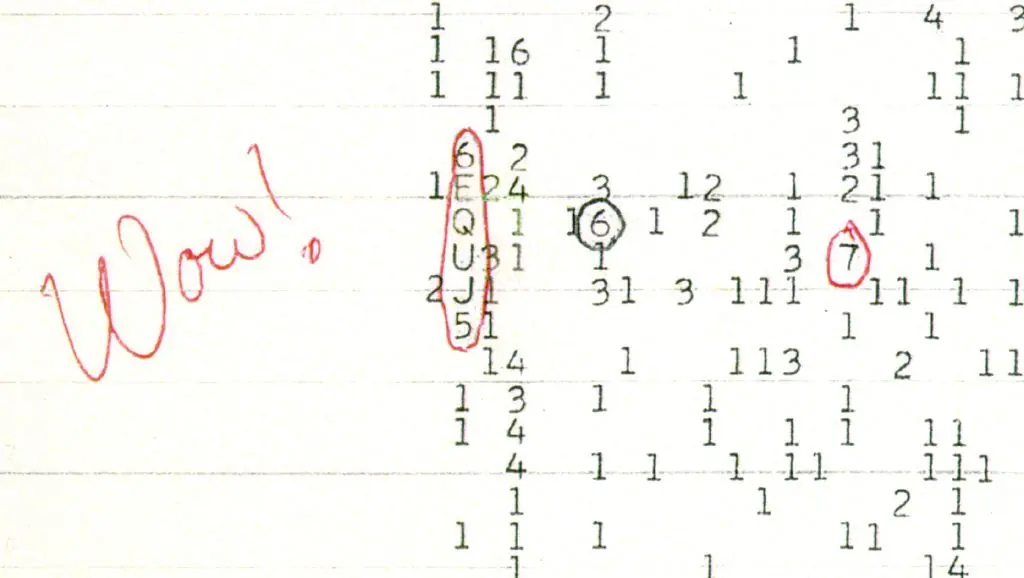
The Wow! Signal was an intense, narrow-band radio signal detected on August 15, 1977 by the Big Ear radio telescope in Ohio (U.S.), while it was taking part in a search for extraterrestrial intelligence: SETI. The name was not chosen by a committee or a marketing campaign. A human gave it, with the most human reflex possible: on seeing the pattern on a computer printout, astronomer Jerry Ehman wrote “Wow!” in the margin.
That “Wow!” was a technical “this shouldn’t be here.” A “this doesn’t look like the usual” said in ink, with no claim about aliens.
The code “6EQUJ5”: the numerical signature of the mystery
When Big Ear recorded data, it did not save a pretty waveform like in the movies. It recorded intensities encoded as characters. And what appeared was a famous sequence: 6EQUJ5. In plain language: the signal rose quickly in intensity, reached a very high peak and then dropped, all in exactly the time the radio telescope took to “sweep” that point of the sky because of the Earth’s rotation.
That “bell” shape matters because it suggests the signal was not random local interference, but something that seemed to come from a fixed direction in the sky, entering and leaving the instrument’s beam as a real astronomical source should… or as interference placed very cleverly to look like one.
The frequency: the “hydrogen channel” and why everyone raised an eyebrow
The Wow! Signal was detected near 1420 MHz, very close to the so-called 21 cm hydrogen line (approx. 1420.405 MHz). That frequency is special because hydrogen is the most abundant element in the universe and, in radio astronomy, that line is a natural “landmark.”
In SETI circles there has been speculation for decades that, if a civilization wanted to choose a “universal” frequency to transmit on, it might pick one that any minimally competent astronomer would recognize. And 1420 MHz is an obvious candidate. That coincidence is one of the reasons the Wow! Signal became a legend.
It lasted 72 seconds: exactly what Big Ear could see… and that complicates things
The signal lasted 72 seconds because that was, roughly, the maximum time a fixed source in the sky could remain inside the radio telescope’s beam during a sweep. It did not last “because the transmitter got tired.” It lasted because the instrument, by design, could only “look” at that point for that long.
And here comes the big problem: the signal was never detected again in later attempts, even though they were made. In science, repetition is the hammer that turns the strange into knowledge. Without repetition, the strange stays in a display case.
Where in the sky did it come from? The Sagittarius region and the two possible positions
Big Ear had a system that produced two possible positions in the sky because of how its receiving “horns” were arranged. The signal could have come from one of two nearby regions in the constellation Sagittarius. We are not talking about a coordinate with surgical precision; we are talking about an area, an astronomical “somewhere around here.”
That has allowed many hypotheses and, at the same time, has prevented closing them quickly. If you knew the exact point, you could check whether there was a known source, a transient object, or something that, over time, fits. But with a wide region, the mystery has room to breathe.
Main hypotheses: what it could have been (and what it couldn’t)
In a case like this, the professional move is not to shout “ET” or to shout “garbage.” The professional move is to weigh hypotheses by plausibility and by their ability to explain the data.
1) Terrestrial interference (RFI): the usual suspect
Radio is full of humans. Satellites, radars, communications, odd reflections, illegal transmitters, faults, harmonics. The first explanation always investigated is radio-frequency interference (RFI).
The Wow! Signal, however, had characteristics that made it look “astronomical”: bell-shaped intensity during the beam’s passage, a narrow frequency, and none of the typical patterns of some interference. That does not eliminate the terrestrial hypothesis, but it forces it to be more specific: “something” won’t do. It has to be “something that fits this.”
2) A natural astronomical source (but a rare one)
The radio sky is not silent. There are pulsars, natural masers, emissions from planets, explosions, transient events… Even so, a signal this narrow and at exactly that frequency is not the most common. Moreover, many known natural sources have repeatable signatures or, at least, a chance of reappearing.
The lack of repetition weakens some options, but not all. Low-probability transient phenomena exist, and there are scenarios in which a source could emit episodically. The problem is that, without a new detection, this stays at “possible” without moving to “probable.”
3) A comet (the modern popular hypothesis)
Years later a hypothesis became popular: that the signal could have been related to the passage of a comet, through emissions from the hydrogen environment associated with it. It is an attractive idea because it uses a real ingredient (hydrogen) and connects it to the emblematic frequency. But it has also been disputed by the community, and there is no definitive consensus.
Comet science works like this: if a comet can produce a signal with these characteristics, it should be reproducible in later observations under similar conditions. And the debate is, precisely, whether that explanation reproduces the “Wow! signature” with enough fidelity.
4) Artificial non-human transmission (the hypothesis everyone wants and nobody can prove)
Could it have been an artificial emission of non-human origin? In the abstract, yes: a narrow signal on a “universal” frequency is the kind of thing SETI dreams of finding. But this is where we have to be adults: a single detection is not enough. If it were a deliberate transmission, we would expect repetition, pattern, modulation, or something more than an isolated peak.
The Wow! Signal is, in that sense, the perfect lure: strange enough not to be forgotten, incomplete enough not to be closed. A mystery with just the right degree of frustration to survive for decades.
Why the Wow! Signal still matters today
Because it is a textbook case of how the border between the known and the unexplained works. The Wow! Signal reminds us of several things:
- Instrumentation matters: the telescope’s design conditions what you can claim.
- A signal is not a message: “detecting” does not mean “understanding.”
- Repetition is king: without repetition, there is no scientific closure.
- Noise is creative: it can imitate the extraordinary with a cruel talent.
The case has also influenced how modern searches are designed: today large portions of the sky are monitored with more sensitive instruments, better records, and the ability to verify transient events in real time or close to it.
How a “new Wow! Signal” would be investigated today
If a similar signal appeared tomorrow, the modern protocol would be faster and more paranoid (in the good sense). The aim would be to:
- Check whether there is known RFI in that band and in that geographic area.
- Confirm with other radio telescopes in different places (if several see it, the “it’s local” explanation shrinks).
- Look for immediate repetition and in the following days.
- Analyze whether there is modulation or informational structure.
- Cross-check with astronomical data: transient objects, comets, cataloged sources, etc.
In 1977, much of this was slower, more manual and more fragile. The Wow! Signal also belongs to an era: the one in which the universe could leave a note on your answering machine and you took a while to get home.
Conclusion: the case file that does not close
The Wow! Signal is an elegant reminder that the universe has no obligation to be clear. It gave us a good-looking anomaly, left us the wink on a sheet of paper, and left without saying goodbye. If it was a natural oddity, it is a beautiful oddity. If it was interference, it is a painful lesson. And if it was something more, it was the briefest and cruelest message in history: “I’m here,” said only once, just when we were looking… and never again.
Until someone finds another signal that fits, this case will remain what it always was: an open case file. And at BrokenUFO, open case files are fuel.
Frequently asked questions
Was the Wow! Signal proof of extraterrestrials?
No. It is an anomalous signal recorded once. There is neither confirmation nor enough repetition to claim that.
Why was it never detected again?
It may be because it was a transient event, a one-off interference, or a source that did not repeat. Without new data, no conclusion can be drawn.
What does 6EQUJ5 mean?
It is the code with which the Big Ear system represented the signal’s intensity over time: it rose, reached a peak and dropped during the sweep.
OSINT – Source traceability
Source consulted at SETI.org (News). Saving a local copy (PDF/HTML) and recording its SHA256 is recommended. Accessed: 2026-02-19
Institutional source (SETI Institute), a news/outreach item that summarizes a hypothesis published by Méndez et al. (2024) and links to a YouTube conversation. It is not the original 1977 “log,” but a contemporary summary.