
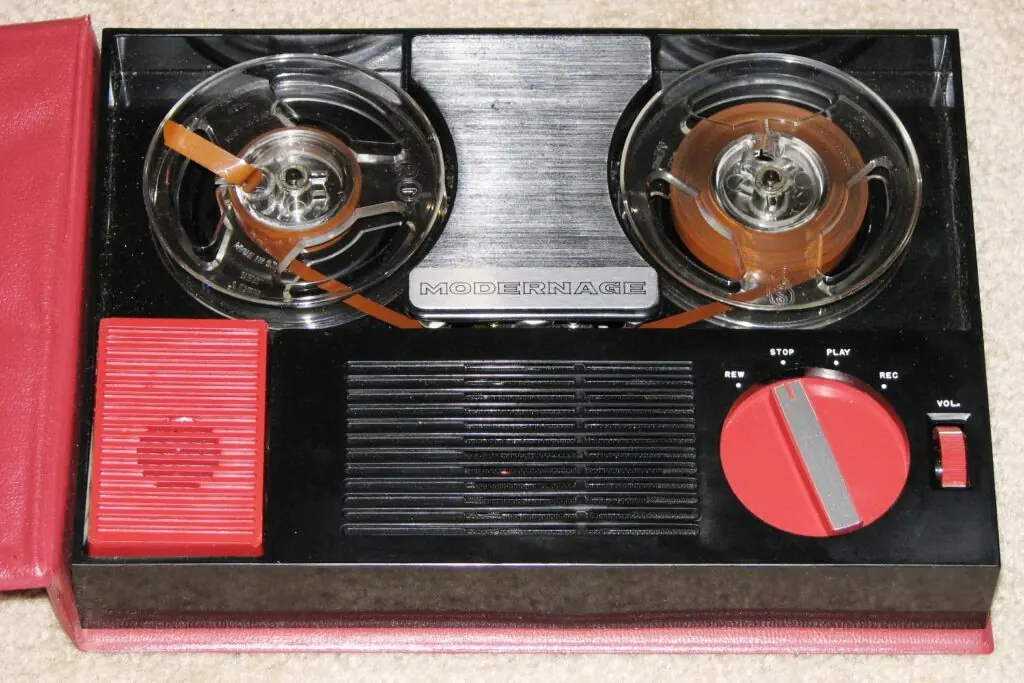
Psychophonies: How a Brain Fabricates a Voice from Two Seconds of Hiss
The phenomenon is sixty years old, with a study paid for by Cambridge and an explanation measured in the laboratory. The variable that best predicts how many voices come out of a tape is not on the tape.
Psychophonies, or EVP, consist of attributing verbal content to fragments of noise captured in recordings. The modern phenomenon begins with Friedrich Jürgenson in 1959 and spreads through the work of Konstantīns Raudive in the 1960s and 1970s. The specific academic study, carried out by David Ellis with a Perrott-Warrick fellowship from the University of Cambridge between 1970 and 1972, attributed the results to radio-frequency pickup, interpreted noise and expectation. Experimental psychology has since measured the mechanisms involved: phonemic restoration (1970), sine-wave speech (1981) and the effect of contextual framing on the perception of voices in noise (2015).
Executive summary of the case file. Everything essential before you dig deeper.
Fact sheet
OSINT - Traceability
Intelligence Network
There is a mental operation we all perform, all the time, without noticing, and it is probably the most astonishing in our repertoire: turning a vibration of the air into a word. The brain does not take the sound in passively, like a package: it follows a formal instruction file and supplies at least half the content: it fills in the phonemes the noise has eaten, corrects the accent of the person who speaks badly, separates the words of a sound chain that arrives without spaces and, if need be, invents what is missing and does not tell us.
That system is so good that it works even when there is nothing to decipher. And this is where this case file begins. Because if you give a human brain three seconds of magnetic hiss and tell it there is a voice inside asking for its mother, the brain does not merely find it: it finds it with timbre, with intonation and with a certainty that many expert witnesses would envy.
The verifiable first, which is how one should walk down a dark corridor: feeling along the wall. And in this case the corridor is surprisingly well lit, because the phenomenon has been studied for sixty years and all the pieces of the puzzle are on the table.
The verifiable first: where this comes from
The story starts in 1959 with a painter and documentary maker of Estonian origin settled in Sweden, Friedrich Jürgenson, who went out into the countryside to record birdsong with a tape recorder. Playing the tape back, he thought he heard human voices in the background, and in later recordings he thought he identified that of his mother, who had died. He published a book in 1964 and the phenomenon had its name. Note the detail, because it is textbook: the first psychophony of modern history is found by someone who was recording something else, on a noisy medium, and the first voice recognized is that of a dead relative. The three conditions that guarantee a false positive, served in a single sitting.
In 1965, a Latvian psychologist named Konstantīns Raudive went to see Jürgenson and became the great apostle of the subject. He recorded for years, accumulated tens of thousands of fragments and published a book that in its 1971 English edition was titled Breakthrough, which, given what was inside, was an optimistic title. His method consisted of recording noise (often, literally, the interference between radio stations) and then listening for words. He found them. In several languages at once, frequently mixed in a single sentence, which he interpreted as a peculiarity of the beyond and which to anyone with training in phonetics sounds like something else.
Serious verification came early and came from where it should. Between 1970 and 1972, David Ellis held a research fellowship from the University of Cambridge (the Perrott-Warrick, endowed precisely to study phenomena of this kind) and devoted himself to examining the recordings and the method. His report, later published as a book, reaches the conclusion that still stands half a century later: a good part of the voices are fragments of radio broadcasts picked up by the equipment, another part is interpreted noise, and the rest is expectation. He was not a professional skeptic dismissing the subject in an afternoon: he was a researcher paid to study it, who studied it and said so.
There was also an experiment with an audience, promoted by the publisher of Raudive’s book, in the studios of a British record company, with shielding and radio-frequency control. It is the episode most often cited in favor and, on close inspection, the one that holds up worst: the subsequent discussion turned on whether what was on the tape were voices, which is not the same as asking whether there were voices on it. When the debate over an experiment comes down to whether those present heard the same thing, the experiment has not measured the phenomenon: it has measured those present.
The whole problem of psychophonies fits in a one-line question: are we analyzing the tape or are we analyzing the person listening to it?
Before going on, one date needs putting in its place, because genealogy matters. The idea that an electrical device could serve as a telephone to the dead was not invented by Jürgenson: it had been floating around since the late nineteenth century, when electricity was still a half-magical thing and spiritualism was at its height. Edison himself was credited with a project to build a device for that purpose, in a 1920 interview that he later left hanging. It is the usual pattern: every new technology premieres its own version of the beyond. Photography brought specters on a plate, radio brought voices, and there has been no medium (tape, video, digital, mobile) that has not had its own season of ghosts.
Friedrich Jürgenson records in the countryside
He thinks he hears human voices on a recording of birdsong. The modern phenomenon is born.
Jürgenson publishes his first book
The idea spreads across northern Europe.
Raudive visits Jürgenson
The Latvian psychologist adopts the method and industrializes it: tens of thousands of recordings.
Raudive's work is published
The 1971 English edition brings the phenomenon to the English-speaking world.
Perrott-Warrick fellowship, Cambridge
David Ellis examines the method and attributes the results to radio interference, noise and expectation.
Warren publishes phonemic restoration
It is demonstrated in the laboratory that the brain fills in speech sounds that are not in the signal.
Sine-wave speech
Remez and his colleagues show that one and the same stimulus is unintelligible noise until the listener is told what it contains.
Studies on backward messages
It is found that listeners do not detect reversed content unless they are told beforehand what to look for.
Auditory pareidolia measured
An experimental study shows that a paranormal context increases the number of voices perceived in pure noise.
What psychology has demonstrated, and it demolishes the case
Saying “it’s suggestion” and shrugging is not enough, and it is not needed: there are specific experiments, replicated and published, that measure the mechanism exactly. Three of them are enough.
Phonemic restoration: the brain plugs the holes and doesn’t say so
In 1970, Richard Warren set up a very simple experiment. He took a recorded sentence, erased one sound (an s, for example) and put a cough in its place. Listeners did not perceive that anything was missing: they heard the complete word, with its s, and on top of that placed the cough at the wrong point in the sentence. The brain had fabricated a phoneme that did not exist in the signal and had integrated it without leaving a receipt. It is a laboratory result you can repeat this afternoon.
Sine-wave speech: the same sound, two different experiences
The second is even more devastating. In 1981, Robert Remez and his colleagues built an artificial stimulus that keeps only the skeleton of the frequencies of speech: a complex whistle that the first time sounds like cheap science fiction and that no one understands. The listener is then told which sentence it contains, the same sound is played again, exactly the same file, and the sentence appears with insulting clarity. And there is no going back: one cannot manage to stop hearing it. The signal has not changed by a single bit. The instruction has changed.
And the effect of context, measured in an experiment
The third closes the circle. In a study published in 2015, several groups of participants were made to listen to ambiguous fragments and also to noise with no content at all, telling some that they were taking part in research on paranormal phenomena and others that they were not. Those in the paranormal framing reported more voices. And the effect appeared exactly where it had to appear: in the psychophony recordings and in speech degraded by noise. In pure white noise, which was the control condition, almost no one heard anything and the framing did not change the result. The variable that best predicts how many psychophonies appear on a tape is what the listener has been told, not the tape.
What it can be, with no need for ghosts
We know, in technical terms with names and surnames, where the recorded sound comes from. There is not a single cause: there is a catalog, and almost all psychophonies fit within it.
The radio that slips in wherever it can
A poorly shielded audio circuit is, unintentionally, a radio receiver. The non-linear components of an amplifier can demodulate a powerful nearby broadcast and put it into the recorded signal, very weak and very dirty, but with the structure of real speech. This explains why many classic psychophonies sound like an announcer, why they appear in several languages and why Raudive’s material, obtained by literally recording the interference between stations, was so abundant. It is first-year electronics.
Noise is not silence
The hiss of a magnetic tape, the background current of a cheap microphone or the artifacts of a compressed file are not a neutral background: they are a soup of energy spread across all frequencies, including those of speech. In a soup like that there are, by sheer statistics, stretches that resemble a syllable. If you listen to forty minutes of hiss looking for words, you will find words, in the same way that anyone who looks at enough clouds ends up finding a dog.
The loop, the best machine for manufacturing sentences
And the usual method makes the problem worse instead of controlling it: isolating a two-second fragment and repeating it in a loop twenty times. That procedure is, without exaggeration, a device for forcing interpretation. Repetition makes the auditory system stabilize one reading and fix it, and by the sixth or seventh pass it is already impossible to hear it any other way. Add the caption with the transcription superimposed on the screen, a habit of mystery television, and we are no longer measuring anything: we are dictating.
And there is a fourth element of the catalog that habit overlooks: the environment of the recording itself. An empty building at night is not silent. Wood creaks as it cools, a pipe drips, a refrigerator hums two floors down, a distant car comes in through a poorly closed window, and the team of investigators itself breathes, whispers and moves; it is numerous, it is nervous and it is wearing clothes. When the listening is done days later, no one remembers who cleared their throat at a quarter past three. The absence of a contemporaneous record of what was happening in the room is the hole through which almost all the material slips in.
Why this case won’t die
It is cheap, participatory and emotionally irresistible. Anyone with a phone can try it tonight, and the result always yields something, because the method is built to yield something. A phenomenon that never fails is not robust: its criterion of success does not exist. In this archive that always switches on the same red light.
Because it also belongs fully to the Spanish cultural landscape. Psychophonies have been a fixture of this country’s mystery radio and television for decades, in formats ranging from the late-night program to the mass-audience popularization practiced by Iker Jiménez. And they belong to the same family as our most domestic and longest-running case, the faces of Bélmez: there the medium was a layer of cement and the system that fabricated faces was the visual one; here the medium is a tape and the system that fabricates words is the auditory one. Same machine, different sense.
And because it serves as an exact counterpoint to another case file in this same sector, the Taos hum. There, people hear something the instruments do not register, and the enigma is real. Here the opposite happens: the sound is on the recording, anyone can analyze it, and what is unclear is what is inside it. The two questions look the same and are not at all, and telling them apart is half the investigation.
Sixty years recording silence, and the only thing we have found in there is ourselves, filling in gaps with a moving diligence. It is no small thing: the machine that fabricates those voices is the same one that lets us understand each other on a street with traffic. It simply works overtime now and then.
OSINT – Source traceability
No specific content is attributed to any recording and no psychophony is transcribed: doing so would be to commit the same error the case file describes. The 1971 experiment in a record-company studio is mentioned without endorsing either of the conflicting accounts of what was heard.
