
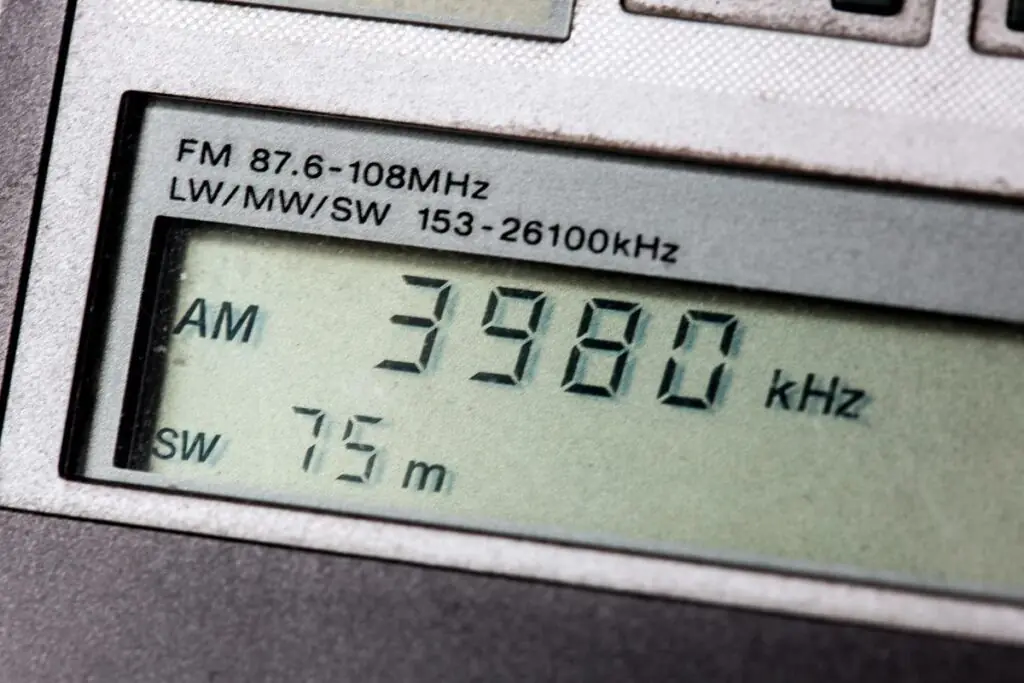
Numbers Stations: The Russian Buzzer, the English Poacher and a Voice That Counts in Fives
They have been broadcasting figures on shortwave for decades, and no government has ever acknowledged a single one. What is on record, in two federal case files, is what they are for.
Numbers stations are shortwave stations that broadcast series of figures read aloud, with no identification of the owner. The court documentation of two espionage prosecutions in the United States (1998 and 2001) establishes their use to communicate encrypted orders to agents by means of one-time pads. UVB-76, on 4625 kHz, has emitted a continuous buzz since the early 1980s, with occasional voice interruptions; it changed site and call sign around 2010. The Lincolnshire Poacher, in English and attributed by amateur direction finding to the British base at Akrotiri, ceased around 2008. No government has ever acknowledged any of them.
Executive summary of the case file. Everything essential before you dig deeper.
Fact sheet
OSINT - Traceability
There is an hour of the early morning, between three and five, when shortwave behaves like a long corridor. The ionosphere cools and lifts, and suddenly the receiver of an amateur in Cuenca can hear, perfectly clearly, something being broadcast three thousand kilometers away. It is well-known and very boring physics: the waves bounce off the upper atmosphere and come back down far from where they started. What is not boring is what comes down.
A woman’s voice comes down, flat, with no recognizable accent, reading groups of five figures. One, seven, zero, two, nine. Pause. One, seven, zero, two, nine. A monotonous buzz comes down that has not fallen silent in decades, twenty-five times a minute, like an enormous refrigerator installed somewhere on the Russian plain. An English folk tune comes down, looped before the numbers begin. And above all there comes down the uncomfortable certainty that this is not a glitch, not an experiment and not a ghost: someone is paying for it, there is a payroll behind it, and it has been running with a discipline that many public services would envy.
I have come to put the smoke in order, not to prove there is a mystery. Because this is one of the few cases in this archive where the strange answer (“they are intelligence services sending orders to their agents”) is the one proven in a federal court, not the exotic hypothesis.
What can be verified, first
Let us start with what is on record in a case file, which is where this archive always prefers to start. In September 1998, the FBI arrested a group of Cuban intelligence agents in Miami. The documentation of the case sets out the communication method in full detail: shortwave receivers, voice transmissions reading groups of figures, and one-time pads to decrypt them. This is material submitted to a U.S. federal court and tested by the defense, rather than a journalistic reconstruction or a radio amateurs’ theory.
Three years later, in 2001, the case of an analyst from the U.S. military intelligence service who had spent years working for Havana described the same system again: shortwave broadcasts, figures, manual decryption. Two separate court proceedings, years apart, documenting the same technique. With that, the question of whether numbers stations are what they appear to be is answered and does not admit reopening.
The specific station in those cases is, moreover, the most listened to in the Spanish-speaking world: a Cuban station that opened its transmissions with the word “Atención” repeated and went on with groups of five digits read by a female voice. Anyone with a decent receiver on the Iberian Peninsula has heard it at some point in the small hours. That the best-documented numbers station in history speaks Spanish is a detail that is never mentioned in Spain.
The system works for a mathematical reason, not out of secrecy. A message encrypted with a one-time pad (a random key as long as the message, used once and destroyed) is indecipherable. Not difficult: indecipherable, formally proven. And a high-power radio broadcast reaches everywhere without anyone knowing who is listening: the receiver emits nothing, connects to nothing and leaves no trace. An agent with a flea-market radio and a notebook is safer than one with the best encrypted phone in the world, because the phone leaves a connection record and the notebook does not.
All modern cryptography is obsessed with who holds the key. These stations solved a different and worse problem eighty years ago: making sure nobody knows there is a conversation.
It is also worth saying how all this is organized, because no ministry made the catalog. Amateurs did. Since the 1990s there has been a European association of radio listeners that classifies each station with a code according to language and mode (voice in English, voice in Slavic languages, voice in other languages, telegraphy) and publishes bulletins with schedules, frequencies and transcripts. It is an archive made by hand, with no budget, by people who get up in the small hours to jot down what they hear. In this trade one ends up with an enormous respect for that kind of stubborn bookkeeping.
Precedents
Encrypted radio transmissions are used in both world wars. The one-time pad technique is formalized.
The Lincolnshire Poacher appears
English-language station with a folk tune as identifier and groups of five figures. British origin is attributed to it.
First documented listening to UVB-76
Continuous buzz on 4625 kHz from a site in the Moscow region.
First recorded voice message from UVB-76
A voice with a call sign and keywords appears amid the buzz. It is recorded by amateurs.
The Conet Project is published
Four-disc compilation of numbers station recordings. The phenomenon enters popular culture.
Arrests in Miami
The court documentation of the case describes the use of numbers broadcasts and one-time pads.
New espionage case in the United States
The same communication method is again documented in court.
The Lincolnshire Poacher ceases
The station stops transmitting without explanation or announcement.
UVB-76 changes site and call sign
Explorers find the Povarovo installation abandoned. The broadcast continues from another location under the call sign MDZhB.
What is said to have happened: the Buzzer
Of all of them, the one that has generated the most literature is UVB-76, known among hobbyists as The Buzzer. It broadcasts on 4625 kilohertz a short, repeated buzz, about twenty-five times a minute, hour after hour, year after year. It is documented since at least the early 1980s. It says nothing. It buzzes.
And every so often (sometimes months apart) the buzz is interrupted and a voice reads out a call sign and a series of words and numbers. Ordinary Russian words, apparently chosen at random, that work as identifiers. The first of these interruptions to be recorded dates from Christmas Eve 1997, and since then an international community of listeners has been logging them, transcribing them and archiving them with a notary’s rigor.
The original site was near Povarovo, about forty kilometers northwest of Moscow. In 2010 the broadcast was interrupted for a few days and when it came back it sounded different; shortly afterward, Russian urban explorers located the Povarovo installation abandoned, with documents strewn on the floor and the building empty. The broadcast, however, continued. It had simply changed houses and call sign: since then it identifies itself as MDZhB.
On its function there is no official data point. None. What there are, are reasonable hypotheses (a permanently open reserve channel for the armed forces, a propagation-checking system, an alert network) and a novelistic hypothesis that circulates widely: that it would be the trigger of an automatic nuclear retaliation system, and that if the buzz ever fell silent for good something terrible would happen. For the latter there is not a single piece of evidence. Not one.
What it may be, with no need for Martians
In this case file the conventional hypothesis does not compete with any exotic one: it crushes it. What is interesting is to break down why an apparently archaic system is still alive in 2026.
Because shortwave needs no infrastructure
A telephone depends on a network that belongs to someone, that logs connections and that can be switched off. A shortwave broadcast bounces off the ionosphere and reaches an entire continent without asking anyone’s permission. For an agent in hostile territory, that means being able to receive orders in a country whose communications are tapped, cut or entirely monitored, with a device that can be bought in any shop and that does not give them away because it does not transmit.
Because the receiver’s anonymity is the key
This is the point almost nobody understands. The system does not protect the content (encryption already does that), it protects the existence of the communication. If a counterintelligence service intercepts an encrypted email, it knows at least that two addresses have spoken to each other. With a numbers station there are not two addresses: there is a public broadcast that everyone hears and a passive receiver that is indistinguishable from any radio. It is the difference between hiding the letter and hiding the mailbox.
Because the one-time pad does not break
And because the encryption they use, if used properly, is mathematically unbreakable. No quantum computer will do: if the key is truly random, as long as the message and destroyed after use, the ciphertext is compatible with any possible message of that length. The weak point is not in the radio or the algebra: it lies in the logistics of distributing the pads and the discipline of burning them.
And what explains the continuous buzz
For the specific case of UVB-76, the most economical explanation is the most bureaucratic one: keeping an assigned frequency occupied. A channel that permanently broadcasts something is a channel nobody else uses, that can be checked daily and that is ready to transmit at any moment without having to switch anything on. It is exactly the same criterion by which an army keeps a landing strip clear in the middle of nowhere for forty years without a single aircraft landing.
And there is a practical consequence of all this worth keeping in mind: listening is legal and so is analysis. Anyone can tune to 4625 kilohertz, record and publish whatever comes out, and in fact that is what has been done for thirty years without anyone filing a complaint. It is no wiretap or intrusion and there is no private communication to violate: it is a public broadcast on a public band. That is precisely the paradox of the system: what protects the message is that no barrier is needed.
Why this case will not die
Because it is the exact reverse of what we normally do here. In most of these case files there is a convinced witness and no documentary proof; here there is impeccable documentary proof (a federal case file) and no witness at all, because those who know do not talk and have not talked for eighty years. It is a secret without a leak. And in an archive devoted to declassification, that category deserves its file.
Because it also dismantles a widespread and very comfortable idea: that a well-kept state secret is impossible and that “someone would have talked.” These broadcasts have been within reach of anyone with a fifty-euro radio for decades, they can be recorded, transcribed and located by triangulation, and even so no government in the world has ever acknowledged a single one of them. The secret does not consist in its not being heard: it consists in its being heard and meaning nothing to whoever should not understand it. The same can be said of the great listening stations of Menwith Hill or Pine Gap: they can be seen from the road and nobody explains what goes on inside.
And because it teaches how to listen. A patient hobbyist can document a station’s schedule, its frequency, its format and its end, and do it better than many official bodies. The international community that catalogs these signals has spent decades keeping an orderly archive, with dates and recordings, without subsidy and without noise. In this trade, that is called fieldwork, and it is what we miss in almost everything else.
And because the phenomenon had, like everything that sounds strange, its cultural life. In 1997 a British label released a four-disc compilation of recordings of these stations, with their notes and dates, and it ended up seeping into pop: in 2002 an American band included on an album a fragment taken from that collection, and there was a lawsuit over the rights to a recording of something that, in theory, belongs to no one. That an intelligence service should end up in the credits of a rock album by way of an intellectual property dispute is, probably, the most Spanish outcome a Russian story could have.
A buzz on 4625 kilohertz, an English tune about a poacher and a voice that counts in fives. Forty years broadcasting in full view of everyone so that nobody understands anything. It is the most elegant way of keeping a secret the twentieth century invented, and it is still working in the twenty-first.
OSINT – Source traceability
No specific message is transcribed or translated: the alleged translations in circulation are invented, because a text encrypted with a one-time pad is indecipherable without the key. The exact number of recorded UVB-76 voice messages is not given, as it varies between listening archives.