
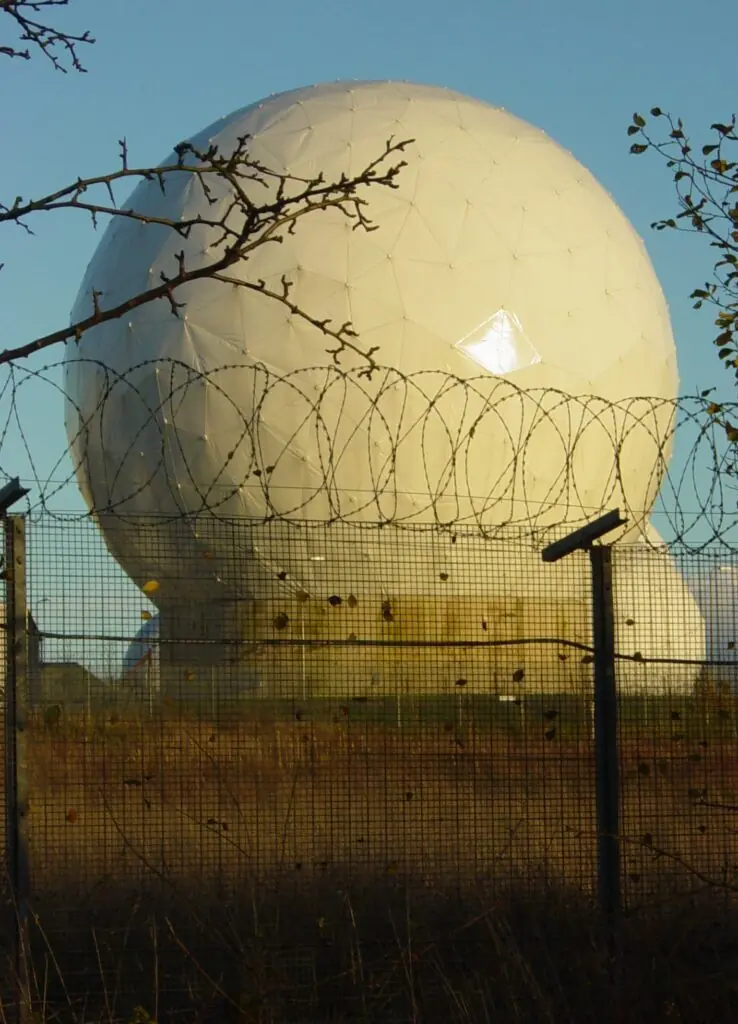
Menwith Hill: Thirty Spheres on a Moor and Sixty Years of Evasive Answers
You can see it from the road, and no British MP has managed to get a concrete answer out of it. The secret is not that it is hidden: it is that it has been placed beyond public oversight.
RAF Menwith Hill is listed as a British Royal Air Force station and has in fact been operated by the U.S. signals intelligence agency since the 1950s. Its documented function is communications interception and participation in the missile-launch early-warning chain. It was named expressly in the report of the European Parliament temporary committee on the global interception system and in the internal documentation leaked in 2013. Its legal cover leaves it outside effective British parliamentary control.
Executive summary of the case file. Everything essential before you dig deeper.
Fact sheet
OSINT - Traceability
Friends, on a Yorkshire moor, a quarter of an hour by car from a spa town with a tea room, there is a field full of white spheres. There are about thirty, each the size of a small building, and they are perfectly visible from the road. It is called Menwith Hill, formally a Royal Air Force station, and in practice it has spent sixty years operating as the largest electronic listening station in the world, run by the U.S. National Security Agency.
It is a place you can photograph from the shoulder of the road, and about which a British MP cannot get a concrete answer. That combination, visible and opaque at once, makes it the perfect example of an idea that interests me a great deal: that contemporary secrecy does not consist of hiding things, but of making them irrelevant to public oversight.
Back to my business: papers, dates, agencies. And there are plenty here, although almost none of them were released voluntarily by the Government.
What can be verified, first
The land was acquired in the mid-1950s and the station began operating shortly afterward, with American personnel from the start. Its legal status is the key piece and it is worth understanding: on paper it is a Royal Air Force installation, under British command. In practice, it is operated by the U.S. signals agency. That administrative fiction is what allows the installation to fall outside the effective reach of British parliamentary oversight while remaining on British soil.
What goes on there has become known through three channels, none of them official. The first was journalism. In the mid-1970s, a report on listening stations in the United Kingdom ended with its authors prosecuted under the official secrets law, in a trial that became a scandal because of its disproportion. What matters for us is that the prosecution confirmed, by trying to punish it, that there was something to tell.
The second channel was institutional and European. At the beginning of this century, the European Parliament set up a temporary committee to investigate the existence of a global communications interception system and published a report. That document, which anyone can read, concluded that the system existed and named the installations that made it up. That a legislative chamber of the European Union states in writing that its citizens’ communications are intercepted from a station on EU territory is a notable fact that barely lasted a week in the newspapers.
The third channel was the 2013 leaks, which again named the installation within interception programs with budgets and code names. And there was no room for interpretation there: these were internal documents.
To this is added a less discussed and perfectly verifiable function: the station takes part in the missile-launch early-warning chain, receiving and relaying data from detection satellites. In other words, it is part of the system that decides whether a flash in the northern hemisphere is a weather rocket or the start of something else.
The land
The estate on the Yorkshire moor is acquired. The installation begins operating shortly afterward with American personnel.
Journalism and the trial
A report on British listening stations ends with its authors prosecuted under the official secrets law. The prosecution confirms, by pursuing it, that there is something there.
Civilian watch
Permanent protest camps are set up in front of the fence. For decades they document vehicle plates, construction and expansions from the outside.
The European report
A temporary committee of the European Parliament concludes that a global communications interception system exists and names the installations involved.
The documents
Material leaked from inside the U.S. agency again names the station within specific interception programs.
The parliamentary question that never gets answered
What interests me most about this case file, rather than the spheres, is the literary genre it has generated. For decades, British MPs from every party have asked in writing what is done at this installation, how many American citizens work there, whether the communications of British people are intercepted and under what judicial authorization. And for decades they have received answers of an admirable uniformity, along the lines that the station contributes to the defense of the United Kingdom and its allies and that intelligence matters are not commented on.
It is a design, not an accident or a discourtesy. An installation that is formally British but operated in fact by another country falls into a perfect limbo, where each of the two governments can refer to the other. The result is a zone of national territory over which parliament exercises no real oversight, and that, not the domes, is what should keep us awake at night.
Add the local element, which tends to be forgotten. There are neighbors who have lived across the road for forty years, protest camps that were set up in the eighties and have not moved, and people who have accumulated convictions for entering the site. That civilian watch, carried out with binoculars and notebooks from the roadside ditch, has documented expansions and construction that no press release announced.
What it can be, with no need for Martians
Everything, in fact
This is one of the few case files here at Broken UFO in which the conventional explanation covers one hundred percent of what is observable, and without effort. The spheres are radomes. The antennas listen to satellites and cables. The airspace is restricted so that nobody photographs the orientation of the dishes. The American personnel are there because the United States operates the installation. And the evasive answers are evasive because mass interception is politically indefensible in a parliamentary setting.
Why it appears in the catalog anyway
It appears because it meets every formal requirement of a secret base of mythology: domes, fences, institutional refusal, lights at night and a hum. And because of a principle this archive has confirmed many times: where there is a sustained official refusal, the collective imagination fills in. It does not matter that the real content is boring; what matters is that there is a gap shaped like an answer.
The cost of filling it in badly
And here is what I find serious. Every time an installation of this kind becomes a stage for fantasy, the cost of talking seriously about it goes up. The MP who asks about the judicial safeguards for interception ends up sharing media space with the person asking about the tunnels, and that defuses the good question. Nobody needs to organize it: it works by itself.
Why this case does not die
Because, once again, the underlying suspicion is correct. Whoever looks at those spheres from the road and thinks “something is going on in there that they are not telling me” is not mistaken at all. They are right, and they also have a European parliamentary report on their side. What happens is that the true answer requires reading about telecommunications law and bilateral agreements, and the false one fits in a photograph.
And it does not die because the British Government refuses to close it. Each evasive answer feeds the machinery for another year. It is a perfectly stable cycle: opacity generates narrative, the narrative discredits the question, and the discredited question justifies continuing not to answer.
The parallel with Pine Gap is almost literal, with the difference that here there is no desert: there is a moor with sheep and a supermarket parking lot ten minutes away. And with the Nevada site it shares the underlying lesson: truly secret places tend to hold things that, once known, turn out to be more uncomfortable than a saucer.
If someday someone publishes a devastating document about Menwith Hill, it will not be about craft. It will be about who was listened to, under what authorization and who knew. And that news will last, with luck, three days.
How to question a government
If this case file teaches anything, it is the anatomy of a badly made question, and I think it is worth dissecting, because the same mistake is made here every day.
A general question, “what activities are carried out at the station?”, is guaranteed a general answer: it contributes to the defense of the United Kingdom and its allies. It is a formula drafted precisely to cover the whole space of general questions, not an improvised evasion. Asking this way is handing the Government its answer already written.
The questions that have produced information in this case have always been the narrow, administrative ones. How many people of American nationality hold permanent accreditation. How many new buildings have gone up in the last five years and under what permit. Which specific authority authorizes the interception of a British resident’s communications from that installation and under what legal instrument. What the annual maintenance cost borne by the British exchequer is.
None of those questions asks for a secret. All of them ask for an administrative data point whose classified status is hard to sustain, and the set of answers, or the pattern of refusals, draws the installation better than any leak.
There is an even more effective variant, the comparative one: asking the same thing twice, years apart. When the wording of the answer changes, something has changed underneath. The researchers who have followed this matter for decades have cataloged those variations and use them as chronological markers. It is administrative tea-leaf reading, and it works.
And a final warning that holds for any country. When the official answer is that intelligence matters are not commented on, it is worth checking whether the information is being denied or the jurisdiction is being denied. They are not the same. A government that says “I can’t tell you” is acknowledging that it knows. A government that says “that is not my responsibility” is saying something far graver about who is in charge of its own territory.
What changed when traffic moved to cables
There is a reasonable objection that deserves attention, because it is often raised by people who know the sector: if the vast majority of the world’s communications traffic now travels over fiber-optic submarine cables and not by satellite, what is a field of antennas on a moor still for?
The answer has three parts. The first is that satellite remains the medium for entire areas of the planet that fiber does not reach, and precisely the areas that most interest an intelligence service: military communications, emergency links, maritime and air traffic, conflict regions. The volume has fallen; the relevance has not.
The second is that a station like this does much more than listen: it receives and processes data from its own satellites, including those for early warning of launches, and serves as a communications node for that whole system. That function does not depend on civilian traffic and has only grown.
And the third, the one that matters for the public debate: cable interception does not eliminate the need for installations, it relocates it. The points where a cable comes ashore are now as sensitive as the antennas were, and there is no protest camp or photograph from the roadside at those points, because they cannot be seen. The secret has not disappeared: it has become invisible, which is a considerably worse way of existing.
Thirty white spheres on a moor, a quarter of an hour from a tea room. You can look at them as much as you like. Asking is another matter.
OSINT – Source traceability
Program code names and the exact number of radomes are not reproduced: they vary between sources and over time. The court cases of the 1970s are described by their established effect, without detailing the proceedings.