The Faces of Bélmez: Fifty Years of Faces on the Floor and Not One Properly Taken Sample
A town in Jaén, a concrete kitchen floor and the most famous paranormal phenomenon in Spain. The real story is not about faces: it is about botched analyses, sugar packets and a mop.
On August 23, 1971, a face-shaped stain appeared on the concrete floor of María Gómez Cámara's kitchen in Bélmez de la Moraleda. Many more followed over decades, dubbed teleplasties. The case accumulated contradictory analyses, a parapsychology prize, a university sociological study and a notarial endorsement. In 2004, after the protagonist's death, new faces appeared in another house in the town in circumstances described by witnesses present as a deliberate fabrication.
Executive summary of the case file. Everything essential before you dig deeper.
Fact sheet
OSINT - Traceability
Intelligence Network
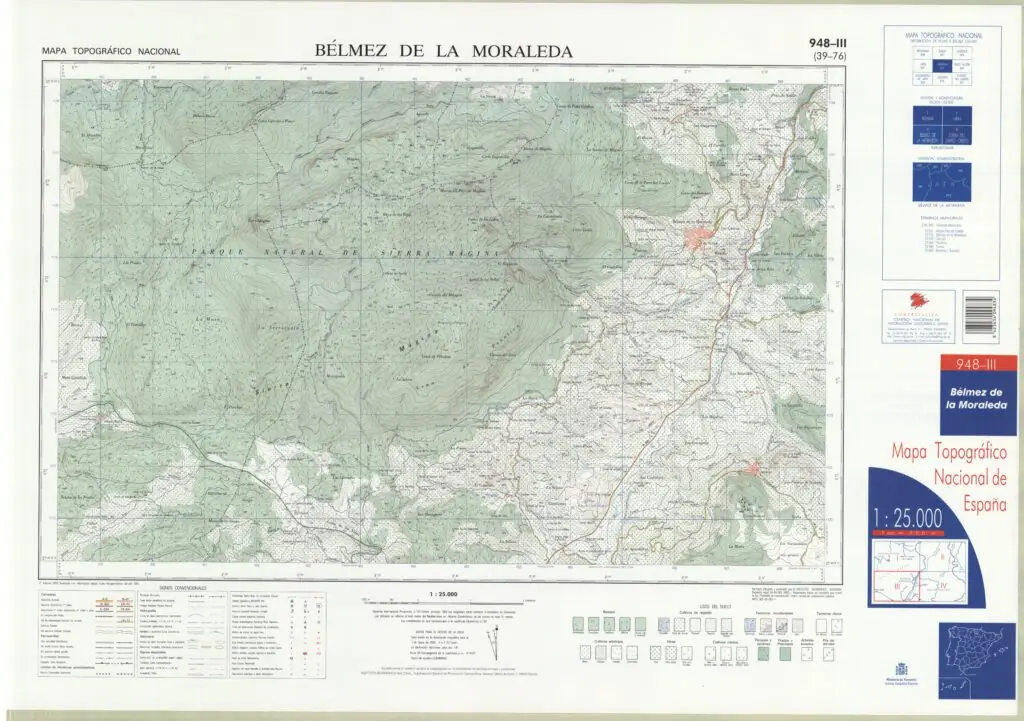
Bélmez de la Moraleda, province of Jaén. Calle Real, number 5. On August 23, 1971, María Gómez Cámara is cooking and sees on the concrete floor of her kitchen a stain with the unmistakable shape of a human face. From there, half a century of Spanish mystery history.
I’m going to tell you this case the way cases are told here at Broken UFO: following the chain of custody. And I’ll give you the conclusion up front, because I don’t like wasting your time: the problem with Bélmez is not that it is an unfathomable mystery. The problem with Bélmez is that in fifty years nobody took a proper sample. Not the believers, not the skeptics. Nobody.
Timeline
The first face
María Gómez Cámara notices a face-shaped stain on the concrete floor of her kitchen. One popular source gives a different date in September, but the canonical one in the bibliography is this.
The bricklayer
Sebastián Fuentes León scrapes the stain and applies plaster. According to those involved, the face reappears days later.
The State steps in
A commission from the Ministerio de la Gobernación (Spain's Interior Ministry) travels to investigate. It is led by José Luis Jordán Peña, vice president of the Sociedad Española de Parapsicología. Hold on to that name.
The press
First report in the local press.
The avalanche
Hundreds of visitors arrive during Holy Week. The town discovers that mystery pays.
The mystery is over
The newspaper Pueblo publishes a report with that headline. The chemist Ángel Viñas points to silver nitrate and silver chloride. The decisive nuance: the conclusion is reached by looking at photographic enlargements, not by analyzing the floor.
The sociological reading
Manuel Martín Serrano, professor at the Complutense, publishes Sociología del milagro: las caras de Bélmez. He does not study the floor: he studies the belief.
The CSIC, first time
A report by J. J. Alonso published in Psi Comunicación gives ambiguous results and detects a melanocratic compound. Along the way he suggests that the famous mark known as La Pelona could be the print of a shoe sole.
A prize
Germán de Argumosa receives the prize of the Swiss Society of Parapsychology for the case. He spent two years on Bélmez and published nothing substantial.
The Instituto de Cerámica y Vidrio
Two samples of 30 and 60 milligrams, handed over by the team of Father J. M. Pilón, are analyzed. Zinc, barium, copper, chromium, phosphorus and lead appear. Conclusion: no traces of paint were found.
The protagonist dies
María Gómez Cámara dies, aged 85.
The mop
Francisco Máñez recounts how Pedro Amorós wet the floor of another house in the town with a mop and waited for it to dry. Stains resembling faces appeared.
The exposé
El Mundo reports that the new faces are fakes.
The court
It becomes public that Court of First Instance no. 3 of San Vicente del Raspeig has rejected the injunction requested against the journalist Javier Cavanilles, with costs to the plaintiff.
The dossier
Javier Cavanilles and Francisco Máñez publish Los Caras de Bélmez. The pun in the title is deliberate.
The museum
The town council opens an Interpretation Center for the Faces in the former school, with European, provincial and municipal funds.
The magic word: “teleplasty”
Once a phenomenon gets a word of its own, it has won half the battle. Bélmez got its own: teleplastia (teleplasty), understood as a projection of forms caused by an unknown energy. Its coinage in this case is usually attributed to Germán de Argumosa, a philosopher and pioneer of parapsychology in Spain, although the bibliography also associates it with José Martínez Romero, and the term also has earlier roots in European parapsychology. Let’s say Argumosa and Martínez Romero popularized it. Coining it is another matter, and I don’t take it as proven.
A telling detail: Argumosa spent two years on the case and published nothing substantial. He received a Swiss parapsychology prize for it in 1977. And over time he came to consider that Martínez Romero’s book discredited the matter. The mystery’s main guarantor ended up unpublished and dissatisfied. In any discipline, that is a signal.
Naming what you don’t understand does not explain it. It only makes it harder to let go of.
The myth of the “CSIC report”
You will hear a thousand times that “the CSIC investigated the faces and found no explanation.” It is false as told, and it is worth taking apart piece by piece because it is a perfect example of how a source gets inflated.
The results from the Instituto de Cerámica y Vidrio in September 1990 are the most cited: two tiny samples, of 30 and 60 milligrams, handed over by the team of Father J. M. Pilón. Granulometric, mineralogical and chemical tests. Zinc, barium, copper, chromium, phosphorus and lead appear in various proportions. And the sentence that has become a banner: no traces of paint were found at any point. Pilón published it in Más Allá in 1992; Tort and Ruiz-Noguez discussed it in the Journal of the Society for Psychical Research in 1993.
Now the part nobody cites. There is another analysis, cited from the skeptical side, which concludes that the material was ordinary, run-of-the-mill concrete. And do you know what objection the skeptical author himself acknowledges against his own result? That the laboratory had no idea how the samples had been taken, delivered in a little café sugar packet.
And that is my point, which will probably annoy both parishes equally. For fifty years, believers and skeptics have thrown laboratory results at each other that are worth nothing, because nobody bothered to do the boring thing: a collection record, a witness, a photograph of the exact spot and a sealed counter-sample. Any insurance adjuster does all that for a leak. Here it was not done for the most famous paranormal phenomenon in the country.
One more note. In 1975, Juan José Alonso, a CSIC researcher acting in an individual capacity, published in Psi Comunicación (the journal of the Sociedad Española de Parapsicología) an analysis arguing that one of the most celebrated marks on the floor, known as La Pelona, could correspond to the print of a size 39 shoe sole. It should be put with the same caution with which he wrote it: he put forward a hypothesis, he did not sign a finding. And, for consistency with what is explained above, it should be said that this is not “a CSIC report.” In fifty years of mythology, that fact has appeared in an astonishingly small number of reports.
The case file that was never written
There is a hole here that obsesses me, and it is bibliographic, not paranormal.
Germán de Argumosa was the case’s main scientific guarantor. A philosopher, university professor, pioneer of parapsychology in Spain, a man with credit. He spent two years on Bélmez. He received an international prize for it in 1977. He took part in psychophony recordings that led to a report titled Las caras hablan in the newspaper Pueblo.
And his monograph? His report? His body of data? It does not exist. Two years of fieldwork on the most famous paranormal phenomenon in the country and there is no substantial work to consult. It is a glaring absence, and in any discipline it means one of two things: either it could not be written because there was no material, or it was written and did not convince its own author.
The German parapsychologist Hans Bender, of Freiburg, one of the great European figures of the discipline, also endorsed the case. And here comes the delicate part: he based a good part of his endorsement on the slight changes of configuration that the images were said to have undergone during the period under notarial seal.
That is, as it happens, the weakest point of the whole case file. Because the skeptics demonstrated something elementary: it is perfectly possible to make drawings with substances that become visible gradually. That is, the phenomenon the notary certified is reproducible. And a phenomenon reproducible by ordinary means cannot also be proof that no ordinary means are involved.
Add the clincher: the notary himself later expressed personal beliefs in paranormal phenomena. That does not make him an accomplice in anything. A notary attests to what he sees, not to why it happens, and that is exactly the problem with using a notarial record as scientific proof. The notary certifies that the stain changed. He does not certify that it wasn’t painted. They are two very different sentences and they have been confused for fifty years.
A notarial record is not an expert examination. It is a snapshot of a moment, taken by someone who was not there when the important thing happened.
No ghosts required: what explains the case
- Pareidolia. The human brain detects faces where there are none: it is a perceptual bias with an evolutionary basis and amply documented. A stained concrete surface is a perfect canvas.
- Direct intervention. Silver nitrate and silver chloride, which are light-sensitive, allow drawings that develop slowly. The infrared photograph of one of the faces, taken by Ramos Perera, showed added pigmentation and brush bristles.
- The change of style. The faces of the 1970s and the later ones show a markedly different workmanship. A classic sign of different hands.
- The notarial record does not prove what is claimed. It was certified that the images changed under seal. The skeptics demonstrated that it is perfectly possible to make drawings that become visible gradually: that is, the certified phenomenon is reproducible. Hans Bender, the German parapsychologist, based a good part of his endorsement precisely on that point, which turns out to be the weakest of the case file.
- Continued economic incentive. For thirty-three years the house drew a steady flow of visitors that sustained the local hospitality trade. The brand “Caras de Bélmez” was even registered with the Oficina Española de Patentes y Marcas (Spanish Patent and Trademark Office) in 2005.
Cavanilles and Máñez, in Los Caras de Bélmez, go further and argue that it was fraud from the first day, attributing the physical authorship to a son of María Gómez. It is a strong thesis supported by abundant documentation. I record it for what it is: the soundest hypothesis available for the original series, not a firm conviction.
2004: when the fraud was carried out live
For the 1971 series we have very solid indications. For what happened in 2004 we have something better: flagrante delicto.
After María Gómez died in February 2004, new “teleplasties” began to appear in another house in the town. Pedro Amorós, president of a parapsychological research society, was investigating them. The new faces were much vaguer and depended almost entirely on the observer’s interpretation.
In November 2004, El Mundo published the exposé. It was also established that several credentials attributed to the investigator did not hold up: no membership in the SETI institute, no collaboration with the BBC, no acknowledged involvement with CNN. A lawsuit was filed against the journalist Javier Cavanilles seeking compensation and an injunction to prohibit future publications. Court of First Instance no. 3 of San Vicente del Raspeig rejected them, with costs to the plaintiff, in a ruling made public on March 31, 2006. The court found that there was no intrusion on the right to honor and that the measure would violate the rights to information and expression.
A court defending the right to say “this is a fraud” does not automatically make the fraud proven. But when someone tries to use the courts to stop further publication about him, one tends to look more closely.
The coincidence that raises the hair on my neck
I told you to hold on to a name. Here it is.
The commission that the Ministerio de la Gobernación sent to Bélmez in 1971 was led by José Luis Jordán Peña. The same man who, twenty-two years later, would confess in writing to being the author of the UMMO fraud.
I am not insinuating that Jordán Peña painted the faces. There is not one data point that suggests it, and I don’t invent. What I am saying is something else, and it is worse: that the Spanish State, to appraise its most celebrated paranormal phenomenon, sent the man who at that very moment was building the most elaborate documentary fraud in the country. Nobody checked. Nobody asked. They trusted the title.
When the State appoints an expert, it is not certifying his competence. It is delegating its laziness.
And the town, which is what gets told least
Here I lower my tone, because it is called for. Bélmez de la Moraleda is a small town in the sierra of Jaén, and for decades it has lived with a phenomenon that brought it visitors, arguments, television cameras and a fame it did not ask for. The house on Calle Real has stayed closed since the owner’s death; her son Miguel says the faces have barely appeared since. In 2013 the town council opened an Interpretation Center in the former school.
Laughing at the town would be stupid and rather cowardly. A town did not manufacture this: it found it dropped on top of it and made the use of it that anyone would have. Those responsible for turning a matter of kitchen and concrete into fifty years of confusion do not live in Bélmez. They live in newsrooms, on TV sets and in the offices that sent a commission without experts.
If you are interested in the machinery of myth-making, continue with the UMMO case, the genealogy of the Men in Black and the profile of José Luis Jordán Peña.
OSINT – Source traceability
The exact day of María Gómez Cámara's death could not be confirmed and only the month is given. The initial date of August 23, 1971 is the canonical one in the bibliography, although one popular source gives a different date in September. The cost figure for the interpretation center is not included because it could not be checked against an official budget. A later confirmation by the Tribunal Supremo (Supreme Court) is mentioned in some sources: it has not been verified and is therefore not asserted.