
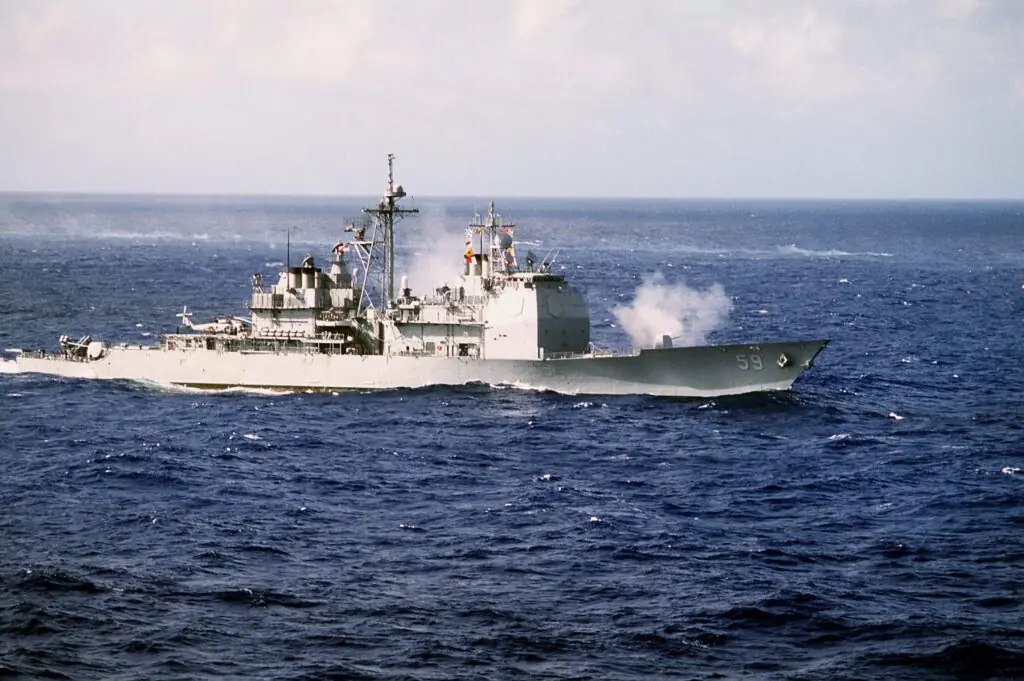
Of the whole Nimitz case, the part that gets told least is the part that interests me most. Because the popular account begins with a fighter pilot looking out of the cockpit window, and the real case begins four days earlier, in a windowless room aboard a cruiser, with a petty officer looking at a screen.
That petty officer is named Kevin Day.
What he states
Day maintains the following, in an account he has kept consistent across public interviews:
- That for several days before the air encounter, the Princeton‘s radar had been detecting groups of contacts that appeared at high altitude over the exercise area and then descended to low altitude in very short times.
- That the contacts did not appear in isolation but in groups, and with a regularity that caught his attention.
- That a malfunction of the system itself was initially suspected, since the ship had just received an equipment upgrade, and that checks were carried out that ruled that possibility out.
- That it was he who insisted that someone be sent to take a look, which ended up leading to a pair of fighters being diverted to the position.
We had been seeing them on the screen for days. They dropped from very high up to low altitude in a time that didn’t fit anything I knew. We checked the system because we thought it was ours. It wasn’t ours.
A rigor warning, which here at Broken UFO we never skip: the quotation is a Spanish-language synthesis of the content of his public statements. It is not a verbatim transcript and does not come from any official document.
Why this testimony is different from the rest
Because he is not a visual witness. And that, contrary to what it seems, makes it more interesting.
A pilot who sees something through the window provides a description subject to all the known traps of perception: misjudged distance, inferred size, relative motion confused with one’s own motion. A radar operator provides something else: a procedure. He does not describe a shape, he describes a track on a system, a verification protocol and an operational decision. His interpretation can be debated, but the debate is about a process, not an impression.
And he provides the element that holds up the whole Nimitz case against criticism: detection precedes the sighting. If the fighters were sent because the radar had been recording something for days, then what the pilots saw was not a chance find, but the visual confirmation of an earlier instrumental contact. That is exactly the sequence that makes a case strong.
The caveats, of which there are several
Let’s not get carried away, friends.
First: the Princeton‘s radar data from those days has not been published. What we have is the account of the person who saw it, not the record. And in a case whose strong point is precisely the sensor, not having the sensor data is an enormous gap.
Second: his public testimony comes long after the events. More than a decade. The memory of a procedure ages better than that of an image, but it ages.
And third: a freshly upgraded radar system that detects strange contacts for several days is, for any engineer, the scenario that most loudly screams “configuration fault.” Day maintains that it was checked and ruled out. I believe him, and I still note that the check is not publicly documented either.
The full development of the case is in our Nimitz case file, and the analysis of the associated videos is in the one on the Navy videos. This testimony is the piece that joins them, and it is also the one that most needs a document to accompany it, one that nobody has yet produced.
OSINT – Source traceability
The attributed quotation is a Spanish-language synthesis of the content of his public statements, and this is expressly stated. It is noted that neither the radar data nor the technical check of the system that the witness mentions is publicly documented.