
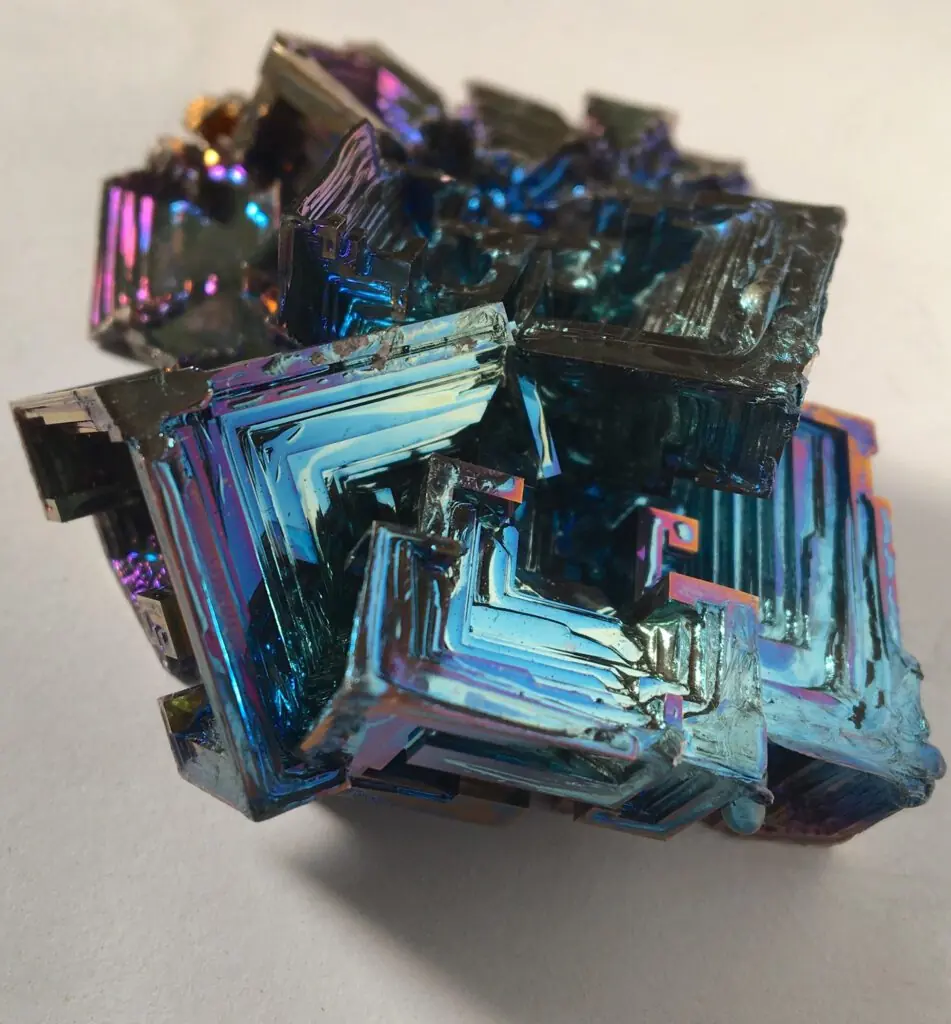
Art’s Parts: Twenty-Seven Years of Analyzing a Metal That Arrived in an Unsigned Envelope
Layers of bismuth and magnesium, real laboratories, the word metamaterial and a provenance that fits in an anonymous letter from 1996.
In 1996 the radio host Art Bell received by mail some metal fragments with a laminated structure (alternating layers of bismuth and a magnesium-zinc alloy) sent by a sender under a pseudonym who attributed them to the Roswell recovery. The material has circulated through private laboratories for almost thirty years and reached the To The Stars materials program in 2019. There is no peer-reviewed publication identifying it as impossible to manufacture on Earth, the available isotopic analyses are terrestrial and the provenance is nonexistent.
Executive summary of the case file. Everything essential before you dig deeper.
Fact sheet
OSINT - Traceability
Friends, today we talk about a piece of metal. One in particular, with a name of its own in the trade: “Art’s parts.” And we talk about it the way you talk about any piece of evidence, by asking about the paperwork before the composition. Because in this business the lab analysis is the easy part. The hard part is the delivery slip.
The story begins in 1996, and it begins on the radio. Art Bell hosted Coast to Coast AM, the late-night show where much of the modern mythology of the phenomenon was cooked up over the years, and he received some metal fragments in the mail. The sender wrote under a pseudonym. He said his grandfather had taken part in the Roswell recovery and that this was what he had brought home. He never gave his name or identified himself, and he never appeared.
I stick to what I do: papers, dates, agencies. And this case file is interesting precisely because there are no papers at all, and yet the material has been passing through real laboratories for almost thirty years, with serious people looking at it under a microscope. It is the perfect case to explain why that, by itself, means nothing.
What can be verified, first
What exists physically is several small fragments with a striking structure: alternating layers of bismuth and a magnesium-zinc alloy, stacked like puff pastry. The bismuth layers are extremely thin (on the order of one micron or a few microns) and the magnesium-zinc ones are considerably thicker. That comes straight from the cross sections published in popular outlets over the decades, with no interpretation added.
What exists in documents is an anonymous letter. Nothing more. There is no delivery record, no inventory, no witness to the find, no one to sign that this metal was in New Mexico in 1947 rather than in a workshop somewhere in 1995. The sender himself chose not to identify himself, and the story of the dying grandfather is exactly the kind of provenance that any serious archive files under “no provenance.”
In between there are two and a half decades of analysis. The fragments have passed from hand to hand: the journalist Linda Moulton Howe publicized them and published results from different laboratories, and in 2019 they ended up in the materials project of To The Stars, which announced their acquisition with considerable noise. What has not come out of all that, in twenty-seven years, is a peer-reviewed paper saying: we have measured this and it matches nothing that can be manufactured.
And it is worth stressing what has been measured and has yielded nothing. When the isotopic ratios of samples of this kind have been examined (the analysis that would truly discriminate a non-terrestrial origin, because the isotopic abundances of elements vary from one solar system body to another), the result has consistently been terrestrial. Not “odd but terrestrial.” Terrestrial.
The package arrives
Art Bell receives by mail metal fragments from a sender under a pseudonym who says he is the grandson of a participant in the Roswell recovery.
The laboratory circuit
The fragments circulate among private researchers. Micrographs and analyses are published in popular outlets, never in peer-reviewed literature.
A company takes them in
To The Stars announces the acquisition of the material for its materials analysis program. The provenance remains the same anonymous letter from 1996.
No published result
No finding is published that identifies the material as impossible to manufacture on Earth.
What it is said to be
The hypothesis that gave the story life was formulated by researchers from the applied physics world: a structure of bismuth and magnesium layers at that scale could behave as a waveguide in the terahertz range, that is, as a metamaterial. And from there the leap: if it is a designed metamaterial, someone designed it, and in 1947 nobody knew how to do that.
We have to be fair to the argument, because it is not stupid. Metamaterials exist, layer engineering at the micrometer scale does things classical optics does not allow, and a periodic structure of two very different metals is, in principle, the kind of thing that could have an electromagnetic function. The reasoning is legitimate.
The problem is that this reasoning has two holes the size of a hangar. The first: that a structure can have a function does not show it was made to have one. In metallurgy, layered structures appear on their own, through solidification, phase segregation, perfectly mundane deposition processes. Nature and industry make puff pastry without meaning to.
The second hole is worse and it is the usual one: even if the material were exotic, we would still not have a single reason to connect it with New Mexico in 1947. The claim “this is from Roswell” does not rest on any data point. It rests on an unsigned letter.
What it could be, no Martians required
An industrial byproduct
Bismuth and magnesium are used together in metallurgy, and laminated structures are a common result of solidification and coating processes. A residue from an industrial process (slag, a leftover from a bath, a test piece) can easily look like that. Ruling this out takes a systematic comparison with known industrial samples, and none is on record as published.
A piece made on purpose for the story
Making a stack of thin metal layers does not require an advanced civilization: it requires a materials laboratory, and in 1995 there were thousands. If someone wanted to make an object that looked impossible and could withstand a microscope, this is exactly the form they would choose: something with no obvious function, that looks strange at high magnification and whose composition is unusual enough to start a conversation. There is no proof it was done that way. Nor is there anything that rules it out.
An ordinary fragment told in an extraordinary way
And the third, the boring one: any piece of metal that became interesting the moment it arrived by mail with a story attached. That is what happened with the Ubatuba magnesium in 1957, with an identical script, forty years earlier: anonymous envelope, ordinary metal, real analyses and a conclusion the analyses do not support.
Why this case won’t die
Because it is tangible, and in a phenomenon made of distant lights and infrared videos, having an object you can pick up with tweezers is a big advantage. It can be photographed, put under a microscope and shown on a screen while someone explains the terahertz business. It is the physical evidence the community had been asking for over decades, with the small detail that it proves nothing.
And it doesn’t die because the analysis circuit feeds itself. Every new laboratory that looks at the sample generates a headline (“a new analysis of Art’s parts”), even if the result is the same as always. The quantity of analyses gets confused with the quality of the proof. They are not the same. An object with no provenance analyzed twenty times is still an object with no provenance.
Here is the contrast that interests me, and that is why this case file and not another. The Navy videos have something Art’s parts lack entirely: a chain. We know which sensor they came from, which aircraft, in which exercise and through which channel they were released. What they show can be debated, and it is debated, but it is debated over something with a file. Here there is no file: there is an envelope. And the AARO historical report insists on precisely that, that the materials handed to it over the years have not withstood the test of origin.
What it would take to close this case file
I don’t like leaving a case open without saying what would close it, so here is the list. It is short and entirely feasible with the technology of any decent university.
First, and the only thing that truly discriminates: isotopic ratios of all the elements present, measured with mass spectrometry and published with their uncertainty. Elements do not have the same isotopic composition everywhere in the solar system; meteorites give it away immediately. If the bismuth and magnesium in that sample had abundances different from terrestrial ones, the matter would be world news within a week. Every time it has been looked at, they have come out terrestrial.
Second: a complete metallurgical characterization (grain structure, interfaces between layers, presence of oxides, crystal orientation) compared with samples from known industrial processes. That is routine work in any materials department and it answers the question of whether the structure could have formed on its own during solidification or whether it requires controlled deposition.
Third, and here is the problem: provenance. And no laboratory can fix this part, because it is not an analytical question. It would require identifying the 1996 sender, or at least documenting the chain since then with dates, custodians and receipts. None of that exists, and the passage of time makes it less recoverable every year.
That is why my practical conclusion is uncomfortable for both camps. If tomorrow a laboratory published an impeccable analysis with a real isotopic anomaly, we still could not say the object comes from Roswell: we would have a strange material of unknown origin, which is already quite a lot. And if it published that it is ordinary magnesium and bismuth, that would not “prove” fraud either, only banality. Provenance is the question, and it is documented at the time rather than analyzed twenty-seven years later.
In the end, what Art’s parts teach best is archival science rather than metallurgy. Evidence is an object plus the chain of hands that brings it to you, with names and dates. Take away the chain and what you have left is a pretty piece of metal and a story. Which is not nothing for a night of radio, but it is not a case file.
OSINT – Source traceability
The composition and structure are described in qualitative terms, as they have been circulated, without reproducing specific thicknesses or percentages: the figures in circulation come from second-hand summaries and not from a report that can be consulted. No conclusions are attributed by name to specific analysts for the same reason.