
Silverbug and the Avro VZ-9 Avrocar: The Flying Saucer That Was Actually Built
There was a Western military flying disc, with a contract and a project number. It is declassified, you can visit it in a museum, and it could not climb more than a meter off the ground.
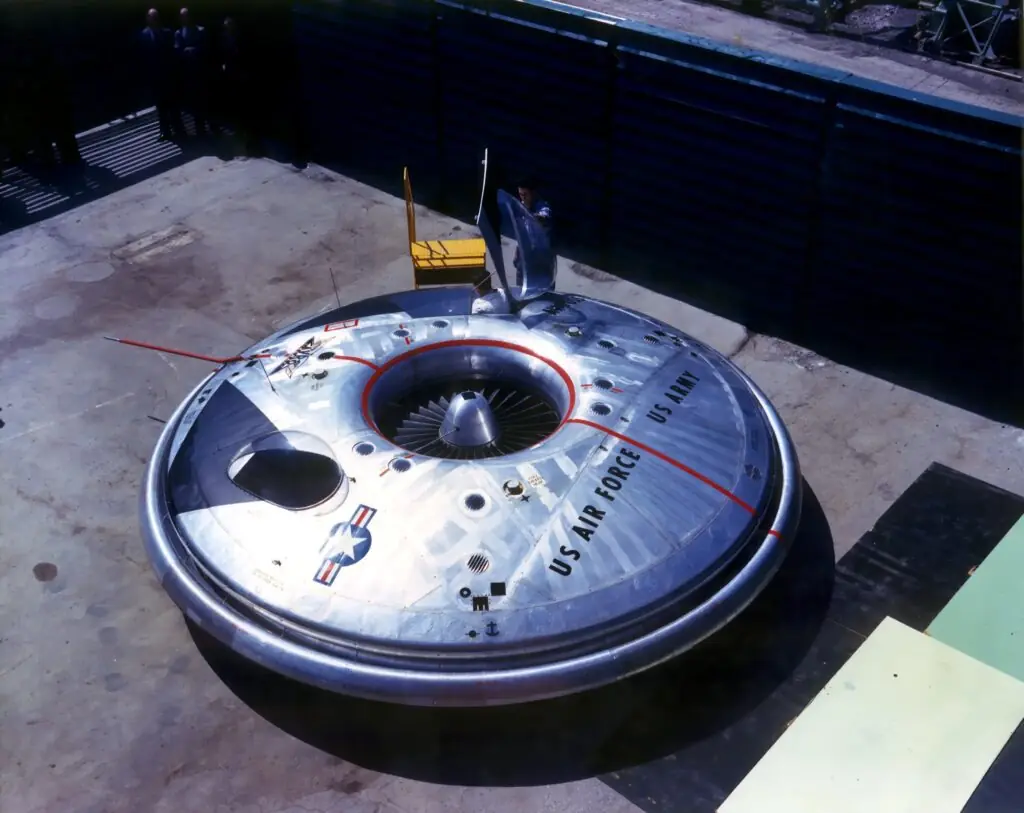
Avro Aircraft Limited, in Ontario, developed circular-airframe aircraft with a central rotor for vertical takeoff during the 1950s, under the direction of engineer John Frost. With U.S. funding the concept was studied as a supersonic interceptor (Silverbug). The demonstrator actually built, the VZ-9AV Avrocar, held itself up only in ground effect and became unstable above approximately one meter. The program was canceled in December 1961 and the two examples are preserved in American museums.
Executive summary of the case file. Everything essential before you dig deeper.
Fact sheet
OSINT - Traceability
Some winters smell of dirty snow and kerosene, and the one in Malton, Ontario, on the outskirts of Toronto, smelled of both. There, in the Avro Canada hangars, among sheet metal, rivets and that postwar discipline in which everyone felt they were about to be late for something, a group of engineers spent much of the 1950s building a flying saucer. Literally. With a contract, a project number and the signature of the U.S. Air Force at the bottom.
This is a case file. And it has the virtue, rare here at Broken UFO, that you can go and see it. The two machines that were built survive in American museums, with their dented sheet metal and their little placard. One is in the National Museum of the U.S. Air Force in Dayton, Ohio. The other is in the U.S. Army Transportation Museum at Fort Eustis, Virginia.
I am not here to prove anything. I am here to sort through the smoke so you can see where the flame comes from. And in this case the flame is especially instructive, because for fifty years it has been said that saucers were secret Western technology. Well: there was a secret Western saucer, it was declassified, and what the papers tell is a story of overreaching ambition and of a contraption that could not climb a meter without lurching all over the place.
What can be verified, first
The story starts with John Frost, a British engineer who had worked on fighters and who headed what was called the Special Projects Group at Avro Canada. In the early fifties, Frost was turning over a real and perfectly earthly problem: vertical takeoff. Combat aviation of the day depended on long concrete runways, and a long concrete runway is the easiest thing in a war to destroy. Hence the obsession, shared by half a dozen countries, with aircraft that could take off from a forest clearing.
The solution Frost explored was a circular airframe with a central rotor, a turborotor, fed by several turbojets, which would expel the gases through a peripheral slot. With that architecture it was possible, in theory, to hold the aircraft up on its own jet in order to take off and then transition to high-speed horizontal flight. The disc shape was not an aesthetic whim: it came out of the physics of the annular jet.
The project went through several phases. It began with Canadian funding (the so-called Project Y and Project Y2) and, when Ottawa turned off the tap around the middle of the decade, the United States picked it up. Under the name Silverbug, the U.S. Air Force studied the ambitious version: a supersonic interceptor in the shape of a disc. The documents from that phase were declassified and made public in the 1990s, and the development report for the USAF-associated project was released by the U.S. National Archives in 2012, with the resulting round of headlines. Its stated objectives were those of an extremely high-performance aircraft: very high supersonic speed, a ceiling above thirty kilometers and a considerable range.
Stated objectives. Write that phrase down carefully, because it is the key to the whole file. A development document describes what is meant to be achieved with the money being requested, not what has been achieved. Confusing the two is the most common misreading in this field, and the one that has turned a funding request report into proof that a Mach 3 disc once flew over Nevada.
What was actually built was something else: the VZ-9AV Avrocar, a subsonic demonstrator, much smaller and much more modest. Two examples. About five and a half meters in diameter, three small turbojets driving the central rotor, cockpits for one or two crew members at the sides. It flew for the first time tethered in the late 1950s and in free flight from 1960.
What happened when it took off
The worst thing that can happen to an aircraft happened: it worked only while it was a hand’s breadth off the ground. In ground effect, that cushion of compressed air between the machine and the terrain, the Avrocar held up reasonably well. As soon as it was asked to climb above that height, it lost the additional lift and a pitch and roll instability appeared, which the engineers christened with a word that says it all: hubcapping, that is, behaving like a hubcap rolling down the road.
The numbers for its real behavior are crushingly humble. Useful flight height: about a meter. Maximum speed reached: that of a bicycle going downhill, around fifty kilometers per hour. Directional stability: poor. Ability to become the supersonic interceptor the papers promised: none.
They tried to fix it. Modifications to the controls and to the geometry of the exit slot were tested. There was no way: the problem lay in the architecture, not in a detail of adjustment. The program was canceled in December 1961 and the two machines ended up in museums, which is where you can photograph them today.
Frost starts drawing
Avro Canada's Special Projects Group, headed by John Frost, explores a circular airframe with a central rotor for vertical takeoff.
Canada withdraws
Ottawa stops funding the development. The concept passes to the American sphere.
Silverbug
The U.S. Air Force studies the ambitious version: a supersonic interceptor in the shape of a disc. The documents would be declassified decades later.
First flights
The VZ-9AV Avrocar demonstrator flies tethered. The following year, in free flight.
The hubcap
Outside ground effect the aircraft becomes unstable. It gets no higher than about a meter and no faster than a bicycle.
Cancellation
The program is closed. The two examples end up in American museums.
The papers, in the open
The U.S. National Archives release the development report for the USAF-associated project and the story goes around the world.
What it may be, without needing Martians
The thesis that the saucers were ours
This is the most widespread reading and the one this case file allows us to examine with data. If Avro built a flying disc, the argument goes, then sightings of discs could be explained by secret prototypes. The problem is one of timeline and performance. Disc sightings begin en masse in the summer of 1947, when Frost had not yet drawn anything; the Kenneth Arnold misunderstanding dates from June of that year. And when a disc finally did fly, it got no higher than a meter and ran no faster than a moped. It does not work as an explanation for anything that has been described in the sky.
The thesis that it did work and was hidden
The romantic version holds that the Avrocar was the cover and that the good version flew in secret. An absolute negative cannot be proven. But one can ask for indications, and there are none. A program that works leaves an industrial trail: suppliers, budgets, personnel, test facilities, accidents. The turborotor architecture also has aerodynamic limitations that more budget does not fix, and the industry itself abandoned that line to move to vectored-thrust jets, which is what ended up truly working.
What it does explain
The Avro file explains something else quite well: why the disc shape was plausible as cutting-edge technology in the fifties. To an engineer of the era it was a line of research with a contract, not science fiction. That atmosphere helps explain why so many people, including military personnel, found it reasonable that a disc-shaped object might be an advanced machine. They were, in a way, right: someone was building one. It just did not fly.
Why this case won’t die
Because every few years someone rediscovers the declassified report, publishes the line about the supersonic interceptor and leaves out the hubcap part. It is a predictable mechanism: the document is authentic, the quote is literal and the headline writes itself. Without lying in a single word, one can imply that the United States had a Mach 3 disc in 1956.
And it doesn’t die because it satisfies both camps at once, which is the definition of a story in good health. For the believer in recovered technology, it serves as a precedent: look, they did make discs. For the non-believer, it serves as an explanation: look, UFOs were this. Both readings require not looking at the flight reports, which are the boring part and the only one that contains the result.
This is, by the way, the same mechanism that sustains Kecksburg or the recovered-technology rumor of Roswell: a real documentary piece, read outside its administrative context. And it contrasts well with the Biefeld-Brown effect, where there was also a genuine phenomenon, a boring explanation and fifty years of people quoting the promise instead of the result.
Why a disc doesn’t fly: the boring and decisive part
It is worth explaining the physics, because without it the Avrocar’s failure looks like bad luck or lack of budget, and it was neither. It was a limitation of the shape.
The aircraft held itself up by expelling air downward through a peripheral slot. Close to the ground, that jet bounces back and forms a cushion of pressurized air under the disc: ground effect, the same one a hovercraft exploits and the same one a pilot feels in the flare before touchdown. That cushion is generous: it provides free lift and, above all, it provides stability, because if the aircraft tilts, the side that goes down compresses more air and pushes back. The cushion corrects by itself.
As soon as the disc rises above that height, the cushion disappears and with it the self-correcting mechanism. And then the underlying problem surfaces: a circular airframe has, by definition, no surface far from the center of gravity with which to generate pitch and yaw moments. A conventional airplane carries a tail precisely for that, mounted at the end of a long arm. A disc has no arm. Everything is at the same distance from the center, which is zero for purposes of leverage.
The result is the wobble that the engineers called hubcapping: the aircraft begins to oscillate and does not have enough control authority to stop the oscillation before it grows. More power or a better pilot does not fix it. What fixes it is control surfaces far from the center, that is, by ceasing to be a disc, or with an automatic stabilization system with fast sensors and actuators, which is exactly what did not exist in 1960 and what today allows multirotors to fly.
There, incidentally, is the answer to the question everyone asks. If it could have been fixed in secret, it would have been fixed in public: military aviation of the time was desperate for vertical takeoff, and every country that tried arrived at the same conclusion. The solution that worked was the vectored jet, not the disc. And that was put into service by a British fighter that flew in full view of everyone.
What remains is the image, which is what always remains. A metal disc five meters across, with two men leaning out of their respective hatches, lurching a hand’s breadth off the ground on an Ontario airstrip while someone writes down numbers on a clipboard. The shape of the future, exactly, and a meter of height.
OSINT – Source traceability
The exact cost figures of the program are not reproduced: those in circulation come from secondary summaries and not from a document that can be consulted. The real performance figures are given as orders of magnitude, as described in the project literature. The speed and ceiling objectives are expressly identified as development goals.