
Townsend Brown and the Biefeld-Brown Effect: The Thrust Was Real, the Antigravity Was Not
A capacitor that moves on its own, sixty years of promises of reactionless propulsion and a control experiment that settles everything: take away the air.
Thomas Townsend Brown observed in the 1920s that an asymmetric capacitor charged to high voltage experiences a net thrust, and interpreted it as a link between electricity and gravity. He patented the principle in 1928 and proposed it to the U.S. military in 1952. The phenomenon is real, but its cause is the ion wind generated by a corona discharge: the thrust depends on air and vanishes in a vacuum. A report from the U.S. Army Research Laboratory established this in 2003, and in 2018 the same physics flew an airplane with no moving parts.
Executive summary of the case file. Everything essential before you dig deeper.
Fact sheet
OSINT - Traceability
Some discoveries come in through the door and some come in through the crack, settle into the mental living room for half a century and can no longer be evicted. The Biefeld-Brown effect belongs to the second category, with the aggravating circumstance that it is true. It is a real physical phenomenon, measurable and reproducible on a tabletop with high-school materials, and no fraud, legend or rumor. It just isn’t what it was said to be.
The story begins in Ohio in the 1920s, with a well-off young man named Thomas Townsend Brown and a professor named Paul Biefeld. Brown observed that a capacitor charged to high voltage, if its two plates were different, moved. It did not tremble: it moved, in a preferred direction, toward the smaller electrode. And it did so without expelling anything visible.
To a young man of the 1920s, it looked like what it would have looked like to anyone: that he had found a link between electricity and gravity. He called his device a gravitator, patented the matter in Great Britain in 1928 and spent the rest of his life (he died in 1985) convinced that he was one step away from reactionless propulsion. The world spent the rest of the century checking that he was not.
What can be verified, first
That the effect exists is disputed by no one, and this deserves emphasis because in this field skepticism is often confused with denial. Take a thin wire and an aluminum sheet, separate them by a few centimeters, apply several tens of kilovolts between them and the whole assembly will pull upward. This is the principle of the so-called lifters, which have been built for decades in garages and classrooms. The thrust is there. It can be weighed on a scale.
Brown took it considerably further than a classroom experiment. In 1952 he presented the U.S. military with a proposal known as Project Winterhaven, in which he set out to develop aircraft based on the principle. In the mid-1950s there was a small media bubble around what was then called electrogravitics: articles in the specialized aeronautical press, companies in the sector saying they were interested, that perfume of the executive office that appears when someone smells a contract.
And then, silence. A silence that for decades has been read as proof of classification (they found it, it worked, they buried it) and that allows a much less dramatic reading: they tested it, it was no good for flying anything, and industry went off to do something else. Both readings are compatible with the silence. Only one is compatible with the measurements.
Because the measurements were made, and they were made at institutions with names. In the late 1980s, a study of propulsion concepts commissioned by the U.S. Air Force examined devices of this type and found no appreciable thrust in a vacuum. In 2003, the U.S. Army Research Laboratory published a specific technical report, signed by Thomas B. Bahder and Chris Fazi, titled simply “Force on an Asymmetric Capacitor.” It should be read in full, because it tends to be cited backwards: Bahder and Fazi verified the thrust, but calculated that ballistic ion wind fell three orders of magnitude short of explaining the measured force, left the mechanism open (they write that the physical basis of the Biefeld-Brown effect is not understood) and asked for precisely the vacuum tests that would decide the question. The conclusion that appears in textbooks today arrived by another route: the study the Air Force commissioned from Veritay Technology (1990-1991), which measured the device in a vacuum down to the microtorr without finding thrust, and the NASA report Asymmetrical Capacitors for Propulsion (Canning, Melcher and Winet, NASA/CR-2004-213312, 2004), which attributed the force measured in air to ion wind.
What ion wind is, and why it is more elegant than it looks
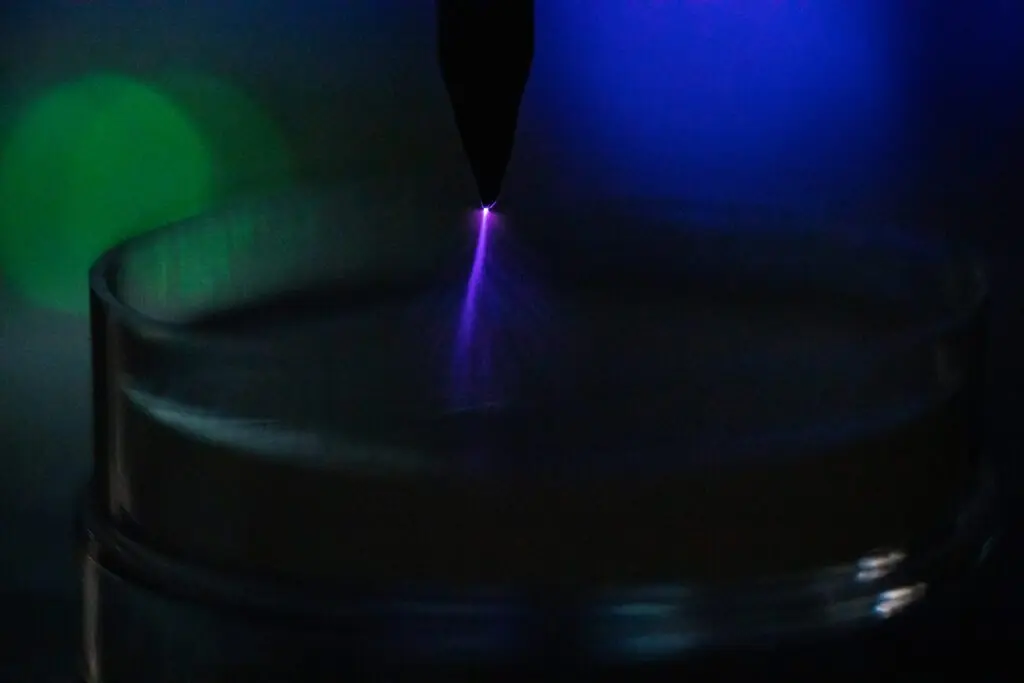
The mechanism is nothing to be disappointed by, if one bothers to look at it. When we apply a very high voltage to an electrode with a small radius of curvature (a thin wire, a point), the electric field at its surface shoots up and tears electrons from the air molecules around it. A corona discharge forms: a small region of ionized air.
Those charged ions feel the field and are shot toward the other electrode. And along the way they collide with millions of neutral molecules, which do not feel the field but do feel the blow. The result is a current of air. A real current of air, which can be felt with the hand and measured with an anemometer. The capacitor pushes air to one side and, by Newton’s third law, moves to the other.
That is to say: there is propulsion, and there is reaction. The device violates nothing. It is doing exactly what a propeller does, only without moving parts and using the air as propellant instead of as a medium. That this is a legitimate form of propulsion was demonstrated in 2018, when a team at the Massachusetts Institute of Technology led by Steven Barrett flew a small airplane with no moving parts, propelled by ion wind, and published it in Nature. That was engineering, not antigravity, and it flew.
The definitive test, the one that settles the matter, is the simplest of all: take away the air. If the thrust came from an interaction between the electric field and gravity, it would still be there in a vacuum. If it comes from moving air molecules, it disappears when there are no molecules to move. And it disappears. Vacuum tests find nothing comparable to the thrust observed in the atmosphere. No interpretation is needed: it is a switch.
The observation
Thomas Townsend Brown, working with Professor Paul Biefeld, observes that an asymmetric capacitor charged to high voltage experiences a net thrust.
The patent
Brown patents in Great Britain a method and apparatus for producing force or motion from the effect.
Winterhaven
Brown proposes to the U.S. military a program to develop aircraft based on the principle.
The bubble
The specialized aeronautical press publishes a batch of articles on electrogravitics. Then, silence.
Brown founds NICAP
The same man launches one of the most influential civilian organizations of the century investigating the phenomenon.
The Army report
The U.S. Army Research Laboratory publishes “Force on an Asymmetric Capacitor”: it verifies the thrust, rules out ballistic ion wind by three orders of magnitude and leaves the mechanism open.
Source ↗It really flies
An MIT team flies an airplane with no moving parts propelled by ion wind and publishes it in <em>Nature</em>.
What it can be, without needing antigravity
A man who was right about the small thing and wrong about the big one
Brown invented nothing. He saw a real phenomenon that no one had characterized well and gave it a wrong explanation, which is the most human and most frequent thing in the history of science. His error also has a chronological excuse: the electrohydrodynamics of corona discharges was not, in the 1920s, a field with a textbook. What no longer has an excuse is that the correct explanation has been published for more than twenty years and the gravitator is still cited as reactionless propulsion.
The silence of the 1950s
The disappearance of the subject from the aeronautical press around 1957 is the pillar of the conspiratorial reading. It deserves a cold examination. What happened in those years is that Western aeronautical industry found something that did work, spectacularly: the turbojet, and after it the liquid-propellant rocket. The budgets went there. A principle that gives a lot of thrust per kilowatt (on the order of one hundred newtons, about fifty times more than a jet engine on that metric) but very little thrust per square meter of device, and whose performance collapses as soon as the vehicle picks up speed, cannot compete with an engine that puts a ton in the air. No dark office is needed to explain an abandonment; a spreadsheet is enough.
What did remain
And quite a lot remained. Electrohydrodynamic propulsion is today an active field with real applications: fanless cooling of electronics, surface treatment, propulsion of silent, very low-load aircraft. Brown’s dream did not come true, but his observation ended up with legitimate offspring. Which is considerably more than most prophets of antigravity can say.
Why this case won’t die
For a reason that gives plenty to think about: because the experiment works. Anyone can build a lifter at home, watch it take off and film it. In a field where almost everything is blurry lights in the distance, having a phenomenon that rises from the table right under your nose is an enormous asset. The video of the device floating is honest: that happens. What you don’t see in the video is the air moving.
And it doesn’t die because Brown, in addition, was a figure of the movement itself: in 1956 he launched NICAP, the civilian organization that, under the direction of Donald Keyhoe, pressed the U.S. government for years over declassification. That is, the man who investigated antigravity and the man who institutionalized civilian investigation of the phenomenon are the same. That dual condition has kept his name alive in both circuits.
The lesson of method is the one that interests this site. Here there was no lie, no doubtful witness, no apocryphal document: there was a real phenomenon and a mistaken interpretation, and to dismantle it there was no need to distrust anyone. A control experiment was enough: take away the air. Compare the EmDrive, half a century later, where the script repeats step by step, or element 115, where the claim could also be taken to the laboratory.
The arithmetic that settles the argument
There is an even simpler way to close this case, and it requires neither a vacuum chamber nor an Army report: all it takes is a division. Ion wind propulsion has a thrust-to-power ratio that can be measured on any bench, and that ratio is what separates a laboratory phenomenon from an engine.
The problem with ion wind is how quickly it gets worse when asked for more. To move more air you have to raise the voltage; raising the voltage increases the discharge current; and a good part of that energy goes into heating the air, producing ozone and radiating bluish light, not into pushing. Efficiency collapses precisely where it would need to rise. That is why the principle can lift a few grams of balsa and not a person.
The other end of the argument is cleaner still. A device like this needs an atmosphere to work, and its performance falls with air density. That is: the higher it flies, the less it pushes, until it stops pushing altogether. A propulsion system whose performance drops to zero precisely where it was meant to be used (space) is an atmospheric fan with very good press, not space propulsion.
And a practical warning for anyone who builds one at home, which is easy to do and worth doing. When the device takes off, bring your hand close above it. You will feel the current of air. That air hitting your palm is, literally, the propellant: the mass the device is expelling in order to lift itself. Antigravity refutes itself, and your own hand refutes it.
One last thing remains to be said in Brown’s favor, and it tends to be omitted when he is treated as a dreamer. In 1956 he founded NICAP, and that organization did serious documentary work for decades, pressed for declassification and gathered cases with method. The man was wrong in his physics and entirely right that a civilian archive was needed. Of the two, the one that has lasted is the second.
Brown died in 1985 without changing his mind. It is a sad ending and a rather fair one at the same time: he spent sixty years chasing the wrong explanation of a true discovery. There are entire careers that don’t get even that far.
OSINT – Source traceability
The number of the 1928 British patent and the thrust figures from the various tests are not reproduced: they vary widely depending on the setup and do not come from a single consultable document. The propulsion study commissioned by the Air Force in the late 1980s is cited generically for the same reason.