
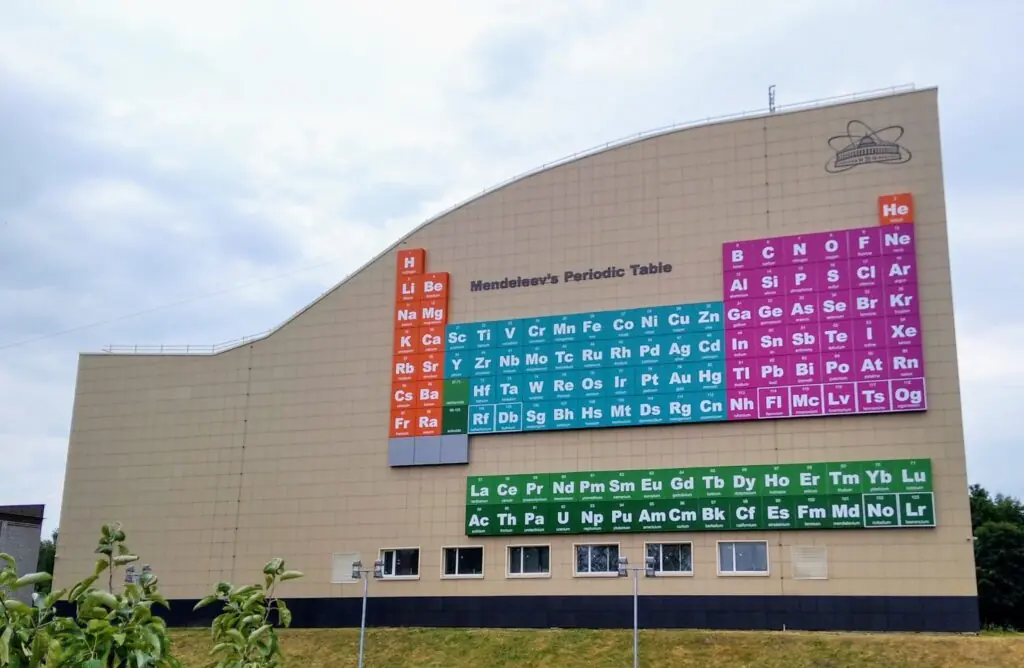
Moscovium: What Happened When Someone Actually Made Element 115
In 1989 it was said to be stable, to exist by the kilo and to produce gravity. In 2003 it was synthesized: it lasts less than a blink and is counted in atoms.
Element 115 was described in 1989 as a stable substance, available in quantities of hundreds of kilos and capable of generating a usable gravitational field. Box 115 of the periodic table was empty at the time. It was synthesized in 2003 at Dubna together with Lawrence Livermore, by bombarding americium-243 with calcium-48, and was named moscovium in 2016. Its known isotopes last fractions of a second, are produced atom by atom, and no macroscopic sample exists.
Executive summary of the case file. Everything essential before you dig deeper.
Fact sheet
OSINT - Traceability
Some claims age badly, and some claims age in reverse: the more time passes, the more the world contradicts them. The claim about element 115 belongs to the second family, and it has the rare virtue of having been testable. In 1989 a man said it existed and was used as fuel. Fourteen years later someone actually made it, and what came out of the accelerator refutes, point by point, what had been promised.
This case file is not about Bob Lazar. Lazar and his account are dealt with in their own case file, with his contradictions over his employment and his degrees that do not turn up. This one is about the substance: about number 115 on the periodic table, about why it took so long to reach it, about how long it lasted when it was finally reached, and about why chemistry closes the door without anyone having to be summoned.
What can be verified comes first. That is how one should walk down a dark corridor: feeling the wall.
What can be verified, first
In 1989, when the story of element 115 was broadcast on television in Las Vegas, box 115 of the periodic table was empty. It was a box that physics had not yet reached, not a military secret. It had one of the provisional names given while waiting, ununpentium, which literally means “one-one-five,” and that is a nomenclature convention, not a clue.
The box was filled in 2003, at the Flerov Laboratory of Nuclear Reactions of the Joint Institute for Nuclear Research in Dubna, on the outskirts of Moscow, in collaboration with Lawrence Livermore National Laboratory. The method was the one used for this whole region of the table: bombard a target of a heavy actinide with a beam of a light, neutron-rich nucleus. In this case, americium-243 with calcium-48. The result was published in 2004 in Physical Review C, signed by Yuri Oganessian’s team, and what it reported was the detection of a few nuclei that gave themselves away through their alpha decay chain, not an ingot.
That is the first fact to take on board, because it changes the whole conversation: moscovium has never been seen. There is no vial. There is no shaving. There is no sample to put in a display case. There are detector records saying that, for an instant, a nucleus with 115 protons was there and then was not. The total number of atoms of element 115 produced by humanity in two decades fits comfortably within a three-digit figure.
The second fact is the duration. The known isotopes of element 115 have half-lives on the order of tens or hundreds of milliseconds; the longest-lived one characterized so far does not come anywhere near the scale of a minute. A human blink lasts about a hundred milliseconds. We are talking about a substance whose existence is measured in blinks, and which decays by emitting alpha particles until it turns into something else.
The name came in 2016. IUPAC and IUPAP validated the discovery and approved four names at once: nihonium for 113, moscovium for 115, tennessine for 117 and oganesson for 118. Element 115 is called moscovium after the Moscow region, where Dubna is located. An element is named once the discovery has been independently verified; that dull, public procedure is the best proof that nothing here was hidden.
The claim
In televised interviews in Las Vegas, an element 115 is described as stable, available in kilogram quantities, and used as a source of energy and of a gravitational field. Box 115 is empty at the time.
The synthesis
The Flerov Laboratory (Dubna) and Lawrence Livermore obtain nuclei of element 115 by bombarding americium-243 with calcium-48. They are detected through their alpha decay chain.
The publication
The results appear in <em>Physical Review C</em>. There is no sample: there are decay chains.
The naming
IUPAC and IUPAP approve the name moscovium (Mc) alongside nihonium, tennessine and oganesson. The element enters the table through the ordinary door.
Source ↗The tally
All known isotopes are intensely radioactive and last fractions of a second. A weighable quantity has never been obtained.
What was claimed, and what it required to be true
The 1989 version asked for three things at once. First: a stable isotope of element 115, or at least one stable enough to be stored and handled. Second: quantity. Hundreds of kilos in storage were mentioned. Third: a physical property that no theory had ever proposed, that of emitting a usable gravitational field that a device could amplify and direct.
All three can be tested separately, and that is the elegance of the matter. There is no need to argue over whether a man did or did not work at a site in the Nevada desert; it is enough to look at what number 115 does when it is brought together with a beam of calcium.
On stability
There is a respectable and long-standing hypothesis called the island of stability: the prediction that certain numbers of protons and neutrons would form closed nuclear shells and yield superheavy nuclei with half-lives much longer than those of their neighbors. It is serious physics. But the island the models predict lies in a very neutron-rich zone, and the isotopes we know how to make are on the opposite shore: we lack the neutrons to get there, and the available reactions do not supply them. Every synthesis of superheavy elements is done, so to speak, by throwing stones at the coast from the dry side.
Put another way: the island of stability is neither a broken promise nor an excuse. It is a geographical feature that we know how to locate on the map and that we still have no boat to reach. And even if we got there, “much more stable” in this neighborhood means seconds, minutes, perhaps years in the best of the theoretical scenarios. It does not mean a block on a shelf.
On quantity
There is no room for interpretation here. Each nucleus of element 115 is produced one at a time, after weeks of continuous bombardment, and is detected by the trail it leaves when it dies. Going from that to hundreds of kilos is a jump of about thirty orders of magnitude, far beyond a difference of industrial scale. It is the distance between finding a drop and having an ocean, and no black budget bridges it.
On gravity
The weightiest claim, and the pun is deliberate, is that element 115 would emit a usable gravitational field. Gravity, as far as verified physics goes, is produced by energy and mass, not by a particular chemical identity. A gram of hypothetical moscovium would weigh exactly what a gram of lead, water or compressed air weighs: one gram. There is no mechanism in the standard model by which a specific number of protons generates a gravitational effect different from the one its mass gives it. It is the very definition of what gravity is in the theory used to put satellites in orbit, and no mere opinion of official physics.
The reply that came later, and why it does not hold
When the element was synthesized, the public response from the side of the account was predictable: it is not that isotope. The one that was used, it was said, is a heavier and more stable one that science has not yet reached.
It is a classic move and deserves cold analysis, not contempt. The problem is not that it is impossible, since nobody can prove that a distant isotope does not exist; the problem is what happens to the claim when it is reformulated this way. In 1989 something testable was said: it exists, it is stable, there are kilos. In 2003 it was tested and the answer was no. And then the claim moves to a place where it cannot be tested. A hypothesis that is rewritten every time a fact catches up with it has stopped being a hypothesis: it is a position.
Why this case does not die
Because it got the form right. Naming an empty box on the periodic table was a remarkably effective move: it sounded technical, it was concrete, and it could not be refuted at the time. Whoever said it chose the one place in chemistry where you can point at a gap and claim that something is inside. That fourteen years later the gap was filled with something else is, in narrative terms, bad luck.
And it does not die because the name moscovium sounds like confirmation to many ears today. “Element 115 exists” has become an argument, when it is exactly the opposite: it exists, it has been measured, and what has been measured contradicts everything that was promised. The confirmation that the box was empty not by military decree but because of experimental difficulty is, if you think about it, the most complete refutation possible.
It is worth comparing with the Ubatuba magnesium, where the extraordinary claim was also put through a laboratory and also went out the back door. And with the Biefeld-Brown effect, where a real phenomenon (there is thrust, it can be measured) ended up with a boring explanation. The profile of Bob Lazar tells the rest of the story.
How to make an atom that does not exist
It is worth pausing on the procedure, because it explains by itself why the word “kilos” has no place in this conversation. To reach number 115 you have to add protons, and protons repel one another with a fury proportional to how close they are. Fusing two heavy nuclei requires hurling them at each other with just the right energy: too little and they bounce; too much and the resulting nucleus breaks apart before it forms.
The recipe that works in this region of the table is so-called hot fusion with actinide targets (the name distinguishes this route from “cold fusion” with lead and bismuth targets, which served for elements 107 to 112 and does not reach this far, and which has nothing to do with the electrochemical “cold fusion” of 1989), and it consists of a target of a heavy, rare element (here, americium-243, which has to be produced in a reactor and chemically separated) bombarded with a beam of calcium-48. Calcium-48 is a stable, very neutron-rich isotope, extremely scarce in nature, which has to be enriched at considerable cost; the choice is no whim. Only a handful of facilities in the world can afford it.
With all that in place, the accelerator fires for weeks. The vast majority of the projectiles miss, and of those that hit, almost all produce immediate fission. Every so many days, if luck holds, a compound nucleus survives long enough to evaporate a few neutrons and settle for an instant. That nucleus passes through a separator that isolates it from the rest of the beam and is implanted in a detector.
And then the interesting part begins, because the element is deduced rather than seen. The detector records a sequence of alpha decays with specific energies and times, and that sequence, the chain, is the signature. It is compared with what theory predicts and with the chains of already known elements in which it ends. When two independent laboratories obtain the same signature, the discovery is considered valid. That is how box 115 was filled: by counting chains, one by one, for years.
That said, the reader will understand why the 1989 claim admits no repair. The obstacle is a barrier imposed by the very structure of the atomic nucleus, not a technology the West has yet to master. Producing a gram of moscovium with the known methods would take a time that far exceeds the age of the universe, and the gram would have decayed entirely long before it finished being made.
One irony remains that makes up for the trip. To refute that story it took two laboratories, one Russian and one American, working together for years in the hangover of the Cold War, bombarding an americium target with a calcium beam to catch a few nuclei that died before anyone could say their name. Reality, when it bothers, turns out to be a good deal harder to come by than legend.
OSINT – Source traceability
Half-lives are described by order of magnitude and not with specific values because they vary by isotope and have been refined in successive measurements. The exact kilogram figures attributed to the 1989 account are not reproduced because they come from interviews and not from any document.