
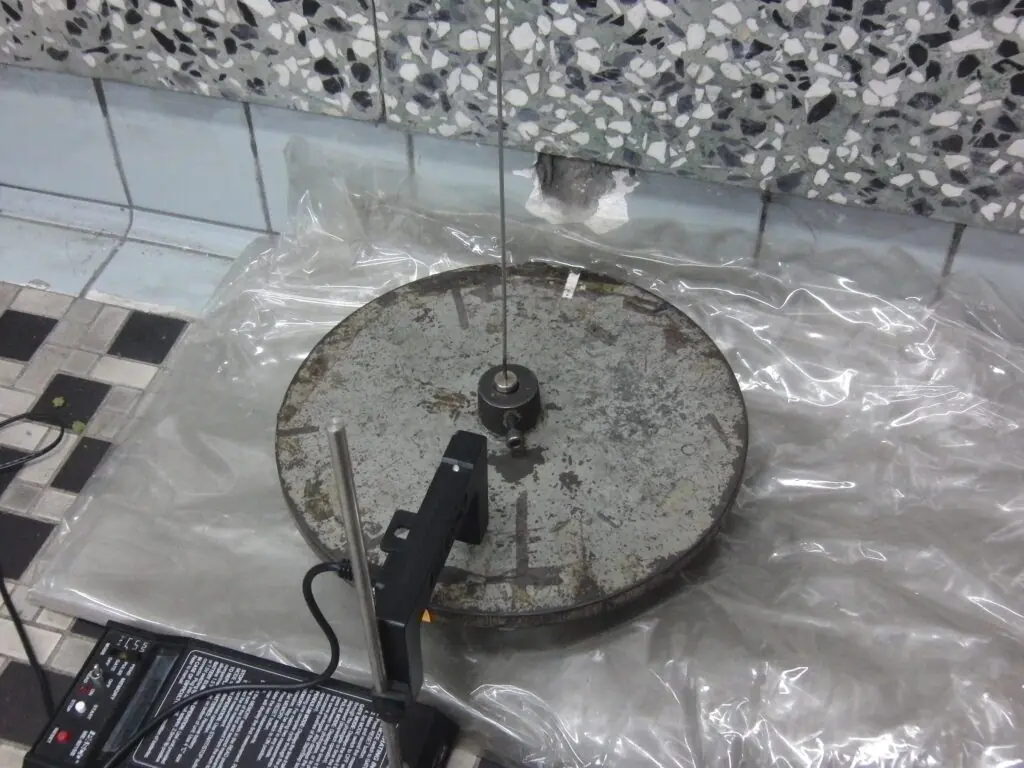
The EmDrive: the whole life of an anomaly, from promise to the Dresden balance
A closed cavity that pushed without expelling anything, a peer-reviewed paper in 2016 and a control experiment that left everything at zero. This is how you close a case properly.
Since 2001 the engineer Roger Shawyer maintained that a closed, truncated-cone microwave resonant cavity produces net thrust without expelling mass. Several groups reported positive measurements, including the Eagleworks laboratory at the Johnson Space Center in a peer-reviewed 2016 paper. Between 2018 and 2021 Martin Tajmar's team at the Technical University of Dresden showed that the signals came from the thermal expansion of the setup and from the interaction of the wiring with the Earth's magnetic field. With those effects controlled, the thrust is zero.
Executive summary of the case file. Everything essential before you dig deeper.
Fact sheet
OSINT - Traceability
Friends, this case file is different from almost all the others in the archive, and that is why I wanted to write it. There are no witnesses contradicting each other here, no documents with cross-outs, no guy who says his grandfather was in New Mexico. Here there is a device, a measurable claim and fifteen years of people measuring it better and better until the matter was closed. It is the story of an anomaly that was born, grew, was reproduced in several laboratories and died of natural causes. Which is how they all should die.
The device is the EmDrive. A closed metal cavity shaped like a truncated cone, with microwaves fed into it. Nothing comes out anywhere: no nozzle, no propellant, no jet. And its promoter, the British engineer Roger Shawyer, has maintained since the early years of this century that the assembly experiences a net thrust toward the wide end.
If that were true, we would not be looking at a better engine. We would be looking at the collapse of the conservation of linear momentum, one of the pillars on which all of physics rests from Newton to the standard model, and not just any empirical law: it follows from the laws of physics being the same here and three meters farther on. Knocking that down would have consequences for absolutely everything.
What can be verified, first
To start with, the claim was never crazy from an experimental point of view: it was a quantitative claim, with a specific setup and an associated number. In this trade, that is gold. It can be built, it can be measured and it can be refuted. Compare it with “I saw a light that accelerated impossibly” and you will understand why I have a soft spot for this case.
The second fact is that the thrusts we are talking about are ridiculously small. We are on the order of micronewtons and, in the best reported cases, some millinewtons per kilowatt of power. To get an idea: a mosquito weighs about twenty micronewtons. Measuring that demands torsion balances, thermal isolation, seismic isolation and a considerable methodological paranoia, because at that scale everything pushes.
And the third, the important one: positive results were published, in respectable places, by competent people. This was never a garage affair. A group at Northwestern Polytechnical University in China reported fairly large thrusts in the late 2000s. And in 2016 the small Eagleworks laboratory at the Johnson Space Center published, in the Journal of Propulsion and Power, vacuum measurements of around one millinewton per kilowatt, peer-reviewed.
That paper was the peak of the wave. For a few months it could properly be said that a peer-reviewed measurement of an anomalous thrust existed. The headlines were what you imagine. And this is where the part worth telling begins, because what came next is exactly what is supposed to happen.
What happened next: how to kill an anomaly properly
What came next was people measuring better. Not people writing opinion columns or arguing on forums: people building finer balances and, above all, designing control experiments. And the decisive work came out of Dresden.
Martin Tajmar’s team at the Technical University of Dresden set up a specific program, which they called SpaceDrive, devoted to testing exotic thrusters with precision instrumentation and with a simple, devastating guiding idea: it is not enough to measure the device’s thrust, you have to measure the device’s thrust when the device should not be pushing.
Their results, published from 2018 and refined in 2021, did indeed find a signal. And then they found where it came from. First: heat. A cavity fed hundreds of watts expands, and expansion shifts the assembly’s center of mass on the balance; that reads as thrust and is not. Second, and more elegant: the wiring. The currents that feed the amplifier run through conductors that sit inside the Earth’s magnetic field, and a current in a magnetic field feels a force. It is the Lorentz force, second-year physics, acting on the power cables.
The definitive test was a beautiful control experiment: detune the cavity, or feed it in a way that it could not resonate, keeping power and cable layout identical. If the thrust came from the cavity, it would have to disappear. It did not disappear. It was the same. That is: the signal did not depend at all on the device whose operation was being tested.
When the Dresden group eliminated and compensated for those effects, the EmDrive’s thrust fell to zero within the measurement error. Not to a small value: to zero. And in parallel, the Chinese group itself that had reported the most striking positive results announced that its initial measurements were affected by experimental interference.
The claim
The British engineer Roger Shawyer maintains that a closed truncated-cone resonant cavity produces net thrust without expelling mass.
Positive results in China
A group at Northwestern Polytechnical University reports considerable thrusts in its own setups.
The peak
The Eagleworks laboratory at the Johnson Space Center publishes in the <em>Journal of Propulsion and Power</em> vacuum measurements on the order of one millinewton per kilowatt, peer-reviewed.
The Chinese correction
Yang Juan's group announces that its earlier measurements were affected by experimental interference.
Dresden closes the case
Martin Tajmar's team (SpaceDrive project) shows that the signal comes from thermal expansion and from the interaction of the wiring with the Earth's magnetic field. With the effects eliminated, the thrust falls to zero.
What it can be, without having to break physics
Heat explains almost everything
At the scale of force where this game is played, a setup that heats up is a setup that moves. Materials expand asymmetrically, supports yield a few microns, the center of mass shifts and the balance records a drift shaped like a thrust: it appears at switch-on, grows and stabilizes. Telling that apart from a real force requires designing the experiment to tell it apart, and most early setups did not.
The cables are not innocent
This one is my favorite, because the irony is perfect. The EmDrive was meant to obtain thrust without interacting with anything external. And it turned out that it did interact with something external: with the planet’s magnetic field, through the power cables. There was a real force, measurable and reproducible. It simply was not the one being sought, and its origin is the same as that of any electric motor.
The experimenter’s suggestion is not needed
It should be said, because it is common to insinuate bad faith when a result collapses. Nothing in this story requires fraud. It requires the usual: insufficiently controlled setups measuring forces at the limit of sensitivity. The Eagleworks people measured what they measured, and published it with their error bars. The problem lay in their list of systematic effects, not in their honesty.
Why this case does not die, and why it should
It stays alive, above all, through informational inertia. The 2016 headline (NASA measures an impossible thrust) circulated infinitely more than the 2021 Dresden result, because the first is a promise and the second is a subtraction. It is the same imbalance that makes the retraction of a scientific paper get read a thousand times less than the paper. There is no conspiracy: there is an economy of attention.
It also stays alive because the promoter has not withdrawn the claim, and in this field a claim that nobody withdraws looks like a living claim. But the burden of proof is not split evenly: whoever maintains that a device violates a conservation law has to show a measurement that survives the controls, not demand that others prove a negative.
And yet this should be the most cited case here at Broken UFO. Because it turned out well. Someone made an extraordinary but testable claim; several laboratories tested it; one of them, with better instrumentation, found the source of the error; and the matter was closed in about fifteen years, without having to believe or disbelieve anyone. That process is precisely what almost everything discussed in the great contemporary cases lacks, where there is no device to take to a laboratory.
The parallel with the Biefeld-Brown effect is almost literal, half a century apart: real force, exotic explanation proposed, decisive control experiment (there removing the air, here detuning the cavity) and mundane explanation confirmed. The devices change; the method does not.
The manual Dresden left behind
The most valuable thing to come out of this case file is the list of controls, more than the verdict. It works for the EmDrive and for any exotic thruster that appears tomorrow, and I dare say it is the most useful contribution of this whole sector in twenty years.
Control one: rotate the device. If the thrust is real and comes from the device, mounting it upside down on the same balance must reverse it. If the signal always points to the same side of the lab regardless of the contraption’s orientation, it does not come from the contraption: it comes from the environment or the setup.
Control two: feed it without resonance. Put in the same power with the cavity detuned, so that the device cannot work according to its own theory. If the signal persists, the case is closed. This was the control that broke the EmDrive’s back.
Control three: separate the heat. Record the temperature of the assembly and the thermal drift of the balance in parallel with the force signal. A real thrust appears with the power and disappears with it; an expansion has a much slower time constant and a characteristic shape of rise and stabilization.
Control four: the wiring. Power it with onboard batteries instead of external cables, or compensate the setup magnetically, or repeat the test with the device oriented in different directions relative to magnetic north. The Lorentz force on the supply currents is so small that almost nobody considers it, and in this measurement range it is enormous.
And control five, the most human: publish the negative result. That the Dresden group devoted years and a top-level instrumentation bench to checking something that almost certainly did not exist, and that it published that it did not exist, is exactly the work that almost nobody funds and that moves the field forward. If there is one thing to learn from this case file, it is that refuting well costs more money and more talent than claiming.
One detail remains that I like to repeat. A better balance killed the EmDrive, not skepticism. Skepticism without instruments is an opinion; with instruments, it is a method.
OSINT – Source traceability
Thrust values are given as orders of magnitude. The exact figure from the Eagleworks paper is not reproduced because its interpretation was superseded by later work and citing it in isolation would be misleading. The Dresden results are described by their methodological content, without attributing a specific title to any communication.