
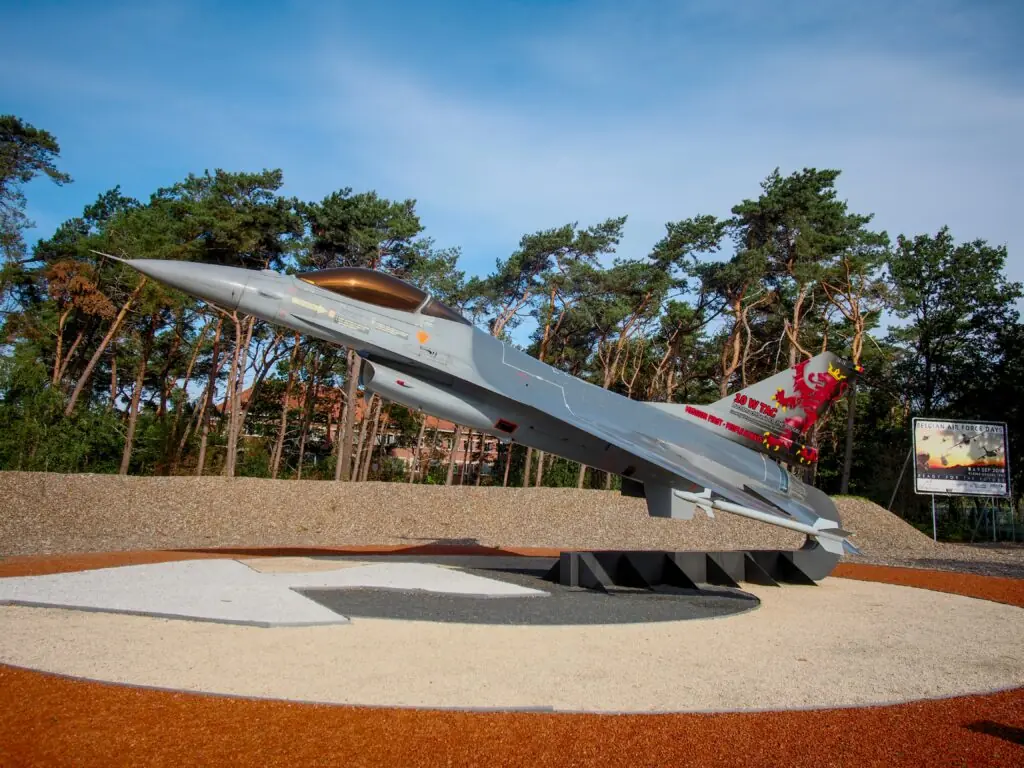
The Belgian Wave: Triangles Over Wallonia, Two F-16s Chasing Echoes, and Europe’s Most Famous Photo, Which Was a Piece of Styrofoam
Between November 1989 and the spring of 1990, Belgium filled up with silent triangles. The Air Force sent fighters, a civilian group collected thousands of reports, and in 2011 the author of the iconic photo confessed he had made it with Styrofoam and three flashlights.
Between November 29, 1989 and the spring of 1990, thousands of people in Belgium reported dark triangular structures with lights at the corners, flying low and silently. The civilian association SOBEPS systematized the collection of testimony and the Belgian Air Force cooperated openly. On the night of March 30 to 31, 1990, after contacts from the Glons and Semmerzake radar stations, two F-16s took off from Beauvechain: nine interception attempts, three radar locks and no visual confirmation by the pilots. The case's iconic photograph, taken in Petit-Rechain in April 1990, turned out to be a fraud confessed by its author in July 2011.
Executive summary of the case file. Everything essential before you dig deeper.
Fact sheet
OSINT - Traceability
Belgium is a country of thirty thousand square kilometers where there is no room to spare: motorways lit from end to end, airports, air corridors, NATO bases, and a population density that means anything crossing the sky will be seen by someone from a kitchen window. By design, it is the worst place in Europe for a mysterious object to go unnoticed.
Between November 29, 1989 and the spring of 1990, thousands of Belgians said they had seen the same thing: a dark, very large, triangular structure with lights at the corners, moving slowly and without noise. And this is where this case separates from the pack: it was not dismissed. The Belgian Air Force spoke to the press, took part in the investigation and even sent up fighters.
It is a story with three layers: a sociological one that is fascinating, a technical one that is debatable, and a confessed fraud that almost nobody in Spain has told properly. Let’s take it piece by piece.
What can be verified, first
- The wave existed as a documented social phenomenon. Thousands of reports were collected, many of them by the civilian association SOBEPS (Société belge d’étude des phénomènes spatiaux), which organized the systematic collection of testimony.
- The Belgian Air Force became openly involved. It neither denied nor ridiculed. It cooperated, appeared in public and provided data. This is unusual institutional behavior and the main reason the case has prestige.
- The F-16s took off. On the night of March 30 to 31, 1990, two fighters left Beauvechain air base after contacts from the Glons and Semmerzake radar stations.
- There were radar locks. Three, over nine interception attempts in more than an hour of flight.
- No pilot saw anything. This fact is crucial and tends to be overlooked: the F-16 pilots never visually confirmed any of the contacts.
- The Petit-Rechain photo is a confessed fraud. Its author admitted it publicly in 2011. We cover it below.
How a wave begins
It begins, as almost always, with people in uniform. On November 29, 1989, two gendarmes on duty in the Eupen area, near the German border, report a large object flying at low altitude, with a flat, triangular silhouette and lights underneath.
That is the perfect trigger: not an amateur, but two officers of the law. Within days the Belgian press puts it on the front page. And from there happens what always happens and nobody wants to look at head-on: the description becomes public and turns into a template. From December 1989 on, what people in Belgium see is no longer “something odd”: it is a triangle. Because the triangle already has a name, a shape and a photograph in the newspaper.
The Belgian researcher Marc Hallet, a skeptic and very uncomfortable for his compatriots, maintained from the start that the wave was a phenomenon of collective psychology amplified by media coverage and by the very way SOBEPS solicited testimony. However hostile the reception of the thesis, it has one virtue: it explains the curve. Waves always have a bell shape and always follow a headline. No wave begins in silence.
Eupen
Two gendarmes on duty report a large triangular structure flying low and silently near the German border. The Belgian press publishes it within days.
The wave erupts
Reports multiply across the country. The description of the triangle with lights at the corners becomes the dominant template.
SOBEPS organizes the collection
The Belgian civilian association systematizes the gathering of testimony and reaches cooperation agreements with the Air Force.
The night of the F-16s
The Glons and Semmerzake radar stations register contacts. Two F-16s take off from Beauvechain. In more than an hour there are nine interception attempts and three radar locks. No pilot visually confirms anything.
The Petit-Rechain photo
A photograph appears of a dark triangle with three lights at the corners and a fourth in the center. It becomes the iconic image of the phenomenon in Europe.
Analysis and publications
SOBEPS publishes its volumes on the wave. The photograph undergoes technical analyses that detect no obvious manipulation.
The confession
Patrick Maréchal explains on the Belgian network RTL that the photograph was a staged fake: a sheet of polystyrene cut into a triangle, painted black, with a flashlight at each corner, hung from a thread.
Assessment
Thirty years after the events, neither the origin of the radar contacts nor the sightings as a whole have a consensus explanation. The photo still circulates as proof.
The night of the F-16s
This is the episode that holds the whole case up, and the one most often told badly. Here is what there is.
On the night of March 30 to 31, 1990, after warnings from the ground, the radar stations at Glons and Semmerzake register unidentified contacts. Two F-16s are ordered to take off from Beauvechain air base. For more than an hour, the fighters make nine interception attempts and obtain three radar locks on targets that, according to the onboard system records, accelerate extremely and descend at speeds no crewed aircraft could withstand.
It sounds impressive. And now the sentence that has to be said out loud: the pilots saw absolutely nothing. Not a light. Nothing. They flew at night over a country lit up like a runway, with the radar calling out targets, and their eyes did not find a single object.
That contradiction is the heart of the case. And the most cited technical explanation is uncomfortable but reasonable: that the locks occurred between the fighters themselves and that other contacts corresponded to Bragg scattering, a known propagation phenomenon in which atmospheric layers return echoes to the radar. This reading has been defended, among others, by the skeptic popularizer Brian Dunning.
The counterargument exists and is honest: locks on one’s own patrol partner are an error that any controller and the pilots themselves can identify, and the Belgian air forces reviewed the data calmly before making it public. That such an error slipped past them three times in one night is possible, but not free.
The anatomy of a wave
I’m going to allow myself a digression, because the Belgian wave is the best laboratory there is for understanding a mechanism that repeats in every country and every decade.
A wave always has the same four-beat anatomy.
- The seed case. A sighting with witnesses of recognized authority: gendarmes, Guardia Civil officers, pilots, controllers. It never starts with a private citizen. It starts with someone society has decided to believe.
- The template. The press publishes a concrete, detailed description. From that moment, the shape exists in everyone’s head. In Belgium it was the triangle; in 1947 in the United States it was the disc; in France in the fifties it was cylinders.
- The curve. Sightings multiply over weeks or months, peak and fall. The curve does not follow the phenomenon: it follows media coverage, with a lag of days. You can lay one graph over the other and it is dizzying.
- The sediment. When the wave recedes, a handful of cases that don’t fit are left behind, along with an iconic image that sums up the whole. Almost always that image turns out to be the most fragile part of the file.
Belgium fulfills the four beats with an almost offensive punctuality. Gendarmes in Eupen. Triangle on the front page. A three-month curve. And a photograph that ended up being, literally, a piece of polystyrene.
That this happens does not mean all the witnesses were wrong. It means that a wave is not a good measuring instrument: once the template is published, it is no longer possible to tell what people see from what people expect to see. And that makes the argument from quantity useless. Ten thousand witnesses with the same template in their heads are worth no more than one; they are worth the same, multiplied by ten thousand.
The photo: let’s say it plainly
If you have seen one image of the Belgian wave, you have seen that one: a black triangle on a dark background, three lights at the corners and a fourth red or orange light in the center. It was taken in April 1990 in Petit-Rechain, near Verviers. It is probably the most reproduced UFO photograph in Europe. It has been on covers, in books, in documentaries, on T-shirts.
For twenty years it withstood technical analyses that found no clear signs of manipulation, which gave it enormous authority. And on July 26, 2011, in an interview for the Belgian network RTL, a man named Patrick Maréchal explained how he had made it.
How the most famous image in European ufology was made
Document · Petit-Rechain photograph, April 1990
Styrofoam, black paint, three flashlights and a thread. Twenty years of analysis and front pages.
The Petit-Rechain photo is the best lesson in method European ufology has given: that an image passes a technical analysis does not mean it is authentic. It only means the analysis did not find the seam.
What it could be (no Martians needed)
- Helicopters. It has been pointed out that the founding sighting at Eupen fits a transport helicopter seen at night and backlit. An aircraft of that type, lit from below and moving slowly, gives a silhouette compatible with a “triangle with lights.”
- Military aircraft in night corridors. Belgium is a NATO corridor. Night aerial refueling, with a tanker and several receivers in formation, produces geometric, silent light configurations at high altitude that baffle anyone.
- Template effect. From December 1989, every Belgian who saw a strange light in the sky already had the triangle mold in their head. This is not dismissing the witnesses: it is how perception works under expectation.
- Bragg scattering and anomalous propagation echoes on the radars, plus possible locks between the fighters themselves.
- Deliberate hoaxes. At least one is confessed and it is the most famous of all. Where there is one, there is almost never only one.
The hypothesis that collapses under its own weight, however widely it circulates, is that of the F-117 or some U.S. stealth prototype. It doesn’t fit: the F-117 was noisy, fast and could not hover in the air, which is precisely what all the witnesses describe. Besides, it had been declassified since 1988. Attributing the wave to a secret aircraft that was no longer secret is a lazy shortcut.
9
night of March 30-31, 1990
0
by the pilots
The problem of silence
There is a feature that appears in practically all the Belgian testimonies and deserves attention of its own: the object made no noise. No engine, no rotor, no whistle. Nothing.
Silence has always been used as an argument for the extraordinary: if something that large flies that low and makes no sound, it cannot be ours. But silence is also the first thing that fails in a night-time testimony. The perception of sound depends on the wind, on the real distance (which almost nobody estimates well at night) and on whether the witness was inside a car, behind a window or with the heating on. A helicopter two kilometers away with a headwind is, for practical purposes, mute.
And there is something sharper: the witness who judges that an object is low and close because it looks enormous is chaining two assumptions. If it was actually high and far, then it is neither that large nor would it have any reason to be heard. Distance is the data point that is lost first and on which everything else depends.
Why this case still matters
For a reason that has nothing to do with triangles: because it is the case where a European air force decided to behave like a public service. It did not deny, did not ridicule, did not classify. It spoke, provided data and cooperated with civilians. That institutional behavior is extremely rare and deserves recognition even if the phenomenon ends up being smoke.
Compare it with what Spain did almost at the same time. Between 1992 and 1999, the Spanish Air Force (Ejército del Aire) opened its files and the result was that almost everything had an explanation. The Belgians did the opposite: they opened up during the phenomenon, in the heat of the moment. And that is why their case, unlike the Spanish one, remains unclosed: investigating in the heat of the moment produces a lot of noise and little conclusion. Investigating in cold blood produces archives and disenchantment.
Both approaches are legitimate. It’s just that one yields headlines and the other yields answers.
Keep pulling the thread
- The Spanish declassification: the opposite approach, with opposite results.
- Tehran 1976: when the pilot does see what he is chasing.
- Manises 1979: interception, radar and an open file.
- Jader Pereira, on how description templates shape what people see.
OSINT – Source traceability
The F-16 episode is v2 as to its existence and v3 as to its interpretation. The testimonial corpus is v4. The Petit-Rechain photograph is expressly marked as an acknowledged fraud. The names of the Eupen gendarmes and the F-16 serial numbers have been omitted because they could not be checked against a primary source.