
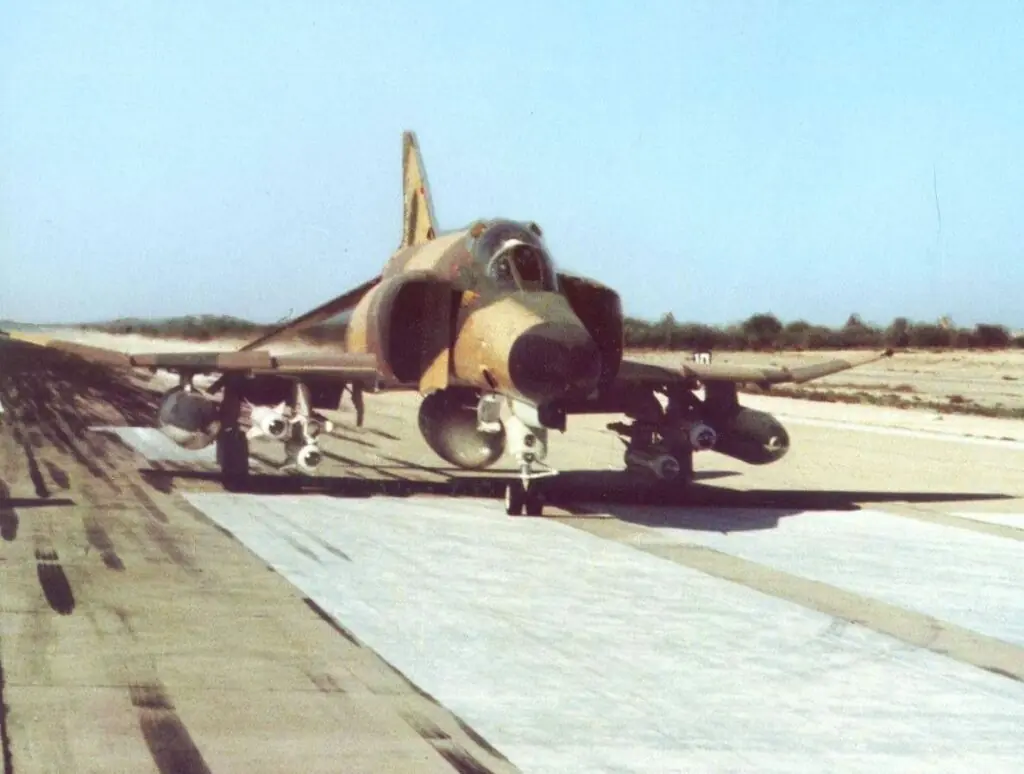
Tehran 1976: Two Iranian F-4s, an Object That Wouldn’t Let Itself Be Caught, and a Report the DIA Sent All Over Washington
In the early hours of September 19, 1976, the Imperial Iranian Air Force sent two fighters after something it could not identify. The paper that came out of it ended up at the White House, the CIA, the NSA and Kissinger's office.
In the early hours of September 19, 1976, after civilian calls to Mehrabad airport, the Imperial Iranian Air Force ordered the interception of a luminous object over Tehran. Two F-4 Phantom IIs took off in succession from Shahrokhi base, in Hamadan, and both reported losses of instrumentation and communications correlated with the approach to the object. The second aircraft, piloted by Major Parviz Jafari, achieved a radar lock and described a weapons system failure as he prepared to fire. A U.S. officer present at the debriefing wrote a report that the DIA evaluated with its maximum rating and that was distributed to the White House, the Department of State, the Joint Chiefs of Staff, the NSA and the CIA.
Executive summary of the case file. Everything essential before you dig deeper.
Fact sheet
OSINT - Traceability
Intelligence Network
Some cases rest on a witness, some rest on a photo, and some rest on nothing, which is most of them. And then there is Tehran, which rests on something far more boring and far more solid: a U.S. military intelligence document with a distribution list.
The distribution list is, for me, the central detail of the whole case file. A paper can be fake. A paper that was sent to the White House, the Secretary of State, the Joint Chiefs of Staff, the NSA and the CIA in 1976 is something else. It means an official decided this deserved to go all the way up. And in the intelligence world, what gets sent up the chain is what someone doesn’t want to be blamed for not sending.
What can be verified, first
- The report exists. A U.S. lieutenant colonel, Olin R. Mooy, assigned to the U.S. military assistance and advisory group in Iran, attended the debriefing session with the Iranian crew and wrote a message summarizing what he heard. That message was distributed to the main agencies of the U.S. government.
- The evaluation exists. In October 1976, an officer of the Defense Intelligence Agency rated the report with the highest score on its internal scale and described it, in practice, as a classic case that meets all the criteria needed for a serious study of the phenomenon. A military intelligence body writing that on an official form is a statistical rarity.
- The flights happened. Two Imperial Iranian Air Force F-4 Phantom IIs took off that early morning from Shahrokhi base, in Hamadan. With their fuel, their flight report and their chain of command.
- The military witnesses exist, identified by name and rank, and accessible for decades. Major Parviz Jafari, who later became a general, repeated his account publicly on several occasions, including an appearance before the international press in Washington in 2007.
That is far more than ninety-nine percent of the world catalog has. Now on to the content, which is where the argument begins.
What is said to have happened
Tehran, early hours of September 19, 1976. The Shah’s Iran is at its moment of peak wealth and peak paranoia: petrodollars, massive purchases of American weapons, SAVAK watching everyone, and a northern border with the Soviet Union that nobody takes their eyes off for a second.
It starts the way they all start: calls from neighbors. Several civilians in the Shemiran district phone Mehrabad airport to report a luminous object over the city. The controller on duty, Hossein Pirouzi, goes out to look. He sees something. And this is what separates this night from the other three hundred and sixty-four: someone with authority decides to escalate.
General Yousefi, of the Imperial Air Force, authorizes the interception. Around one thirty in the morning the first Phantom takes off from Shahrokhi, in Hamadan. According to the report, as it approaches to about 25 nautical miles from the object, the aircraft begins to lose instrumentation and communications. The pilot breaks off the approach. As he moves away, everything works again.
Ten minutes later the second one takes off, with Major Parviz Jafari at the controls and Lieutenant Jalal Damirian as weapons systems officer. Jafari achieves what his colleague did not: a radar lock at about 27 nautical miles, on a return whose size on the screen he compared to that of a Boeing 707. The object keeps its distance with maddening stubbornness: it accelerates when he accelerates.
And then comes the part that made the case famous. According to the account collected in the report, Jafari prepares to fire an AIM-9 missile and the weapons system stops responding, along with part of the communications. He maneuvers away and everything recovers.
A fighter pilot whose weapons system dies just as he is about to squeeze the trigger has two options: report it or don’t. Reporting it means a report, a maintenance review and uncomfortable questions. He reported it.
Calls from Shemiran neighbors
Several civilians alert Mehrabad airport to a luminous object over northern Tehran. The controller on duty goes out to check.
Interception authorized
General Yousefi, of the Imperial Iranian Air Force, orders takeoff from Shahrokhi base, in Hamadan.
First F-4 takes off
Piloted by Lieutenant Yaddi Nazeri. On approaching to about 25 nautical miles, it loses instrumentation and communications. He aborts and everything is restored.
Second F-4 takes off
Major Parviz Jafari, with Lieutenant Jalal Damirian, achieves a radar lock at about 27 nautical miles on a return comparable in size to a Boeing 707.
Weapons system failure
According to the report, as he prepares to launch an AIM-9 the system stops responding. Jafari maneuvers away and the fault subsides.
Descent and alleged landing
The crew descends from 25,000 to 15,000 feet to mark the spot where they believe the object has touched down.
Landing and debriefing session
The crews are debriefed. U.S. Lieutenant Colonel Olin R. Mooy, of the military advisory group, attends.
The message leaves for Washington
Mooy's summary is distributed to the White House, the Department of State, the Joint Chiefs of Staff, the NSA and the CIA.
DIA evaluation
An officer of the Defense Intelligence Agency rates the report with the maximum score for reliability and value and describes it as a classic case suitable for the study of the phenomenon.
Jafari appears in Washington
Now a retired general, he takes part in an international press conference on military UAP cases held at the National Press Club.
The paper, which is what matters
It is worth understanding what kind of document the Tehran report is, because it has often been sold as “a DIA report on a UFO” and that is imprecise.
What exists is a field intelligence report: a U.S. officer present in an allied country listens to what local personnel tell him and passes it on. It is not a U.S. investigation. Nobody from the DIA went to Iran to measure anything. The agency received the account, considered it well constructed and evaluated it as first-rate material. That is all, and it is a lot.
Assessment of the September 19, 1976 episode
Document · Evaluation of the report on the Tehran incident, October 1976
The Iran of 1976, which was no ordinary country
To understand why this case file exists you have to understand where it happened. The Iran of Mohammad Reza Pahlavi was, in 1976, the largest customer for American weapons on the planet. The Shah had turned oil revenue into a showcase air force: F-4 Phantom II fighters, F-5s, and on the way the F-14 Tomcats, which the United States had not sold to anyone else.
That meant two things. First: there were hundreds of American military advisers in the country, embedded in the units, sitting in meeting rooms, taking notes. Lieutenant Colonel Mooy’s presence at a debriefing of Iranian crews was routine, not an anomaly.
Second, and more important: Iran shared a very long border with the Soviet Union. An unidentified object over Tehran in 1976 was read as a possible Soviet reconnaissance incursion, not as a curiosity. That is why takeoff was authorized in the middle of the night, why the aircraft were armed, and why the matter went up the American chain so quickly. Nobody was hunting Martians: they were checking whether the Russians had sent something in from the north.
And there is still a third factor, more human and less cited: fear of ridicule did not exist. In an imperial air force, with the discipline of an absolute monarchy and a foreign adviser in the room, a pilot who reported a malfunction at the moment of firing had many incentives to keep quiet and none to invent. That is, for me, the strongest argument for the sincerity of the account.
Electromagnetic effects, a slippery category
What made Tehran famous is the correlated malfunction, not the light. In the jargon of the trade it is called an EM case, for electromagnetic, and it forms a whole family within the world catalog: cars that stall, radios that go silent, compasses that spin.
This category should be handled with tongs, because it has a basic problem: the failure is attributed to the object because the object was in front of the aircraft. It is an inference, not a measurement. If the same aircraft had lost its instrumentation that night flying toward a cloud bank, the report would say “electrical fault” and we would not be here.
That said, Tehran offers something most EM cases lack: repetition and reversibility. Three different aircraft, the same night, with the same pattern (failure on approach, recovery on moving away). That does not prove causation. But it is exactly the kind of structure that, in any other discipline, would make a researcher want to repeat the experiment.
And it cannot be repeated, of course. The F-4s have been scrapped for half a century, the air force that operated them ceased to exist under that name in 1979, and nobody is going to pull the maintenance logs of those aircraft out of any Tehran archive. It is the most frustrating thing about the case file: we have the perfect report on data that no longer exist.
What it could be (no Martians required)
The most developed criticism of the case is old and comes from the aviation journalist Philip J. Klass, the genre’s professional skeptic for four decades, later backed by the space writer James Oberg. Their reconstruction is this:
- The initial stimulus was Jupiter. At that time of year the planet was very bright and low in the sky from Tehran. It is the classic candidate and explains the neighbors’ calls and the object “that never got closer” well.
- The failures were failures. Klass documented that the first F-4 had a history of electrical problems and had been through maintenance shortly before. In an aircraft of the period, with tube and transistor avionics coexisting badly, an intermittent fault is not a cosmic anomaly: it is a Tuesday.
- Radar in manual mode. A lock on a spurious return, in manual tracking mode and at night, can confuse a tense crew. Especially if the operator expects to find something.
- Meteors. The date coincides with activity from several minor meteor showers. The “objects breaking off” from the main one fit reasonably well.
- Lack of experience. The Iranian crews of 1976 had very little time on the F-4 and its radar. It is a real factor and one frequently omitted by supporters of the case.
Does this close the matter? Not entirely, and for two reasons. First: Jupiter explains an unreachable point of light, but explains much less well that two different aircraft suffered failures correlated with distance to the object and recovered on moving away. Second: the electrical-fault explanation requires two different aircraft to fail the same night, each at the dramatically opportune moment. It is possible. It is also the kind of coincidence that makes one raise an eyebrow.
The honest counterargument to the counterargument: we do not have the technical records. There are no maintenance logs, no radar tapes, no recordings of the frequency. All there is is what some men told hours later in a room, transcribed by a third party who did not speak Persian as a first language and who was taking notes. The whole fifty-year discussion rests on that.
Why this case won’t die
Because it is the perfect example of something this site repeats often: the value of a case is not in what was seen, it is in what was written. Tehran has identifiable military witnesses, an agency report and a distribution list that reaches the top of the most powerful state on the planet. It is OSINT in its purest form: you don’t need to believe anyone, you only need to read the paperwork and see where it circulated.
And because it has an unusual historical ending. Three years after that night, the Shah’s regime fell. The Imperial Air Force ceased to exist as such, its archives were scattered or destroyed, many officers went into exile and others were purged. The country that generated the case disappeared. The only thing that survived intact was the copy a U.S. lieutenant colonel sent by teletype to Washington.
An archivist’s irony: the document that today supports the best military case of the twentieth century exists because one ally was taking notes on what the other was doing. Allies are always taking notes.
5 levels
White House, State, JCS, NSA, CIA
27 NM
according to the crew's account
Keep pulling the thread
- The DIA report on the Tehran case, document profile.
- Manises 1979: the Spanish equivalent, three years later.
- The Belgian wave: when NATO fighters go up at night again.
- Rendlesham Forest: the other case supported by a signed paper.
OSINT – Source traceability
The document is highly verifiable. The observational content is testimonial and is not backed by any surviving instrumental record. The report's reference numbers were deliberately omitted because they could not be checked against a primary source. Added during the cross-check pass: the report was released to the public on August 31, 1977 through a request under the freedom of information law, and its attached evaluation sheet rates the information as confirmed by other sources and its relevance as high. The detail appears in the document profile. The report's internal reference numbers remain omitted because they could not be checked against a primary source.