
There is a widespread confusion that needs clearing up before anything else: this is not a DIA report on a UFO. It is a field report written by a U.S. officer stationed in Iran, which the DIA received, distributed and evaluated. The difference looks like a nuance and is not.
Nobody from the agency went to Tehran. Nobody measured anything. What exists is a secondhand account gathered methodically by a professional and sent through intelligence channels. And even so, it is the best documentary piece in the military canon of the twentieth century. That tells you how low the bar is in this trade.
What it contains
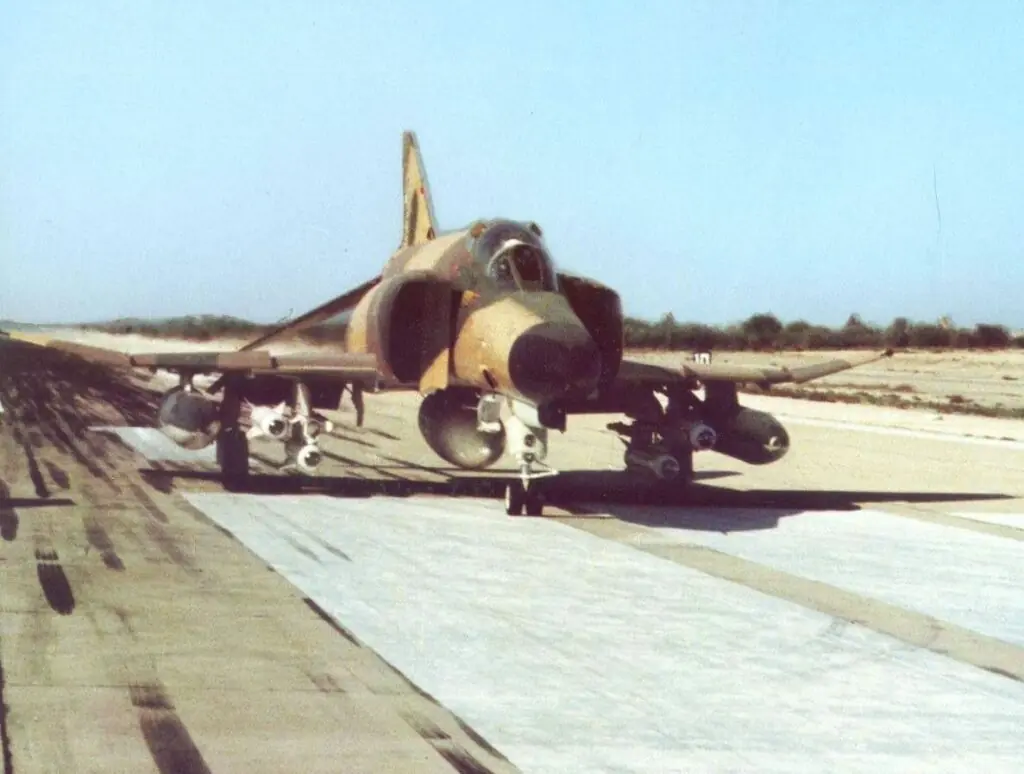
The account of the night of September 19, 1976: civilian calls to Mehrabad airport, authorization to intercept, the successive takeoff of two F-4 Phantom IIs from Shahrokhi base, in Hamadan, losses of instrumentation and communications correlated with the approach to the object, radar lock by the second aircraft and failure of the weapons system at the moment of preparing to fire.
Assessment of the content
Document · Evaluation of the report on the Tehran episode, October 1976
The distribution list, which is the data point
If you take away only one thing from this document, make it the list of who it was sent to. White House. Department of State. Joint Chiefs of Staff. NSA. CIA.
That does not happen by accident. In an intelligence bureaucracy, a report goes up the chain when someone calculates that the cost of not circulating it is greater than the cost of circulating it. Either because the matter may have implications for the defense of a key ally, or because a pilot has reported a weapons system failure in front of an unidentified object a few kilometers from the Soviet border.
The list does not say that anyone believed in spacecraft. It says that someone took it seriously as an operational matter. That is the difference between faith and procedure, and in this trade only the second is publishable.
What this document is not
- It is not an investigation. It is the transcription and transmission of an oral account. Nobody checked the F-4 maintenance logs, nobody recovered radar tapes, nobody repeated the flight.
- It is not an institutional endorsement of any hypothesis. The maximum rating on the scale refers to the quality of the report and the reliability of the source, not to the origin of the object. A flawless report on a sighting of Jupiter would get the same grade.
- It contains no measurements. Not a single preserved instrument data point. All the figures are magnitudes stated verbally by the crews: distances in nautical miles, altitudes, size comparisons.
And why it still matters so much
Because the country that produced the original data ceased to exist three years later. With the 1979 revolution the Imperial Air Force disappeared, its archives were scattered and its officers went into exile or were purged. This U.S. report is, to this day, practically the only thing left in writing about that night.
It is an uncomfortable reminder of how the historical record works: what survives is what was copied, not what happened.
- The full case file on Tehran 1976.
- The Halt memorandum, the other paper of the canon.
- File 791111 on Manises, the Spanish version.
Classification history: from restricted channel to public domain in eleven months
The report was transmitted through intelligence channels as an encrypted message, with the distribution we have already seen and the restrictions that apply to that traffic. What stands out is how briefly it stayed closed.
The document was made public on August 31, 1977, following a request under the freedom of information law. A little over eleven months after the events. By the standards of this trade, that is less a declassification than a revolving door.
Why so fast? Because the material compromised nothing of its own. The report does not describe U.S. capabilities, does not reveal sources or methods and contains no intelligence judgment on an adversary. It describes what some Iranian military men told a U.S. officer. By releasing it, the administration was releasing nothing of its own. And that, if you will allow me, is the real criterion that governs almost every declassification celebrated as a gesture of transparency: what gets opened is what costs nothing.
And now the form that is really worth reading, the evaluation. Because a field report has stapled to it a sheet on which someone at the agency scores what was received, and that sheet is filled in for internal use, without a thought that forty years later a man in Spain would read it.
On that form, the information appears rated as confirmed by other sources and its relevance as high: unique, timely and of great importance. And in the comments section, the evaluator wrote, in translation and by its content, that this was an exceptional report and that the case was a classic that met all the criteria necessary for a valid study of the phenomenon.
The same sheet lists the reasons: observation from different locations by several witnesses, high credibility of the observers (a general, qualified crews, tower controllers), correlation between visual sighting and radar tracking, effects on the systems of three aircraft and maneuverability beyond the ordinary.
An analyst at the Defense Intelligence Agency wrote that this was a classic case. He wrote it on an internal form, in 1976, with no audience in front of him. That is why it counts.
I repeat what was said above, because it is best not to get dizzy over the high grade: that evaluation refers to the quality of the report and the reliability of the source, not to the nature of the object. Nobody at the agency ruled that there was a craft there. What they ruled is that the paper was well made and that the matter deserved study. It is less spectacular and far more useful.
OSINT – Source traceability
The report's internal reference numbers have been deliberately omitted because they could not be checked against a primary source. The text reproduced in the document block is a description of the content of the evaluation, not a verbatim transcription. Added in a cross-checking pass: the date of public release (August 31, 1977, via FOIA) and the content of the attached evaluation sheet, including the source and relevance ratings and the criteria listed by the evaluator. The evaluator's comments are given translated and by their content, not as a verbatim transcription. The omission of the report's internal reference numbers remains in place: they still could not be checked against a primary source.