
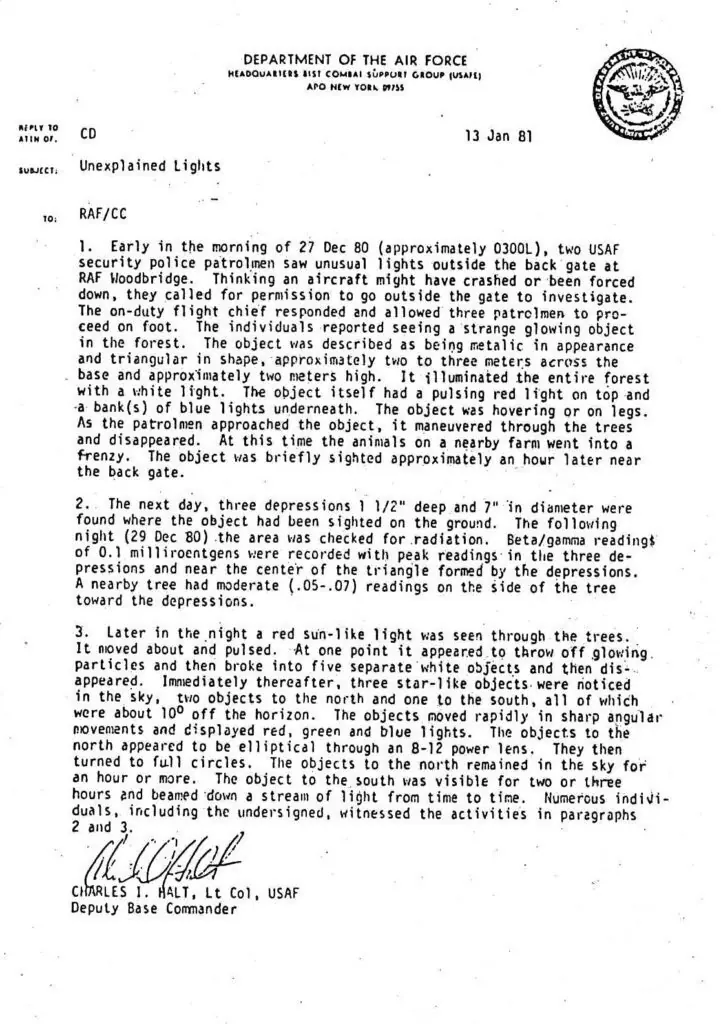

An internal memorandum from the U.S. Air Force is, normally, the least interesting thing in the world. Heading, addressee, subject, numbered paragraphs, signature. They are written by the thousands and nobody reads them except the person who has to file them.
This one has been read by half the planet.
What it says
Three paragraphs. One for each thing that had to be reported.
Our translation from the original English text
Document · 13 Jan 81 — SUBJECT: Unexplained Lights — TO: RAF/CC
The document goes on to describe star-like objects observed to the north and south, a few degrees above the horizon, and beams of light projected from them. That final part is the one that has most fed the myth, and also the one that best fits bright stars low on the horizon twinkling through refraction.
How to read it
Three caveats that change the usual reading quite a bit.
- Paragraph 1 is secondhand. Halt was not there the first night. He is summarizing what the military police told him. Everything spectacular in the document (the triangular object, the legs, the frenzied animals) is someone else’s account, collected by an officer.
- The dates are off by one day. The memo says December 27 and 29. The events are now placed on the 26th and 28th. An offset of that kind in a document written two weeks later is not suspicious: it is human. But it is worth knowing before arguing about chronologies.
- The radiation figures are tiny. Tenths of a milliroentgen per hour, with a nearby tree reading only slightly less. That is in the range of natural background or very close to it, and the instruments used that night were not suited to discriminating at that level. The document does not describe a radiological anomaly: it describes a measurement with no clear meaning.
What it is worth and what it is not
It is worth something as proof that the episode happened and that the chain of command considered it worthy of a formal report to the host country’s ministry. That is a lot. It is also worth something as a record of the sequence and of what was measured.
It is not proof of the nature of what was observed. A memorandum establishes what its signer wrote, not what was in the forest. And its own author, thirty years later, added an interpretation of the origin of the phenomenon that the 1981 text does not remotely contain: we cover it in his testimony.
Why it ended up with the British ministry
A detail that is usually taken for granted and deserves an explanation: why would a U.S. lieutenant colonel write to the United Kingdom’s Ministry of Defence?
Because RAF Bentwaters and RAF Woodbridge were, formally, British bases made available for U.S. use. That is the legal fiction that underpinned the entire U.S. military presence in the United Kingdom during the Cold War: the installation belongs to the RAF, the occupant is the USAF. So any incident occurring on the perimeter or in its vicinity had to be reported to the host.
Halt was not filing a complaint or seeking explanations. He was meeting an obligation of institutional courtesy between allies. That routine character is, paradoxically, what gives it the most weight: nobody writes a liaison report to build a myth.
It also explains the brevity. One sheet is exactly what is devoted to a matter considered closed and without operational consequences. Had Halt believed it was a security incident, the document would have been a different one, would have gone through a different channel and would carry a stamp.
- The Rendlesham Forest case file.
- Charles I. Halt, the signer.
- The DIA report on Tehran, the other paper that holds up an entire case.
OSINT – Source traceability
The text reproduced is a free translation into Spanish from the English original, widely circulated in facsimile since the 1980s. It has been expressly noted that the first paragraph relays the account of third parties and that the dates in the document are one day off from the accepted chronology.