
A career military officer is, among other things, someone trained to avoid drawing attention to himself in writing. Reports are written flat. Opinions are left out. And the strange, if it is too strange, tends not to get written down.
That is why the case of Charles Irwin Halt is interesting long before it gets to UFOs: he is the portrait of an officer who, in January 1981, decided that this had to be put on paper even if it made him look like a crank. And then, with the uniform already hung up, he decided that he also had to say what he believed it was. The first gave him a place in history. The second complicated it.
A normal officer in a normal posting
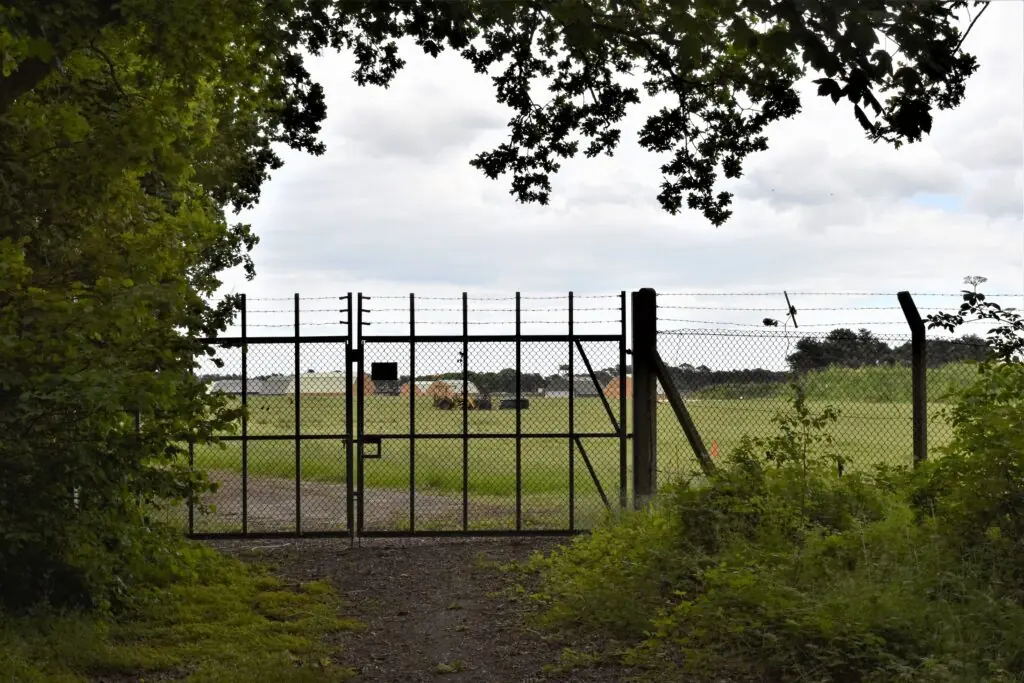
Born in 1939, Halt had the career that thousands of officers of his generation had: Vietnam, Japan, Korea, and then a European posting. In 1980 he was in Suffolk as deputy base commander of the twin complex of RAF Bentwaters and RAF Woodbridge, two installations operated by the U.S. Air Force on British soil that housed tactical nuclear weapons.
Being the number two at a base like that is not a ceremonial post. He is the man who makes sure everything works while the commander plays politics. Budget, discipline, security, incidents. He is exactly the kind of man who does not want an inexplicable episode on his perimeter right at Christmas.
The night he went into the forest
In the early hours of December 26, 1980, a military police patrol left the Woodbridge perimeter after lights that were descending over Rendlesham Forest. Halt was not there on that first night. He was there on the second, the night of the 28th, and he went by his own choice.
He went in with a team, a counter to measure radiation, an arc lamp that broke down on them and a microcassette recorder in his pocket. That last detail is what makes him a character and not just one more witness: it occurred to him to document things as they happened. The resulting recording is the most honest record of the case.
Very few people, in the middle of a scare, have the reflex to switch on a recording device. That reflex says more about Halt than any later statement.
The memorandum
On January 13, 1981 he signed a one-page memo titled Unexplained Lights, addressed to the British Ministry of Defence. It had three numbered paragraphs of administrative prose and no adjectives.
And here is the detail that changed everything: he did not put a classification stamp on it. Not confidential, not restricted, nothing. An unclassified document is a document that can be requested. In the early 1980s someone requested it, and from there it jumped to the British press and into myth. We cover it in detail in the memorandum’s file.
It has never been clear whether that lack of classification was an oversight, a deliberate decision, or simply the reasonable judgment of an officer who did not consider the matter a security issue. Over the years he has given to understand that it was the second. I lean toward the third, which is the most boring and therefore the most likely.
1991: he retires and starts talking
Halt left active service in 1991 with the rank of colonel. And only then did he appear publicly, first on television, confirming the authenticity of the memorandum and the recording.
For almost two decades he was the ideal witness of the genre: high rank, dry tone, no books to sell, no embellishments. When someone said “this is just a few fantasists,” the answer was Halt. A retired colonel of the U.S. Air Force saying that that night there was something he could not identify. Period. Nothing more. And that “nothing more” was his strength.
June 2010: the sentence that cost him dearly
In June 2010, Halt signed a sworn affidavit in which he summarized the events and added a conclusion: that the objects he saw up close were of extraterrestrial origin.
It earned him headlines around the world. And it took from him, for many analysts, exactly what made him valuable. A witness who describes what he saw is a source. A witness who interprets what he saw becomes an interested party, even if his interpretation was sincere. It is a change in evidentiary status, not a moral judgment.
What remains
The paper remains. The tape remains. And so does a figure who, much to everyone’s annoyance, is useful to both positions: proponents cite him for his rank, skeptics cite him because his own recording contains the coincidence of the five-second flash with the Orford Ness lighthouse.
A witness who serves both sides is usually an honest witness. The ones who serve only one are the ones to look at under a magnifying glass.
- Rendlesham Forest 1980, the full case file.
- The Unexplained Lights memorandum.
- His documented testimony.