
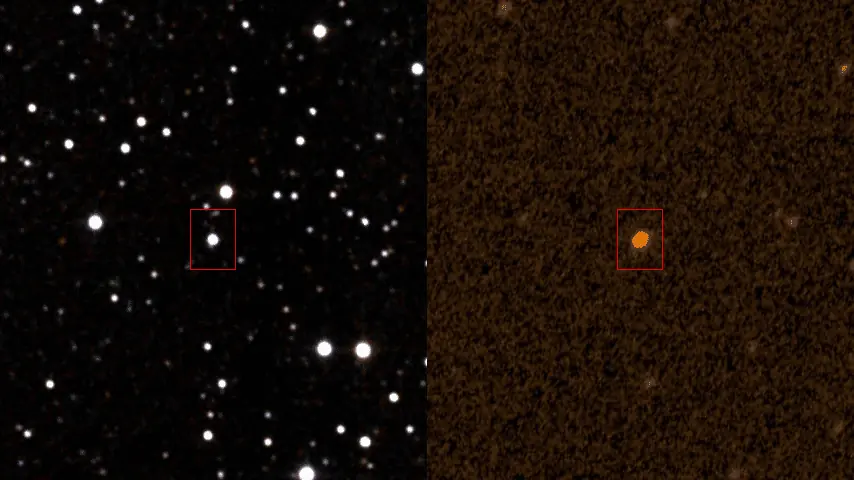
KIC 8462852: the star that was supposed to have a megastructure
Brightness dips of 22%, irregular and unexplained. An astronomer mentioned the word megastructure with every caution, and the world kept the headline. The color of the shadow settled it.
KIC 8462852 is a star in the Kepler field that shows brightness dips of up to nearly 22%, irregular and without periodicity, detected by volunteers of the Planet Hunters project and published by Tabetha Boyajian and her team in 2016. The absence of a satisfactory explanation led to the hypothesis of a megastructure being raised as a last resort. Radio and optical listening gave negative results, and the 2017 observations showed that the dimming is chromatic, which requires dust and excludes a solid object. The origin of that dust is still under discussion.
Executive summary of the case file. Everything essential before you dig deeper.
Fact sheet
OSINT - Traceability
In October 2015 the whole world decided for a week that some very diligent engineers were building a public works project around a star in Cygnus. The curious part, and the reason this case file is here, is that the nonsense did not come from a late-night radio show: it came from a sound scientific paper, from a hypothesis put forward with every caution by a serious astronomer, and from a headline that swallowed the cautions in one bite.
The star is called KIC 8462852, and today it is known by the surname of the person who signed the study, Tabetha Boyajian. It lies about fifteen hundred light-years away, is somewhat hotter and larger than the Sun, and has absolutely nothing remarkable about it except one thing: it dims at times, a lot, irregularly and with no pattern that fits a planet.
What follows is the story of how the megastructure hypothesis was raised, who raised it, on what conditions, how it was tested and what killed it. Because it was killed, and killed well: with a data point that admits no argument and that was obtained, what is more, with money raised on the internet.
What can be verified, first
The Kepler space telescope spent four years staring at a single patch of sky between the constellations of Cygnus and Lyra, measuring the brightness of more than a hundred thousand stars with a precision that had not existed before. Its goal was to detect transits: the tiny drop in light produced when a planet passes in front of its star. A typical planetary transit lowers brightness by a fraction of one percent, lasts hours and (this is the important part) repeats with the regularity of a station clock.
KIC 8462852 looked nothing like that. The dips were very deep, up to nearly twenty-two percent; they lasted days; they had asymmetric, ugly shapes, with steps and shoulders; and they did not repeat with any period. A planet cannot do that: to block twenty-two percent of a star’s disk you would need dimensions no planet has. And even if it had them, it would pass again every so many days, always the same.
People spotted the oddity, not an algorithm. Kepler generated so many light curves that a team at Yale University set up Planet Hunters inside the Zooniverse platform, using the data NASA published openly, a citizen science project where anyone could review graphs by eye. For years, volunteers flagged that star as weird and puzzling on the project’s forums, until the science team started looking at it seriously. I love that detail: the most talked-about object in recent astronomy was found by bored people on a Sunday afternoon.
The paper came out in 2016 in Monthly Notices of the Royal Astronomical Society, signed by Tabetha Boyajian and a long team, and its title carried an unusual expression for a journal of that level: where’s the flux?, which roughly means “where has the light gone?” The body of the text is an exercise in elimination: it goes through the possible explanations one by one (instrumental defect, intrinsic variability of the star, young dust disk, recent planetary collision, passage of an interstellar cloud) and discards them or leaves them lame. The one that fit least badly was the passage of a swarm of cometary fragments.
A paper titled “where’s the flux?” is a paper written by honest people. Those who already know the answer pick another title.
Kepler observes the Cygnus field
One hundred thousand stars measured with unprecedented precision. KIC 8462852 among them.
Planet Hunters volunteers flag the star
They flag it as weird and puzzling on the project’s forums.
Boyajian et al. publish “Where's the flux?”
Dips of up to 22%, irregular and without a period. No explanation fits fully.
Jason Wright raises the megastructure hypothesis
As a last resort and with every caution. The press keeps the headline.
Allen Telescope Array listening and optical SETI
No artificial emission appears.
Crowdfunding campaign
More than seventeen hundred people fund continuous monitoring from the Las Cumbres network.
New dips: Elsie, Celeste, Skara Brae, Angkor
For the first time they are observed live and in several colors at once.
Boyajian et al. publish the results
The dimming depends on color: the occulter is dust, not a solid object.
What is said to have happened
The extraterrestrial hypothesis was put on the table by Jason Wright, an astronomer at Penn State, who had been working for some time on how large-scale technosignatures might be searched for. The underlying idea comes from Freeman Dyson, who in 1960 proposed that an energy-hungry civilization might end up surrounding its star with collectors, and that such a structure would be detectable by the excess infrared it would emit as it heated up. Wright said something far more modest than what was attributed to him: that the light curves of that star were strange enough to be worth pointing an antenna at it, and that the technological hypothesis was the last on the list, not the first.
The nuance lasted exactly as long as it takes a headline to go around the world. Within days the star was “the alien star,” there were illustrations of rings of solar panels in every newspaper, and people were talking about a Dyson sphere under construction. It is the usual mechanism: the press does not lie, it removes subordinate clauses. And a last-resort hypothesis, without its conditional, becomes an announcement.
In the community’s favor, it must be said that it reacted as it should. Instead of arguing it out on talk shows, they pointed instruments. The Allen Telescope Array listened to the star in radio for weeks looking for narrowband emissions and found nothing above the noise. An optical search for laser pulses was also made, with the same result. And the infrared was checked: if a huge structure were absorbing light, it would have to be radiating that heat somewhere. Nothing of the kind appeared.
And here it is worth explaining where Dyson’s idea comes from, because it is almost always told as science fiction and it is not. In 1960, in a two-page paper in Science, Freeman Dyson set out a purely thermodynamic argument: if a civilization grows in energy consumption for long enough, it will end up wanting to use an appreciable fraction of its star’s light, and that will require collecting surface in orbit. His proposal was not to build a solid ball (that caricature came later) but to look for the inevitable residue of any machine: the waste heat, which would be emitted in the infrared. Dyson was not proposing a fantasy, he was proposing a search criterion.
What it may be, with no need for Martians
Here there is a good answer and a question that remains open, and it is best not to mix them.
The data point that settled the megastructure question
The key is color. A solid, opaque object (a plate, a panel, a sheet of whatever) blocks light equally at all wavelengths: if you stand in front of a light bulb, the bulb dims the same in blue as in red. Fine dust does not: it preferentially scatters blue light and lets red pass more easily, which is exactly why sunsets are red. In 2017, when a dip could finally be observed live and in several filters at once, the dimming turned out to be clearly chromatic: much deeper in the blue than in the near infrared. Translated: what is in front of the star is dust, not a solid object.
Where that dust comes from (this is still open)
The live hypotheses involve material shed by a disintegrating body: a family of giant comets on eccentric orbits, the remains of a moon torn from its planet, or the debris of a relatively recent collision. Each explains some things well and others poorly, above all the timing of the dips. It is a complicated problem of planetary dynamics and it is not solved. But it is a problem of the kind “we don’t know which body is falling apart,” not of the kind “we don’t know what sort of phenomenon this is.”
And the century-long dimming
One loose end remains. In 2016 it was argued, from digitized historical photographic plates, that the star had been slowly dimming for a century. Other teams replied that this archive has calibration problems that can produce false trends. Kepler’s own data showed a gradual decline over the four years of the mission, so something underlying seems to be there. It is the kind of technical discussion that never reaches the newspaper and that really decides things.
It is worth stressing what it cost to get to that measurement, because it was not automatic. Kepler stopped observing that field in 2013, so the known dips were all archival: past, frozen, impossible to study in real time. To catch one live you had to watch the star every night for months without knowing whether anything would happen, and that is precisely the kind of telescope time no committee grants. Hence the crowdfunding campaign. In May 2017 the dip finally came, they christened it Elsie, and Celeste, Skara Brae and Angkor followed: only the last two are named after archaeological sites. Then, and only then, could the shadow be examined in several colors at once.
Why this case won’t die
Because it is the cleanest example in the whole archive of an extraordinary hypothesis formulated, funded, measured and ruled out in three years. No secret committees, no denialism and nobody angry. The community did not laugh at Wright: it bought the idea just enough to go and check it, which is the only respectful way to treat a strange hypothesis. Compare it with the treatment other proposals in this sector receive, including some from the Galileo Project, and you will see why procedure matters as much as the idea.
Because the funding also tells a story by itself. The continuous monitoring that ended up giving the answer was paid for by a crowdfunding campaign in which more than seventeen hundred people took part. There was no agency, no black program and no military budget: there were people putting in twenty dollars so that a robotic telescope would look at a star every night. In the sector this archive works in, where everything is explained by dark money, it is worth remembering how this was resolved.
And because it leaves the criterion in your hands. The next time an astronomical anomaly appears and someone utters the word megastructure, the question is no longer whether it is possible: it is whether the dimming depends on color, whether there is infrared excess and whether anyone has listened. Three concrete questions, with measurable answers. That is what this case has given the trade, and it is more than most case files on the search for technosignatures leave behind.
Because it also forces us to look in the mirror. This archive deals with cases where the conventional explanation almost never arrives, and here it arrived in three years. The difference lies in the object, which was still there, let itself be looked at again and could be measured with different instruments, rather than in the intelligence of the researchers. A UFO from 1957 cannot be reobserved; a star can. When someone asks why science solves some mysteries and not others, the answer usually lies in whether the phenomenon has the decency to repeat itself.
A star that dims at times, a headline that swallowed the conditionals, and a robotic telescope paid for with donations that ended up giving the answer by looking at the color of the shadow. There are no engineers up there; there is something crumbling. Which is not bad either.
OSINT – Source traceability
The depths of the dips are given approximately because they depend on the processing of the light curve. The debate over secular dimming based on historical plates is presented as open, not as established fact.