
SETI: more than six decades listening to a sky that doesn’t answer
Since 1959 a serious scientific program has been searching for artificial radio signals from beyond Earth. Zero confirmed detections. Here is what has been done, with what money, and why the silence doesn't mean what it seems to.
SETI is the search program for artificial radio signals of extraterrestrial origin that began with the Cocconi and Morrison paper in Nature (1959) and Frank Drake's Ozma campaign (1960). It ran on U.S. public funding until the congressional cancellation of the HRMS in 1993 and on private funding since. It has produced no confirmed detection. Its documentary value lies in the method: every candidate has been re-observed and either explained or filed.
Executive summary of the case file. Everything essential before you dig deeper.
Fact sheet
OSINT - Traceability
I’ll start with the ending, which is the honest thing to do: in more than six decades of systematic radio listening to the sky, nobody has confirmed a single signal of technological origin from beyond Earth. Not one. What exists is a huge archive of candidates that fell apart when examined, a handful of anomalies that never repeated, and a scientific infrastructure that has survived the withdrawal of public funds, parliamentary mockery and discredit by association with newsstand ufology. That is the result. And that result, friends, is a data point.
I say it is a data point because in this house we take seriously the difference between “there is no evidence” and “nobody has looked.” With UFOs that distinction is usually a trap: the search is poor, the filing is worse, and then someone draws a conclusion. Not with SETI. Here there are public budgets, parliamentary records, peer-reviewed papers, antennas with names and coordinates, and a documented chain of decisions going back to 1959. It can be audited. It is, probably, the only search program for non-human intelligence that withstands a real audit.
What follows is that audit: what was searched for, with which instruments, with what money, who signed the papers and what was found. And also, because otherwise this would be a brochure, how ridiculously small a fraction of the problem has actually been covered.
What can be verified, first
The starting point is a two-page paper in Nature. In September 1959, Giuseppe Cocconi and Philip Morrison, both at Cornell University, published “Searching for Interstellar Communications.” Their argument was much more modest and much more useful than that someone was out there: if someone were, and wanted to be noticed, the 1420-megahertz band, the emission frequency of neutral hydrogen, the most abundant substance in the universe and the first one any radio astronomer learns to look at, is the obvious place to call. Their closing line has been quoted a thousand times and remains the best defense of the program: the probability of success is difficult to estimate, but if we never search, it is zero.
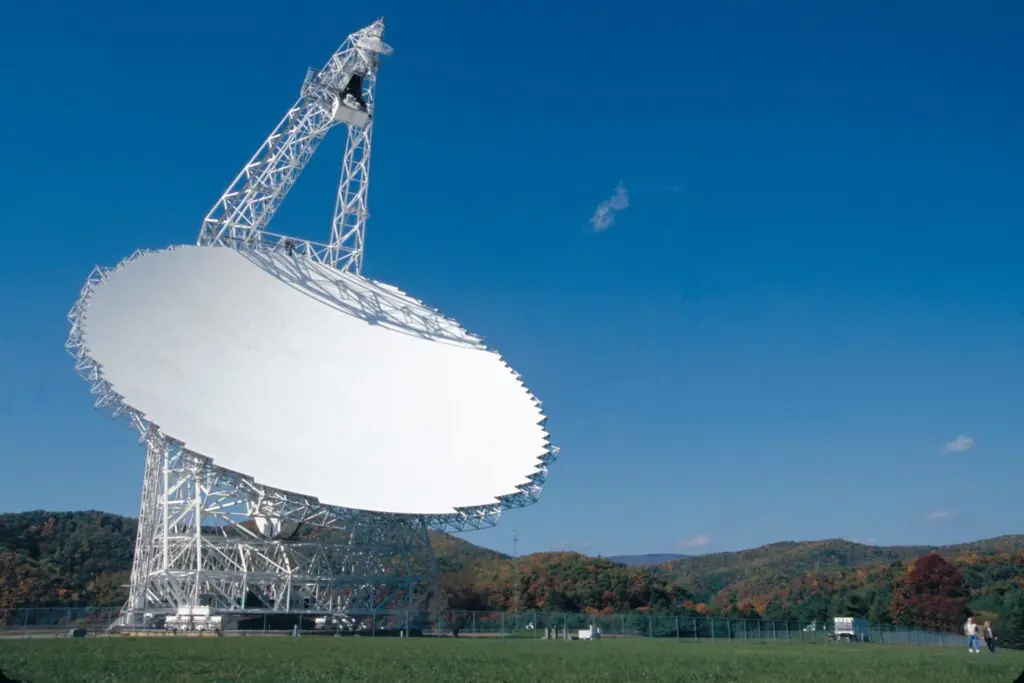
Frank Drake, who was then working at the Green Bank observatory in West Virginia, was already preparing exactly that without knowing about the paper. In the spring of 1960 he pointed the 26-meter Tatel radio telescope at two relatively nearby Sun-like stars, Tau Ceti and Epsilon Eridani, and listened in the hydrogen band. He called it Project Ozma. It lasted a few months, found nothing and had its inaugural false alarm: a strong, clean, perfectly terrestrial signal from a military experiment. The whole later history of this discipline fits in that anecdote.
The following year, in November 1961, Drake gathered about ten people at Green Bank to put the problem in order. Out of that meeting came the equation that bears his name, which is not a formula for calculating civilizations but an index of our ignorance with the boxes properly laid out. We gave it its own case file, because it deserves one: the Drake equation and the Fermi paradox.
In the 1970s the subject had its institutional moment. NASA funded the Project Cyclops report, led by Barney Oliver from the Ames center, which designed on paper a forest of a thousand antennas and calculated what it would cost. Not one was built. In November 1974, Drake and Carl Sagan used the Arecibo radio telescope to transmit a three-minute message toward the globular cluster M13, more as a demonstration of capability than as a serious attempt at conversation: the reply, if there were one, would take tens of thousands of years. And in August 1977, the Big Ear radio telescope of Ohio State University recorded the most cited anomaly in the field, the Wow! signal, which was never heard again.
The budgetary moment of truth came in October 1992, when NASA launched the High Resolution Microwave Survey: a targeted search aimed at specific stars from Arecibo and a general sky survey from Goldstone. Twelve months later, in the fall of 1993, the U.S. Congress withdrew its funding. The senator who led the amendment, Richard Bryan of Nevada, presented it as a saving for the taxpayer and made the obligatory joke about little green men. It was the end of U.S. public SETI and the beginning of everything else.
Cocconi and Morrison publish in Nature
They propose 1420 MHz as the listening band. Two pages that found a discipline.
Project Ozma
Frank Drake points the Green Bank Tatel at Tau Ceti and Epsilon Eridani. Negative result and a military false alarm.
Green Bank Conference
The Drake equation is born as the meeting's working agenda.
Project Cyclops report
NASA designs a dedicated array of a thousand antennas. It is not built.
Arecibo message
Three minutes transmitted toward M13. Technical demonstration, not conversation.
Wow! signal
Big Ear records the most cited unrepeatable anomaly in the field.
SETI Institute founded
The search gets a permanent civilian structure.
NASA's HRMS begins
Targeted search from Arecibo and sky survey from Goldstone.
Congress cancels the HRMS
Thirteen months of life. Public money ends and private money begins.
Project Phoenix
The SETI Institute continues the targeted search with private funds.
SETI@home
Millions of home computers analyze Arecibo data.
First light of the Allen Telescope Array
42 antennas of the 350 planned.
Breakthrough Listen
Yuri Milner announces one hundred million dollars over ten years and open data.
Collapse of the Arecibo radio telescope
The instrument that did a good part of the work is lost.
What has been done since the public money ran out
The interesting thing is that the 1993 cancellation did not kill the program: it privatized it. The SETI Institute, founded in 1984 in Mountain View, took over the targeted-search portion and relaunched it in 1995 as Project Phoenix, with Jill Tarter at the helm and money from foundations and from personal fortunes in the valley. Phoenix spent almost a decade listening to a catalog of nearby Sun-like stars, with time rented at Arecibo, Green Bank and Parkes. Result: nothing. And the administrative detail is worth stressing: the science did not change, what changed was who paid the electricity bill.
In 1999 came the idea that turned this into popular culture. SETI@home, set up at Berkeley by David Anderson and Dan Werthimer, handed out chunks of Arecibo data to home computers that analyzed them while their owners slept. It was the most popular distributed-computing project of its time, gave rise to the BOINC platform that half of science uses today, and ran until March 2020, when the team stopped distributing work to analyze what had accumulated. It produced candidates. None survived re-observation; we devoted a separate case file to the most famous one.
The next leap was in hardware. The Allen Telescope Array, in northern California, was designed as the first large radio telescope conceived from the start to carry out this search alongside conventional radio astronomy. It was to be 350 small antennas working as one; Paul Allen’s money paid for 42, which entered service in 2007. In 2011 the observatory was idle for a few months for lack of operating funds. It is the history of the field in miniature: the problem has never been the idea, it has been the payroll.
And in July 2015 real money appeared. The investor Yuri Milner announced in London, with Stephen Hawking sitting beside him, one hundred million dollars over ten years for Breakthrough Listen: time bought at Green Bank, at Parkes and on the Automated Planet Finder optical telescope, with a commitment to publish the data openly. That commitment matters more than it seems, because it means anyone can reanalyze and refute. Out of it came the best-documented candidate of recent history and also its debunking, BLC1.
Nervousness is measured in budgets. Sixty years searching for intelligence out there, and the recurring obstacle has always been convincing a committee in here.
Why we haven’t heard anything (no Martians required)
Here it is worth toning down the epic register and running some rough numbers. A negative result only means something if you know how much you have looked at, and in this case we have looked at far less than the press suggests every time it headlines that we remain alone.
The search space is absurdly large
Detecting a signal requires getting five things right at once: the direction in the sky, the frequency, the bandwidth, the polarization and the moment. Missing any one of them is equivalent to not having searched. The comparisons that circulate (the glass of water taken from the ocean) are rhetorical, but the order of magnitude of the problem is real and has been calculated in the technical literature. The honest conclusion is uncomfortable for both camps: the silence observed to date is perfectly compatible with a sky full of emitters we have never pointed at.
We listen for what we know how to listen for
The whole classic strategy assumes a narrowband, powerful, deliberate signal, because that is the only thing we know how to distinguish with certainty from a natural phenomenon. Nature does not produce pure tones; transmitters do. The problem is that we ourselves have stopped transmitting that way: high-power analog television was switched off, and modern communications use spread spectrum and look more and more like background noise. If another civilization has followed the same technical path, its detectable era will have lasted barely a century. A blink.
Money and telescope time
All told, the historical investment in this search is a minuscule fraction of what a single medium-sized planetary mission costs. For decades the work was done on borrowed time, in gaps in the schedule or in parasitic mode, analyzing the signal others receive while observing something else. That shapes what gets looked at and, above all, how many times it can be looked at again, which is precisely the requirement for confirming anything. Without re-observation there is no detection: there is anecdote.
Interference contaminates everything
Our own noise is the main enemy. Every promising candidate in history has died of the same cause: it was terrestrial. A radar, a satellite, a local oscillator, a microwave oven in the observatory kitchen. The microwave is not a joke: it happened at Parkes and we devoted an entire case file to it, because it is the best lesson in method radio astronomy has given in twenty years.
Why this case doesn’t die
Because it is the counterexample. When someone says official science refuses to investigate the possibility of non-human intelligence, the answer is here: it has been investigating it since 1959, with names, surnames, papers and a budget. What science refuses to do is accept an unrepeatable anomaly as good evidence, which is a very different thing and considerably more reasonable.
Because it has also built the standard of proof that we apply to everything else in this house. The Rio scale, proposed in 2001 by Iván Almár and Jill Tarter and revised since, is used to score the significance of a supposed finding before the press release goes out. The post-detection protocol of the International Academy of Astronautics, from 1989, says what to do if it ever happens: verify independently, notify the scientific community and not reply on anyone’s behalf. Compare that with the UFO sector’s habit of calling the press conference first and analyzing afterward, if at all.
And because the field is mutating in front of us. The search for technosignatures has widened from radio to optical, to infrared excesses, to industrial pollutants in exoplanet atmospheres and to stellar brightness anomalies, which is where the circus of Tabby’s star came from. It has even returned to the territory of interstellar objects with Project Galileo, with more media noise than results to date.
Sixty-five years of antennas pointed at the void, and the entire harvest fits in a folder of dead candidates. To me that does not look like a failure: it looks like the only search of this family that has known how to say it found nothing.
OSINT – Source traceability
Figures for hours of observation and stars covered have been deliberately avoided: mutually incompatible versions circulate in secondary sources. They are described qualitatively, as in the GEPAN Technical Note 16 file.