
SHGb02+14a: the SETI@home candidate that was noise with good press
In 2004 it was “the mystery signal” from the largest listening network on the planet. Its own team explained from day one why it was noise. It still turns up on lists of unsolved enigmas.
SHGb02+14a was a SETI@home project candidate detected three times in Arecibo radio telescope data, the last during the March 2003 reobservation campaign. Publicized by New Scientist in September 2004 as a mystery signal, it showed intensity at the edge of the noise and an excessive frequency drift that also reset at each detection, and it came from a region with no known stars within a thousand light-years. The project's own team attributed it to noise. It was never redetected or the subject of a scientific publication.
Executive summary of the case file. Everything essential before you dig deeper.
Fact sheet
OSINT - Traceability
In September 2004, New Scientist reported that the most popular listening project in history had a mysterious signal on its hands, coming from a point in the sky where there is no known star. The candidate’s name was unpronounceable, SHGb02+14a, and that, oddly, helped: it sounded like a case file number, like something serious, like something that had come out of a machine.
For a few weeks it was the signal of the moment. And yet, if you read what the project’s own leaders were saying at the time, you find the rebuttal published almost simultaneously with the news. There was no need to wait years or mount a reobservation campaign: the team that had found it explained from day one why it was almost certainly noise.
That is exactly why I am bringing the case to this archive. The signal amounted to nothing, but the case is the perfect example of how a third-division candidate becomes world news, and of why, when you work with millions of detections, coincidences stop being coincidences and become well-known statistics.
What can be verified, first
To understand the case you have to understand the machine. SETI@home, launched at Berkeley in 1999, did not control any telescope: it piggybacked on the signal the Arecibo radio telescope collected while it did other things, sliced it into packets and distributed them over the internet to volunteers. Millions of home computers analyzed those slices looking for narrowband tones and sent back the results. It was a colossal success in participation and, along the way, the largest factory of false positives ever built.
I say factory without any malice: it is arithmetic. When you examine billions of combinations of frequency, time and direction looking for something that stands out from the noise, you find things that stand out from the noise. Nothing needs to be there: noise, if you look at it enough times, produces peaks through pure fluctuation. In particle physics this is called the look-elsewhere effect, and it is corrected with well-established statistical methods. In press coverage nothing is corrected.
The project knew this and so it did the right thing: it accumulated candidates and from time to time negotiated real telescope time to look again at the best ones. In March 2003 there was one of those campaigns at Arecibo. It established that SHGb02+14a had appeared three times in total, which is what gave it the status of a candidate with a name of its own.
And that is where the good news ends, because each of its properties, looked at closely, is a problem.
One detail of how it worked changes how everything else reads. Working in parasitic mode meant the project did not choose where to point: it listened to whatever was in front of it while the telescope served the programs that did have allotted time. Arecibo, moreover, was not steerable in the usual sense; the dish was fixed in a sinkhole and what moved was the receiver suspended above it, so the sky drifted overhead. Translated: coverage was what it was, chance set the direction, and looking again at a specific point required asking for time and waiting your turn.
SETI@home starts
Arecibo data distributed among volunteers around the world.
Reobservation campaign at Arecibo
The list of best accumulated candidates is looked at again. SHGb02+14a adds its third appearance.
New Scientist publishes the case
The candidate hits the world press labeled a mystery signal.
The team itself rebuts it
Eric Korpela, of SETI@home, explains publicly that it is most likely noise.
No redetection
The signal does not reappear in any later observation.
SETI@home stops distributing work
The project moves to analyzing what it has accumulated. No candidate has ever survived verification.
Why the candidate was a bad one
First, intensity. The signal was weak, very close to the noise level in all three cases. That does not rule it out by itself, but it means the difference between “this is something” and “this is a fluctuation” depended on a very narrow margin. A strong candidate needs no defense; this one needed it entire.
Second, and this is the good one, frequency drift. Any signal coming from a planet arrives with its frequency shifted by that planet’s motion, and that shift changes gradually over the course of the observation. It is the classic criterion, the same one that discarded the extraterrestrial hypothesis for the first pulsar and the one that made BLC1 interesting. Here the drift was enormous, so large that, to produce it, the emitter would have to be on a body spinning far faster than the Earth.
Third, and this is directly a hole: the drift started again from zero in each of the detections. A real signal emitted by a rotating object does not reset its shift every time you look at it; it follows a continuous curve that can be predicted. That the starting point repeats points to an artifact of the search procedure itself, not to an emitter.
And fourth, direction. The point in the sky it supposedly came from, between Pisces and Aries, has no known star within a thousand light-years. The press told this as if it were an added, exciting mystery. It is the opposite: it is a problem. A civilization needs a star, and if there is none in that direction, the candidate loses its only contextual support.
When four properties of a signal point to its being noise, the signal is noise with good press, not an enigma with four layers.
Another element that rarely gets told: what exactly it meant to be a candidate in that system. Each packet returned by a volunteer carried a list of detections with their scores, and the server cross-matched them looking for repetitions in the same direction of the sky. Those that appeared more than once climbed a table, and that table was the one taken to Arecibo when there was time to reobserve. It was not, therefore, a scientific verdict: it was a priority queue. Mistaking a high place in that queue for validation is the underlying error of all the 2004 coverage.
What it can be, with no need for Martians
Here no exotic alternative explanation is needed: understanding how numbers behave when many tests are run is enough.
The statistics of triple coincidences
The argument that sustained the case in the press was that the signal had appeared three times. It sounds like a lot. But you have to ask three times out of how many: if the system examines billions of candidates and then reobserves the best ones, some of them will test positive again by chance, which is to be expected. The right question is never “what was the probability of this happening,” but “what was the probability that something like this would happen somewhere in the data set.” The answer is usually: high.
Noise with structure
Moreover, a receiver’s noise is not a perfectly random cloud. It has structure: gain ripples, artifacts of the transform that breaks the signal down into frequencies, remnants of the electronics themselves. Those artifacts can repeat from one observation to the next, because the apparatus is the same. That would explain why the drift started again the same way each time, which is the most revealing anomaly in the case file.
And the lack of a physical story
A good candidate comes with a coherent story: there is a star, there are planets, there is a geometry that explains the drift. Here there was none of the three, and the drift demanded a planet spinning at an extravagant speed. When saving a signal requires inventing a strange world to produce it, the signal is already dead; all that is left is deciding how long it takes to sign the certificate.
And here is where this archive has to apply its own criterion, which is that of base rates. The argument was formulated by Allan Hendry for ufological casework: if of every thousand reports received the vast majority end up explained, the rational response to a new one is to remember what population it comes from before asking what is strange about it. Signals work exactly the same way. Among billions of detections, the number one candidate on the list is still, almost certainly, noise. Being the best in the queue makes it the least bad, not good.
Why this case won’t die
Because it keeps circulating. Twenty years later, SHGb02+14a appears on lists of “signals science has been unable to explain” alongside the Wow! signal, which is an incomparably stronger case: that one had brutal intensity, an intensity profile that fits exactly the passage of a source through the telescope’s beam, and an entire instrument devoted to it. Putting them on the same list is like putting a museum piece and a photocopy in the same display case.
Because it also illustrates a vice of this trade that deserves a name: authority borrowed from the technical name. SHGb02+14a sounds like a military case file and so it was cited a lot. It is the same mechanism that makes a ufological case with a reference number look more solid than one without. The code validates nothing; it is an archive label.
And because it shows the contrast with how things were done later. Seventeen years later, with BLC1, there were two papers in a top-tier journal, an explicit verification framework and an identified explanation. With SHGb02+14a there was none of that, because there was nothing to publish. The difference between the two episodes measures fairly precisely how much the discipline has matured in two decades.
Because it also holds a lesson on how a candidate should be announced, and the tool already exists. The Rio scale, proposed by Iván Almár and Jill Tarter, serves precisely to rate the significance of a supposed discovery by combining the class of signal, its credibility and the estimated distance. Applied to this case, SHGb02+14a would have come out at practically zero. The rule exists and the number exists; what does not exist is the habit of publishing it alongside the news.
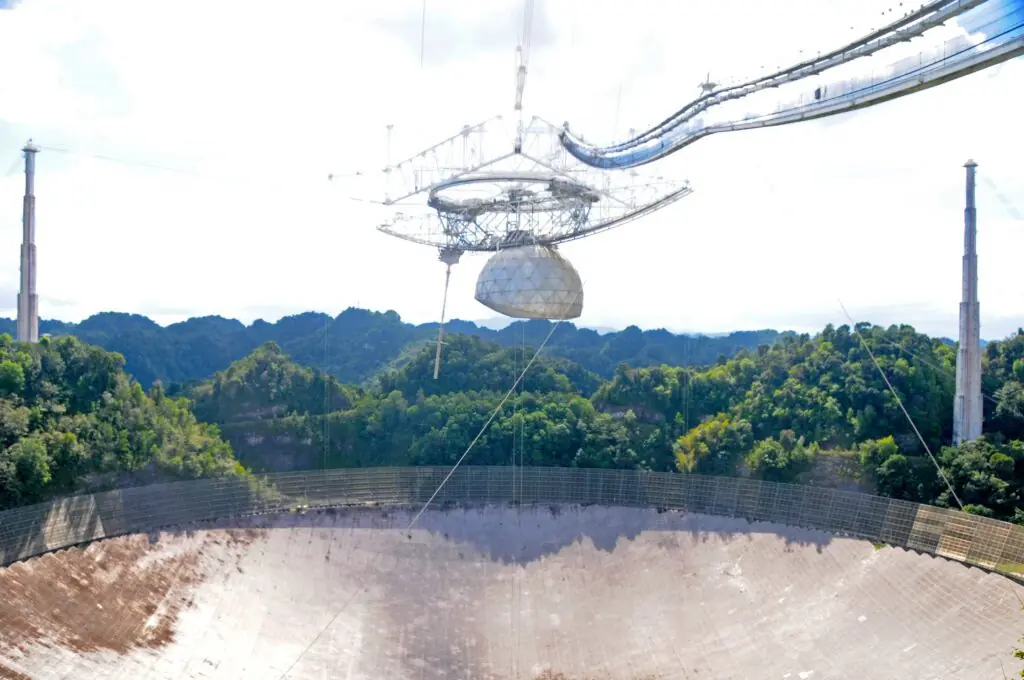
And because the instrument is no longer there to rebut it. The Arecibo radio telescope, which for half a century had been the most important dish in the world and from which came both the 1974 message and the data for this candidate, collapsed on December 1, 2020, when the cables holding up the platform gave way. There is no way to look again at that point with that apparatus. In an archive that demands reobservation, the loss of an instrument is also the loss of a chance to close old cases.
Something should be said in the project’s defense, because not everything is reproach. SETI@home did what had to be done: accumulate, prioritize, reobserve and explain in public why its best candidate was not worth it. In twenty years of operation it never sold a finding, never staged a press conference and never let the expectations of its millions of volunteers bend its judgment. In the casework this archive handles, that is an absolute rarity. What failed was the circuit that runs from the lab to the headline.
A name with hyphens and a number, three coincidences among billions and twenty years on lists of mysteries. Sometimes what survives of a case is the license plate, not the signal.
OSINT – Source traceability
No numerical values for the frequency drift are given: the figures in circulation come from a press item and not from a technical paper, and they vary among secondary sources. They are described qualitatively.