
BLC1: the Proxima Centauri signal that made the front page before it was analyzed
The best technosignature candidate in forty years hit the press in December 2020 through a leak. Ten months later, two papers in Nature Astronomy explained where it really came from.
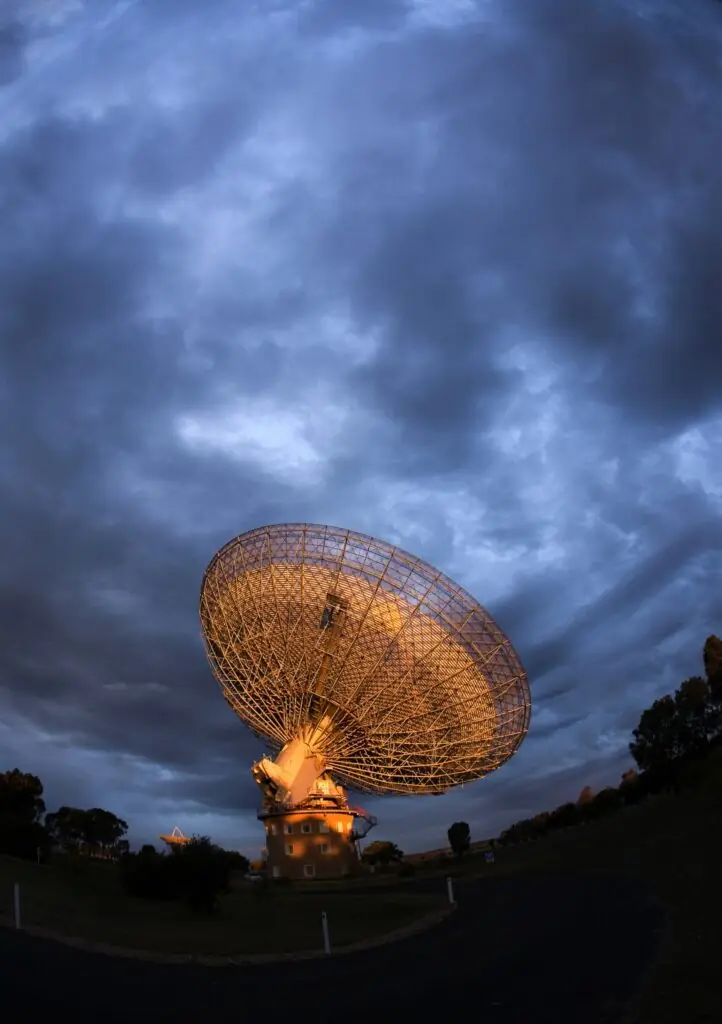
During a Breakthrough Listen campaign on Proxima Centauri from the Parkes radio telescope in April and May 2019, later analysis identified an extremely narrow-band signal at 982.002 MHz with frequency drift, present only in the positions pointing at the star. It was named BLC1. A leak to the press in December 2020 made it worldwide news before any analysis had been published. In October 2021, two papers in Nature Astronomy concluded it was interference of human origin, after locating dozens of twin signals in the same archive.
Executive summary of the case file. Everything essential before you dig deeper.
Fact sheet
OSINT - Traceability
On December 18, 2020, in the hangover of the pandemic year, The Guardian reported that a project funded by a Russian billionaire had detected a radio signal coming from the star nearest the Sun and that scientists could not explain it. Within hours the story was everywhere. What almost nobody reported, then or since, is that the story was a leak: the team was halfway through its analysis, had published nothing, and the conclusion it would reach ten months later was going to be exactly the opposite.
The signal is called BLC1, for Breakthrough Listen Candidate 1. It is, by a wide margin, the best technosignature candidate the field has produced since the Wow! signal of 1977. And it is also, by a wide margin, the best documented, because this one was killed with a thirty-page paper that explains exactly how it was killed and what method was used.
That is the real interest of this case file. Not the signal, which was junk. The protocol.
What can be verified, first
Let’s start with the target, which was no accident. Proxima Centauri is a small, cold red dwarf, the star closest to us, a little over four light years away. In 2016 a planet in the temperate zone, Proxima b, was confirmed for it, and later another one. By proximity and by having planets, it is the first place on anyone’s list. Breakthrough Listen (the hundred-million-dollar program Yuri Milner launched in 2015) observed it from Parkes for about thirty hours in April and May 2019, in a campaign that was actually aimed at characterizing the star’s flares.
The data were stored and analyzed at leisure. In October 2020, an intern named Shane Smith found in them something that survived every automatic filter: an extremely narrow-band tone at 982.002 megahertz, with a slight, positive frequency drift, and (this is the important part) present only when the antenna pointed at the star and absent when it pointed away.
That last detail is the heart of the method. The technique is called nodding and it consists of alternating: a few minutes looking at the target, a few minutes looking at an empty spot nearby, then the target again. Terrestrial interference, which arrives through the antenna’s side lobes, shows up equally in both positions. A celestial source shows up only when you point at it. BLC1 behaved like a celestial source across all five alternations. That is why it passed the filters. That is why it caused concern.
The drift fit too. A signal emitted from a planet that rotates and orbits arrives with its frequency shifted by the Doppler effect, and that shift changes gradually: this is what is called drift, and it is the criterion that in 1967 made it possible to rule out the extraterrestrial hypothesis in the case of the first pulsar. BLC1 had a small drift, but it had one. A fixed terrestrial transmitter, in principle, should not drift at all.
A serious candidate is one that has survived the tests designed to kill it, not one with no explanation. BLC1 survived three. Then they designed others.
It is worth explaining why narrow band is the credential everyone looks for. Natural processes that emit in radio (agitated plasma, electrons spiraling in a magnetic field, hot gas) spread their energy over a wide range of frequencies, because a huge number of particles in different states are involved. Concentrating all the power in a pure tone only a few hertz wide requires an oscillator. Nature has some tricks to come close, such as astrophysical masers, but nowhere near that fineness. That is why the pure tone is the signature everyone pursues: it is the only thing we know that only machines do. The problem, of course, is that our machines are much closer.
Proxima b is confirmed
The nearest star has a planet in the temperate zone. It jumps to the top of every list.
Breakthrough Listen observes Proxima from Parkes
About thirty hours spread across April and May, with alternating pointing.
Shane Smith finds the signal in the archive
Narrow-band tone at 982.002 MHz, present only in the on-target positions.
Leak to The Guardian
The story comes out before any analysis has been published. It goes around the world in hours.
The team urges caution
Breakthrough Listen states publicly that the analysis is ongoing and that interference is the most likely explanation.
Publication in Nature Astronomy
Two papers: the detection and the verification framework. Conclusion: human interference.
How the signal was killed
The work was finished off by a team led by Sofia Sheikh, with Danny Price and Andrew Siemion among others, and it consisted of something as unglamorous as combing the rest of the archive for relatives. The question was: if this is interference, where are its sisters? Because radio junk rarely comes alone.
They turned up. Dozens of signals with the same look (narrow band, similar drift, same structure) spread across the dataset, and with a telling property: their frequencies were not randomly distributed but fell at almost exact multiples of frequencies typical of consumer electronics oscillators. That is, the signature of a device. Any digital equipment has a crystal that sets the pace, and those crystals generate harmonics that leak in everywhere.
With that, the interpretation changes completely. BLC1 was one member of a large family of local artifacts, not a single, inexplicable signal, and the one that had the bad luck (or the good luck, depending on how you look at it) of appearing only in the on-target positions. That it slipped through with that pattern is a matter of statistics: if you generate thousands of intermittent interference signals, some will coincide by chance with your alternation sequence.
And there is one final fact that seals it: the signal never appeared again. The star was reobserved and there was nothing. Without reobservation there is no detection, and that rule admits no exceptions, not even when the candidate is a beauty.
The analysis procedure also deserves a line, because it explains how a candidate slips through. The program does not listen: it records a torrent of data and then an algorithm combs the spectrum looking for tones that shift gradually in frequency. Millions of raw detections come out of that, and they are filtered: out goes whatever appears in all pointing positions, out goes whatever matches known telecommunications bands, out goes whatever lacks the expected shape. At the end of the funnel a few things remain for a person to look at. BLC1 was what was left when the funnel finished its work, and the one who sat down to look at it was, indeed, an intern. That is not a charming anecdote: that is how this works.
What it can be, no Martians required
In this case the conventional explanation is published and signed, no mere hypothesis. But it is worth breaking down why it took so long to reach it, because that is where the lesson lies.
The pointing pattern can be imitated by chance
The alternation test is powerful but not infallible, and this is what almost nobody understands. If interference is intermittent (a device that switches on and off, a link that transmits in bursts) and you have thousands of such cases in the record, the probability that one of them coincides with your pointing sequence stops being negligible. The test that seemed definitive is in fact statistical. That is exactly the kind of nuance that separates an analysis from a headline.
Frequency drift is not enough either
A fixed transmitter on the ground was supposed to be unable to drift. It can: drift is also produced by the thermal instability of an oscillator, a device that warms up after being switched on, or the movement of any platform. Drift is a necessary condition, not a sufficient one. Every criterion in this trade, looked at closely, has a back door.
The radio environment is a jungle
And it gets worse every year. A modern observatory coexists with phones, links, satellites and its own electronics, and the protected band is an extremely narrow strip. It is the same problem that was solved bluntly in the case of the Parkes perytons, at the same observatory and with the same moral: before looking at 1,500 light years away, look at fifteen meters.
And there is a consideration about the recipient that almost nobody voiced in December 2020. Proxima Centauri is a very active red dwarf, with flares capable of sweeping the atmosphere of a nearby planet, and Proxima b sits so close to it that it almost certainly keeps the same face turned toward its sun at all times. Something could be there, but it is one of the most hostile places on the short list. That the signal pointed right there should have triggered somewhat more skepticism than it did, if only because of how nice it looked.
Why this case won’t die
Because out of it came what the field lacked: a written verification framework. The second of the two 2021 papers does not merely say that BLC1 was junk; it proposes an ordered battery of tests that any future candidate must pass, with explicit criteria. It is the equivalent, in this field, of a chain of custody. In an archive like ours, which scores every record by the documentary backing it has, that is worth more than the signal.
Because it also shows why the post-detection protocol exists. The December 2020 leak did exactly the damage that was feared: it planted in millions of people the idea that there was a signal from Proxima Centauri, and the October 2021 correction did not come close to reaching the same audience. Ten months’ head start for the headline. Anyone who works in this field knows that the retraction never catches up with the news.
And because it marks the difference with what happens in the rest of this archive. Compared with the Wow! signal, which remains without a closed explanation because nobody kept the raw data or was able to reobserve in time, BLC1 is a luxury: there is an archive, there is independent reanalysis, there are papers and there is a conclusion. It does not matter that the conclusion is boring. It is a conclusion.
Because it also teaches something about the value of publishing data. Breakthrough Listen committed in 2015 to making its records open, and that commitment is what allowed the analysis to be reproducible and the correction to carry weight. Compare it with the usual practice of the sector this archive works in: videos without metadata, testimonies without a case file, “evidence” that exists only in the presentation of whoever shows it. The difference between a discipline and a spectacle is, almost always, whether they let you have the raw material so you can try to refute them.
What remains to be said is the most uncomfortable part, and I say it as one of those who ask for transparency every day: here the transparency came late and in disorder. Nobody on the team went out to sell anything, but someone spoke ahead of time, and the result was a worldwide expectation built on a half-finished analysis. The lesson concerns protocol, not volume: a communication protocol is as much a part of the scientific method as the interference filter. When something that withstands every test is detected, the difference between an announcement and a circus will be set by that protocol, not by the signal.
Four light years, thirty hours of antenna time, an intern and a quartz crystal from some gadget. The nearest star still has nothing to say, and now we know with considerably more precision how to check it next time.
OSINT – Source traceability
The exact number of twin signals identified and the precise value of the drift are not given: the figures vary between the two papers depending on the segment analyzed. They are described qualitatively.