
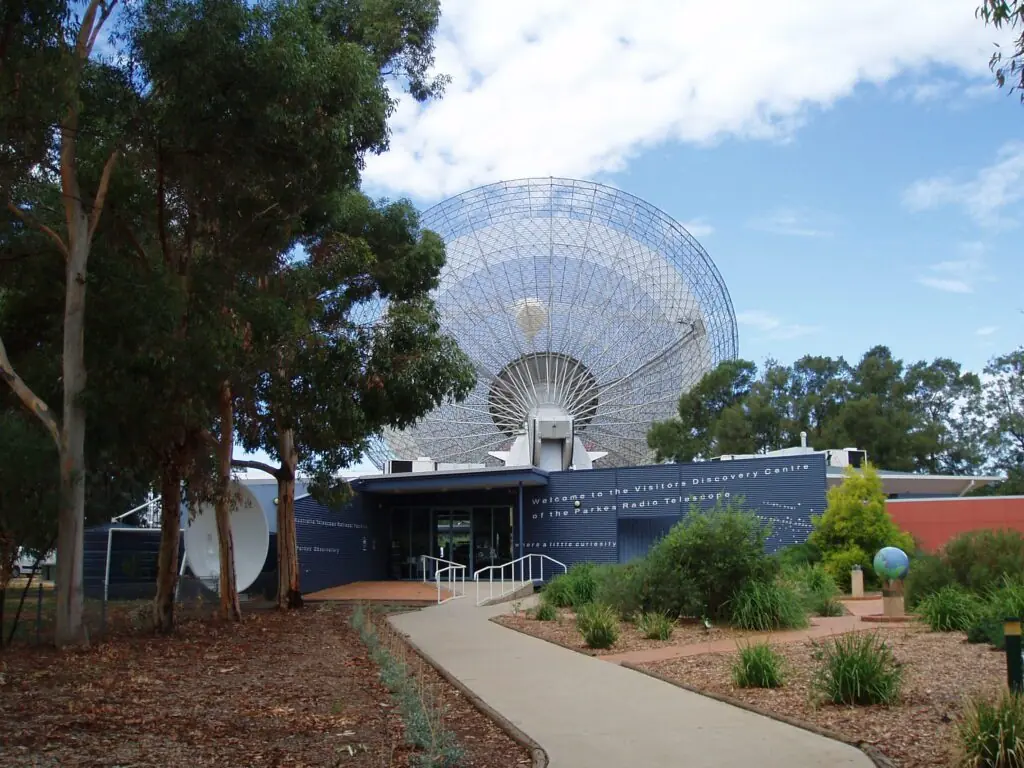
The Parkes Perytons: Years of a Mysterious Signal and a Microwave Oven
An Australian radio telescope had spent almost two decades recording pulses that seemed to come from other galaxies. They came from the kitchen of the building. The best lesson in method modern radio astronomy has given.
Between the late 1990s and 2015, the Parkes radio telescope recorded a family of millisecond pulses with a frequency sweep resembling fast radio bursts, dubbed perytons. Their simultaneous appearance in all thirteen beams of the receiver pointed to a local origin, but the specific source resisted for years. In January 2015, an interference monitor correlated three perytons with 2.4 GHz emission from the observatory's own microwave ovens: when the door is opened with the magnetron on, its shutdown produces a frequency sweep. The phenomenon was reproduced in a controlled way.
Executive summary of the case file. Everything essential before you dig deeper.
Fact sheet
OSINT - Traceability
If I had to pick a single case to explain why here at Broken UFO we distrust the unrepeatable anomaly, I would pick this one. There are no military personnel, no declassification, no witness with memory problems. There is a sixty-four-meter radio telescope in the middle of the Australian countryside, seventeen years of records and a family of very strange signals that for almost a decade nobody could trace. And there is an ending that is the most honest and the most humbling thing that has happened to modern radio astronomy.
They came from the microwave oven in the observatory kitchen. From opening the door before the beep sounded.
I tell it in full because the point is how much work it took to get to the joke. Nine years, two serious papers, a new instrument installed for the case and a team that publicly accepted it had spent a decade recording its own lunch.
What can be verified, first
The context comes from another discovery. In 2007, Duncan Lorimer and his team combed through archival Parkes data taken in 2001 and found something that should not have been there: a very bright pulse lasting only a few milliseconds, with one very specific feature. The high frequencies of the pulse arrived before the low ones, with a delay that follows a known law and measures how much plasma the signal has crossed along the way. The amount of plasma involved was enormous, far greater than what exists in our galaxy. Translation: it came from very far away, from another galaxy. That is how fast radio bursts, FRBs, were born.
And with them, the problem. Because in the following years other pulses appeared at Parkes that looked a lot like it (same appearance, same frequency sweep) but had a telltale flaw: they showed up in all thirteen beams of the receiver at once. A multibeam receiver is, in essence, an eye with thirteen pupils pointing at slightly different spots of the sky. An astronomical source falls in one, perhaps spills into two. If something appears in all thirteen, it is here, nearby, lighting up the antenna through its sidelobes, and not in the sky.
In 2011, Sarah Burke-Spolaor and her colleagues characterized the phenomenon and gave it a beautiful and far from casual name: perytons, bestiary creatures that cast a human shadow. That is, things from the sky that are really from here. Their paper showed that perytons had a frequency sweep similar to that of FRBs but imperfect, that they arrived in groups and that (a fact that should have set off every alarm) they clustered on working days and around local noon.
The signal followed the staff’s mealtimes rather than the sky. That is the kind of correlation a serious researcher does not want to see, because it can only mean one thing.
It was a big deal. If perytons were some kind of unidentified terrestrial interference, and they looked so much like FRBs, the obvious question was whether FRBs were also local junk. In other words: an entire new field of astrophysics hung on knowing what on earth those midday pulses were. Everything was proposed, including little-known atmospheric phenomena and electrical activity from distant storms.
It is worth setting the scene, because this is no ordinary gadget. The Parkes dish, which the traditional owners of the land named Murriyang, has been operating since 1961 in the middle of wheat fields in New South Wales, and it is the same one that relayed to the world a good part of the images of the first Moon walk in July 1969. It even has its own movie. In other words, the anomaly was not recorded at an amateur observatory with a secondhand receiver, but at one of the most veteran and best-characterized antennas in the Southern Hemisphere.
The pulse later known as the Lorimer burst is recorded
Nobody notices: it stays buried in the Parkes archive.
Lorimer et al. publish the finding in Science
The field of fast radio bursts (FRBs) is born.
Burke-Spolaor et al. describe the perytons
They appear in all thirteen beams at once: they are terrestrial. They cluster on working days and at midday.
Hypotheses pile up
From atmospheric phenomena to distant electrical activity. None is confirmed.
An interference monitor is installed at the observatory
An auxiliary receiver watches the radio environment of the site.
Three perytons with a witness
The monitor records 2.4 GHz emission coinciding with the three pulses. Someone had opened the microwave early.
Petroff et al. publish the identification in MNRAS
The source is the observatory's ovens, when the cycle is interrupted.
A galactic FRB
A burst is detected from the magnetar SGR 1935+2154. FRBs are confirmed as astrophysical.
How it was caught
The solution did not come from a brilliant idea but from instrumentation. In January 2015 the observatory switched on an interference monitor: a small receiver devoted exclusively to watching the radio environment of the site, with its own time log. The logic is straight from the police manual: if you suspect the noise comes from inside the house, put a camera in the hallway.
On January 23, 2015, three perytons were recorded. And for the first time there was an instrumental witness: at the same instant, the monitor had picked up emission in the 2.4 gigahertz band. That band has some very well-known tenants, and one of them was a few meters away. The team went to the kitchen.
What they found has a remarkable physical elegance. A microwave oven emits nothing appreciable outward while it runs normally: the cage is well built. But if someone opens the door while the magnetron is still on, the tube does not switch off instantly: it shuts down over a few milliseconds, and during that death throe its frequency slides. A frequency sweep lasting milliseconds. Exactly the signature the astronomers were interpreting as the accumulated delay of a pulse crossing an ocean of intergalactic plasma.
The authors checked it by hand, by cooking: they generated perytons at will by interrupting the cycle of the building’s ovens and observing with the antenna. Reproducible. With that, the case was closed and the paper appeared in Monthly Notices of the Royal Astronomical Society, signed by Emily Petroff and her team. The conclusion is one that will be cited for decades: almost twenty years of an astronomical anomaly produced by the hunger of the night shift.
It is worth understanding why the frequency sweep was considered such a solid credential. When a radio wave crosses a medium with free electrons, the low frequencies are delayed relative to the high ones in a mathematically very specific way, proportional to the inverse square of the frequency. That delay, the dispersion measure, works like an odometer: the larger it is, the more plasma the signal has crossed and the farther away the source is. A pulse with a dispersion far greater than the Milky Way can supply is, almost by definition, extragalactic. Faking that from the ground seemed unthinkable.
What we learn, no Martians required
This case file needs no alternative hypotheses because it is solved. What it has are lessons, and they are the best that can be drawn from a case of signals.
Discriminating criteria are designed beforehand, not afterward
What saved the matter was the receiver’s thirteen beams, not anyone’s sagacity. That design, conceived for something else, accidentally provided an automatic and objective test of locality. When in this archive we insist that a UFO case with two independent radars is worth infinitely more than one with ten witnesses, we are asking for exactly this: a redundancy that lets us separate “it’s out there” from “it’s in the apparatus.”
The most convincing signature can be fabricated by a household appliance
The frequency sweep of FRBs was considered a signature almost impossible to fake, because it encodes the journey through plasma. And it turns out that a dying magnetron imitates it well enough to fool specialists for years. Apply that elsewhere: every time someone says that a video, a radar trace or a spectrum “cannot have a conventional origin,” the right question is whether anyone has looked for the appliance, whatever the speaker’s cleverness.
Human patterns betray human causes
The definitive clue had been on the table for years: perytons occurred during working hours and clustered at midday. An astrophysical phenomenon does not know what day of the week it is. This criterion is directly exportable to ufological casework: if the sightings in an area cluster on Friday nights or coincide with the launch window of a firing range, the explanation probably carries a terrestrial license plate. It is what we did, for example, with the firing schedules of the Bardenas.
Killing the noise does not kill the phenomenon
A very important detail, and one that is almost always told backward: identifying the perytons did not dismantle FRBs, it strengthened them. Separating the local junk from the real phenomenon left signals that do appear in a single beam, with coherent dispersion and extragalactic provenance. In 2020 a burst of this type was detected from a magnetar in our own galaxy, and the field was closed off from above. The cleanup is what made the discovery possible.
And there is a fourth lesson, uncomfortable for the profession: during those years some people used the perytons to argue that the whole field of fast radio bursts was an instrumental artifact. It was not an absurd position, and it was defended in serious papers. What settled the argument was neither anyone’s prestige nor a vote, but a new instrument pointed at the right place. When a controversy is resolved like that, with a cheap device installed in the hallway, you understand why in this archive we insist so much on measuring before opining.
Why this case won’t die
Because it is the best vaccine available against the argument from residual mystery. There was no negligence here: there was a first-rate instrument, clean data, competent teams and peer-reviewed papers. And even so, the explanation took years to appear and it was domestic. The lesson is that the margin of unexplained anomaly in any archive, ours included, always contains a fraction of unidentified microwave.
Because it fits what this archive has been repeating from the start: without reobservation there is no case. In the SETI case file we see it in the death of every candidate, and in BLC1 with almost surgical precision: the Proxima Centauri signal fell apart when its terrestrial twins appeared. Here the reobservation was literal, with the team opening and closing the oven door to see whether the ghost would show up.
And because it is proof that a ridiculous ending does not subtract a gram of value from the research. The 2015 paper hides nothing, does not touch up the years of waiting and does not hand out blame. It publishes the finding under its full name: the mysterious signal was dinner. That, in a world of statements that never correct anything, is worth more than many discoveries.
And because it justifies a specific way of working: instrumenting the place where the thing happens instead of collecting stories about it. It is what has been done for decades in the Norwegian valley of Hessdalen, with automatic stations that record while nobody is watching. The perytons are the definitive argument in favor of that method: without the interference monitor, today we would still be writing papers about an unknown atmospheric phenomenon in southeastern Australia, and we would be writing them with good data.
Nine years of astrophysical mystery, a paper in a Royal Astronomical Society journal and a beep that nobody waited to hear. This is the case we put on the table every time someone tells us their anomaly has no possible explanation.
OSINT – Source traceability
No exact figures are given for the total number of perytons recorded: the published series cover different periods and are not directly comparable. It is described qualitatively.