
The Drake Equation and the Fermi Paradox: Two Tools Almost Nobody Uses Well
A lunch at Los Alamos in 1950 and a blackboard at Green Bank in 1961. From them come the two most repeated and worst-cited phrases in the debate over intelligent life beyond Earth.
Fermi's question was posed at a lunch at Los Alamos in the summer of 1950 in front of Konopinski, Teller and York, and was reconstructed from documents by Eric M. Jones in a laboratory report in 1985. The Drake equation was written as the agenda for the Green Bank meeting of November 1961. Neither is proof: they are frameworks for organizing ignorance. The astronomical half of the equation has been settled; the biological half still has no empirical anchor.
Executive summary of the case file. Everything essential before you dig deeper.
Fact sheet
OSINT - Traceability
Two phrases come up in any conversation about intelligent life beyond Earth, and both get cited badly. One is the Drake equation, which is almost never presented for what it is (a meeting agenda) and is treated instead as a cosmic calculator that spits out the number of civilizations in the galaxy. The other is the Fermi paradox, which Fermi never wrote down and which is not exactly a paradox. Between them they prop up half of twentieth-century popular science and a good deal of twenty-first-century conspiracy thinking.
I stick to my trade: papers, dates, who was in the room and what exactly they said. Because this is one of those cases where the genealogy of the idea explains the matter better than the idea itself. And because both, properly understood, do not say what people make them say. The equation does not prove we are surrounded by neighbors. Fermi’s question does not prove we are alone. They are tools for organizing ignorance, and they are very good at it.
Fair warning: there is no incident here, no witness and no light in the sky. There is a lunch at Los Alamos, a meeting of eleven people in West Virginia and an argument that has gone unsettled for sixty years. It is, by a wide margin, the dullest case file in this sector and the one that explains the most.
The Verifiable Part, First
Let’s start with the lunch. In the summer of 1950, at Los Alamos National Laboratory, Enrico Fermi had lunch with Emil Konopinski, Edward Teller and Herbert York. The conversation began with a The New Yorker cartoon about extraterrestrials stealing garbage cans in New York and drifted toward interstellar travel. Fermi did what he always did, which was to calculate out loud, and in the middle of something else he dropped the question that outlived him: “Where is everybody?”
That we know this in such detail is no accident: in 1985, Eric M. Jones, of the laboratory itself, wrote to the three survivors to reconstruct the scene and published their replies in a technical report, LA-10311-MS, titled, precisely, “Where Is Everybody?” An Account of Fermi’s Question. It is a short, public and charming document, and it is the reason we can put names on this file instead of saying “the story goes.” All three remembered the phrase; they differed a little on the exact wording. That is on the record too.
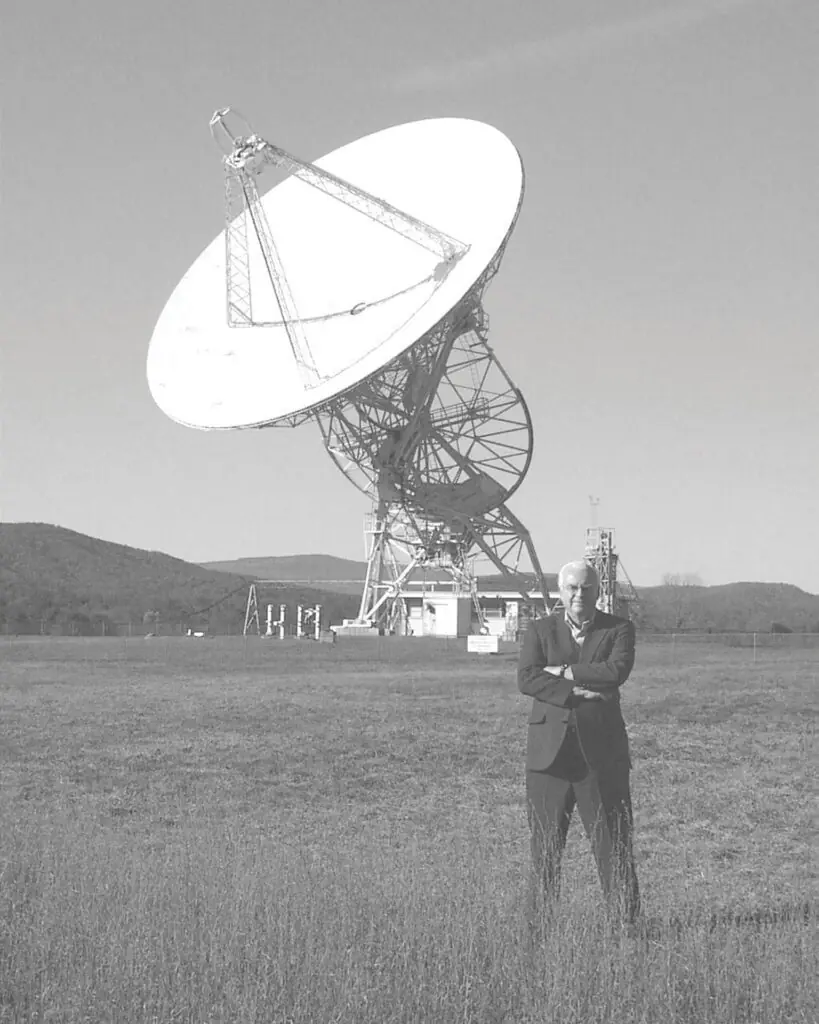
The second piece is a meeting. In November 1961, at the Green Bank observatory in West Virginia, eleven people gathered at the invitation of the National Academy of Sciences to discuss whether searching for signals made sense. There were Otto Struve, who chaired; Frank Drake, who had just carried out Project Ozma; a twenty-six-year-old Carl Sagan; Melvin Calvin, who was told during the meeting that he had been awarded the Nobel Prize in Chemistry; Barney Oliver, of Hewlett-Packard; Philip Morrison, co-author of the founding paper; and John C. Lilly, the dolphin neurophysiologist, who gave the group its later nickname, the Order of the Dolphin.
Drake needed an agenda. What he wrote on the blackboard was a chain of factors that, multiplied together, give the number of detectable civilizations in the galaxy: the rate of star formation, the fraction with planets, how many of those planets are habitable, on how many life appears, on how many that life becomes intelligent, how many develop technology that emits, and (the decisive factor) how long that emitting stage lasts. That is all. It is a list of the things we would need to know, set out in the order in which they have to be found out, and no model.
One detail that always gets lost: the Green Bank meeting was not an eccentricity of amateurs but a commission from the radio astronomy committee of the U.S. National Academy of Sciences. And the discussion went international early: in 1971 a joint Soviet-American conference on communication with extraterrestrial intelligence was held at Byurakan, in Soviet Armenia, with Sagan and Morrison on one side and Nikolai Kardashev’s school on the other. In other words, at the height of the Cold War, two blocs that agreed on nothing sat at the same table to talk about this. The idea that the subject was always marginal is false.
Lunch at Los Alamos
Fermi asks “Where is everybody?” in front of Konopinski, Teller and York.
Cocconi and Morrison in Nature
Listening by radio stops being speculation and becomes a plan.
Project Ozma
Drake carries out the first real search. Negative result.
Green Bank meeting
Drake writes the equation as the agenda for the meeting. Eleven attendees.
Byurakan conference
The discussion becomes international with Soviet participation.
Michael Hart, QJRAS
Formalizes the argument: if they existed, they would already be here.
Frank Tipler
Adds von Neumann self-replicating probes to the argument.
Report LA-10311-MS
Eric Jones documents the 1950 scene with the witnesses still alive.
Robin Hanson
Proposes the Great Filter as a framework for ordering the hypotheses.
Sandberg, Drexler and Ord
Argue that by treating uncertainty as distributions, the paradox dissolves.
What Each Factor Really Says, Today
The nice thing about the equation is that, sixty years on, it can be audited factor by factor to see where we have advanced. And the result of that audit is crushing: we have almost completely solved the astronomical half and have not moved a millimeter on the biological half.
The rate of star formation in the Milky Way is known with reasonable confidence and is a few stars a year. The fraction of stars with planets was settled by the Kepler mission between 2009 and 2018: planetary systems are not the exception, they are the norm. How many of those planets sit in the temperate zone and have suitable conditions is a matter of active debate, but it is no longer a total unknown: there are catalogs, there is statistics and there are numbers with error bars.
And that is where the good news ends. The fraction of habitable planets where life arises is estimated from a single known case, which is also our own, and methodologically that is the closest thing to running a survey and answering it yourself. The fraction in which that life becomes intelligent and then technological has absolutely no empirical anchor. And the duration of the emitting phase, the famous L, is the sink of the whole business: depending on what you put there, the result varies by several orders of magnitude and can be a million civilizations or fewer than one.
The Drake equation calculates nothing. It organizes. It is the difference between a calculator and an application form: one gives you a number, the other tells you which papers you are missing.
Drake said so many times, and it bears repeating here because on television it is never repeated: the formula’s usefulness is pedagogical and organizational. When someone uses it to announce that there are ten thousand civilizations in the galaxy, what they are doing is publishing their own assumptions about the last three factors in the disguise of an arithmetic operation. It is an old rhetorical technique: multiply what you don’t know by what you also don’t know and present it to two decimal places.
What It Could Be, Without Any Martians
Fermi’s question is only a paradox if you accept a chain of premises that almost nobody spells out. Let’s spell them out, because that is where half the argument falls apart.
Colonization may not be inevitable
The strong argument, Hart’s and Tipler’s, says that even with slow ships and no exotic physics, an expansive civilization would take between 1 million and 100 million years to cross the galaxy. Since the Milky Way is more than 10 billion years old, any civilization that had started would already be here. The weak point is the word “expansive”: the argument assumes that indefinite expansion is a universal trait of intelligence, and that is anthropology projected onto a galactic scale. No data support it.
The filter may be behind us
Robin Hanson formulated the Great Filter in 1996: if the chain from chemistry to a detectable civilization has one wildly improbable step, the silence explains itself. The optimistic version is that we have already passed that step (the origin of life, or the leap to the complex cell, which on Earth took a whopping 1.5 billion years). The uncomfortable version is that the filter lies ahead, and that it is precisely the duration of the technological phase. Which is, literally, Drake’s L staring us in the face.
The silence may be an artifact of our method
This is the one that convinces me most and the one that gets told least. We have been listening for very little time, on very few frequencies and in very few directions, as we detail in the SETI case file. And we look for emissions like the ones we ourselves were sending in 1960, which we no longer send. Concluding from that that nobody is out there is like looking out a window for fifteen seconds, seeing no one go by and declaring the street deserted.
Uncertainty may dissolve the paradox itself
In 2018, Anders Sandberg, Eric Drexler and Toby Ord, of Oxford, did something nobody had done: instead of putting a single value for each factor into the equation, they put in the distribution of uncertainty that the scientific literature allows for each one. The result was a distribution of outcomes so wide that it assigns a non-negligible probability to our being alone in the observable galaxy, rather than a single number. Their conclusion is that there is no paradox to explain, only a calculation done wrongly for decades. It is a debated preprint, not a revealed truth, but it is the most serious contribution to the debate in twenty years.
And there remains the drawer of unfalsifiable hypotheses, which are worth naming if only to know where not to go. The zoo hypothesis, proposed by John Ball in 1973, says they are watching us and have decided not to interfere. The Rare Earth hypothesis, by Peter Ward and Donald Brownlee in 2000, holds that microbial life may be common and complex life extremely rare. The transcendence hypothesis says that an advanced civilization stops expanding and turns inward. None of the three generates a prediction that can be tested with an instrument, and so, in terms of method, they are worth exactly the same as a well-written shrug.
Why This Case Doesn’t Die
Because it is the mental infrastructure of everything else. Every time someone argues whether an interstellar object is a probe, whether a star flickers because of a megastructure or whether a Pentagon video proves visits, they are using, without knowing it, Drake’s bookkeeping and Fermi’s clock. Knowing where the two come from is the difference between arguing and repeating.
Because it is also the best antidote to the two extremes that wear us out equally here at Broken UFO. To the enthusiast who multiplies factors until he gets the figure he wanted, the equation reminds him that three of its seven boxes are empty. To the skeptic who uses Fermi as a mallet to close the debate, the 2018 work reminds him that his paradox depends on a calculation nobody had done with the uncertainty included.
And because the sector has expanded without being resolved. Today the hunt for technosignatures includes stellar brightness anomalies such as Tabby’s Star and projects that track interstellar objects such as Project Galileo. The instruments change; the empty boxes on the Green Bank blackboard remain exactly as empty.
And because there is a reading of L that is not astronomical but down here. If the average duration of a civilization’s technological phase turns out to be short, the explanation for the silence lies in how civilizations end when they learn to manipulate energy before learning not to use it against themselves, rather than in the galaxy. Drake wrote that factor in 1961, in the middle of the nuclear race, and it was not an abstraction. It still isn’t. It is the only term in the equation about which we have, in principle, something to say.
Sixty years after that blackboard, we are still filling in the same form with the same three boxes left blank. The difference is that now we know exactly which ones they are, and in this line of work that is already a good deal more than usually gets achieved.
OSINT – Source traceability
No numerical value is offered for the equation: any concrete figure would be the writer's assumption dressed up as a calculation. The exact date of the Los Alamos lunch is not recorded precisely even in Jones's report; “summer 1950” is given.