
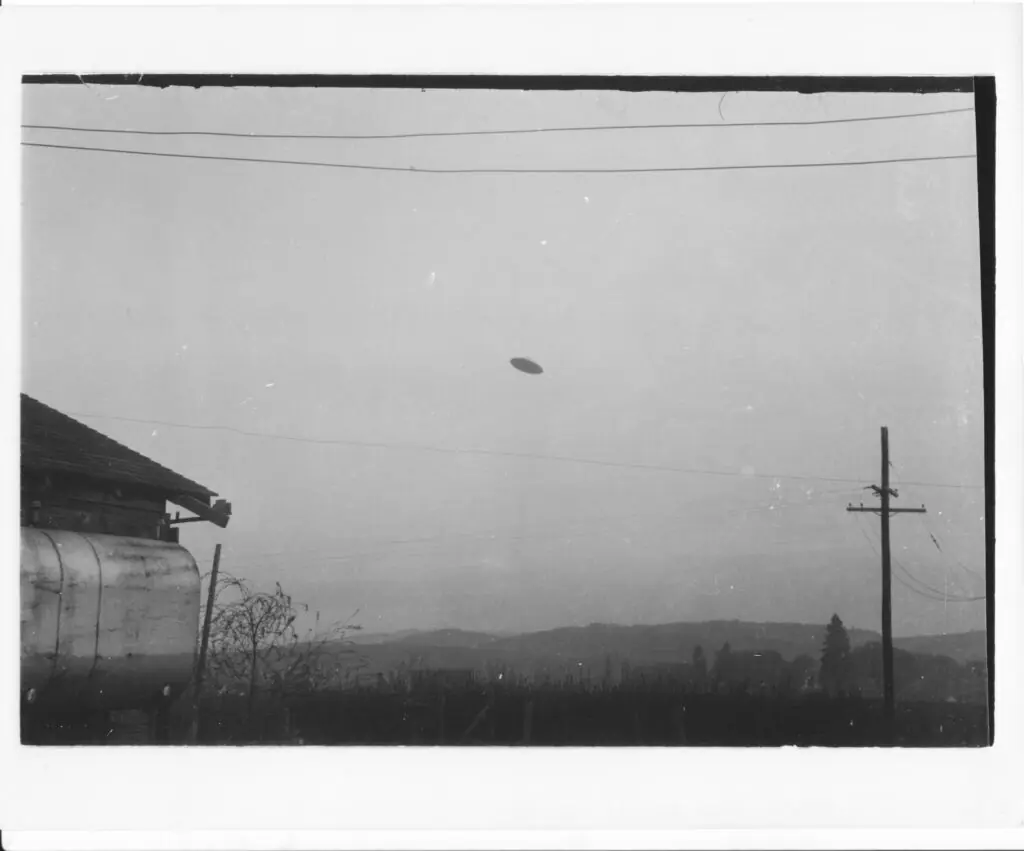
McMinnville, 1950: The Two Photographs the Condon Report Could Not Sink
A married couple of Oregon farmers took two photos in the yard of their home. The official study used to close Project Blue Book found them compatible with a real object. Then came the shadows on the shed.
On May 11, 1950, around 7:30 p.m., Evelyn Trent observed a metallic, disc-shaped object over the family farm near Sheridan, Oregon, and her husband Paul took two photographs. Published on June 8 in the local newspaper and on June 26 in Life, they became the most famous photographic pair in the corpus. The original negatives, recovered in 1967, were analyzed by William K. Hartmann for the Condon Report, which found them compatible with a real extraordinary object. Later analyses by Sheaffer, Klass and the IPACO team maintain that it is a model suspended from a power line.
Executive summary of the case file. Everything essential before you dig deeper.
Fact sheet
OSINT - Traceability
Intelligence Network
Some photographs age badly and some photographs age slowly. The two Paul Trent took on May 11, 1950, from the yard of his farm have been aging slowly for seventy-six years: they are still sharp, still strange, and still without an explanation that convinces everyone. Which, in this trade, is almost a record.
They are also the only case to which a study paid for by the U.S. Air Force, and written by people who were going about their own business, devoted a sentence that still stings. Let’s put it in order, and let’s put in order what came after, which is less glamorous and a good deal more uncomfortable.
What can be verified, first: some rabbits, a camera and two shots
The Trents were farmers. Not lecturers, not astronomy hobbyists, not people with an organization behind them. That May afternoon, Evelyn Trent was in the yard feeding the rabbits when she saw a metallic, disc-shaped object approaching slowly from the northeast. She called her husband. Paul came out of the house, went back in for the camera, checked that it had film, went out again and fired twice before the thing headed off to the west.
That coming and going is an important detail and it is usually told badly. It was not an instant flash: there was time. The two negatives show the object in slightly different positions, with the same power line and the same shed in the background. It is a photographic pair, not a single image, and that makes it possible to measure things.
And now the detail that interests me, because it is one of those that says something about people. The Trents called no one. They finished the roll (there were exposures left) and took it to be developed when it suited them, weeks later. The story came out because the prints ended up being shown around town and a local banker told a reporter at the Telephone-Register. There is no press release, no agent, no one selling anything. For the supposed most profitable photographic fraud in the history of the subject, its authors took almost a month to show it and did not charge for it.
The two photographs
Evelyn Trent sees a metallic, disc-shaped object approaching from the northeast at the family farm, near Sheridan, Oregon. Paul Trent takes two photographs seconds apart before the object moves off to the west.
Front page of the local paper
The McMinnville Telephone-Register runs the story on the front page, under a headline announcing that at last there were authentic photographs of a flying saucer. The images pass to the International News Service and are circulated across the country.
Life
Life magazine publishes cropped versions of the two photographs, alongside a picture of Paul Trent with his camera. The case goes international.
The negatives turn up
The original negatives, given up for lost, are located in the archives of United Press International, which had absorbed the International News Service. Their recovery finally allows a serious analysis.
The Condon Report, case 46
Astronomer William K. Hartmann analyzes the photographic pair for the University of Colorado study and concludes that all the factors examined are compatible with the presence of an extraordinary object. He nevertheless records the hypothesis of the model hung from a thread.
Return
The negatives go back to the Trents.
The skeptical counteroffensive
Philip J. Klass and Robert Sheaffer maintain that the shadows on the shed correspond to a morning hour rather than evening, and propose that the object is an exterior vehicle rearview mirror hung from the power line.
The IPACO analysis
A French team specializing in photographic analysis publishes a geometric study concluding that it is a model suspended from a thread attached to the power line.
The sentence in the Condon Report that nobody expected
The context needs setting. The Condon Report was the study the Air Force used to close Project Blue Book. Its general conclusion was crushing: twenty-one years of studying the phenomenon had added nothing to scientific knowledge and there was no reason to continue. That is the document. And inside that document, in case number 46, astronomer William K. Hartmann wrote the opposite.
In translation (and I point this out because it is a free translation and the original is in English), Hartmann wrote that this is one of the few UFO reports in which all the factors investigated, geometric, psychological and physical, appear to be compatible with the claim that an extraordinary flying object, silvery, metallic, disc-shaped, tens of meters in diameter and evidently artificial, flew within sight of two witnesses.
The document that buried the official study of the phenomenon contains, in its case forty-six, the best sentence any body has ever written in favor of a UFO photograph.
Now, the part that is quoted far less and that belongs to the same analysis: Hartmann also recorded that he could not rule out that the object was a small model suspended from the nearby power line by a thread not resolved by the emulsion. That is, the author of the famous sentence himself put in writing the hypothesis that thirty years later would take the case down. He was not naive. He was honest.
From a county weekly to the most widely read magazine in the world, in eighteen days
The spread of the case is almost as interesting as the case. On June 8, 1950, the McMinnville Telephone-Register, a county weekly with a modest circulation, led its front page with the two photographs and a headline that already came with the question mark in place: at last, authentic photographs of a flying saucer. That question mark, in 1950, was almost an act of professional courage.
From there it jumped to the International News Service, one of the three big American wire services, and from the wire service to the whole country. On June 26, eighteen days later, Life magazine published the images cropped, next to a portrait of Paul Trent holding his camera. Life in 1950 was the most powerful visual dissemination machine on the planet. A couple who had called no one ended up, in under three weeks, on the coffee tables of half of America.
And here comes the archival disaster that defines the case for seventeen years: the negatives left with the wire service and did not come back. The Trents kept copies. Any serious analysis between 1950 and 1967 had to work on reproductions of reproductions, which is like trying to authenticate a signature from a fax. When in 1967 someone bothered to look in the archives of United Press International (which had swallowed the INS along the way) the negatives turned up. Only then did the real case begin.
What it could be (no Martians required)
- A model hung from the power line. This is the dominant hypothesis today. In the frame there are electrical wires just above the object. A small model suspended from a fine thread, a few meters from the camera, produces exactly that silhouette and explains the absence of surface detail.
- A pickup truck’s exterior rearview mirror. Proposed by Philip J. Klass and Robert Sheaffer. The shape of the object (a dome on a disc with a side mast) recalls a rearview mirror of the period seen from below. It is a concrete, checkable morphological identification, not a passing thought.
- The shadow problem. The strongest argument against the Trents. Sheaffer maintained that the lighting on the shed in the background corresponds to a morning, not to half past seven on a May evening in Oregon. If that is correct, the testimony is false on a point that allows no memory error.
- The reply on the shadows. Other analysts have answered that the sky was overcast, that diffuse light complicates the reading of shadows, and that the brightness of the shed may be due to the reflectance of the material. The debate remains open and depends on details of the copy being examined.
- A mundane identification not found. It is always possible. But it is the weakest of the hypotheses here, because the object does not resemble any aerial craft of 1950 and because the two negatives are consistent with each other.
The underlying problem: a photograph is not proof, it is an indication with good press
Something unpleasant has to be said here. For decades, the McMinnville case has been used as the closing argument in any discussion: sure, but there are the Trent photos. And the Trent photos are extraordinary in the literal sense of the word, but they are not proof. A photograph documents that something was in front of the lens. It does not document how far away it was, or how big it was, or whether it hung from a thread. All of that has to be deduced, and deductions depend on assumptions.
The case has been losing ground precisely because the analyses have been getting better. In 1968, with the tools of 1968, Hartmann measured densities in the negative and found indications that the object was far away. With the tools of 2013, the IPACO team re-examined the pair and reached the opposite conclusion. I have no technical standing to arbitrate that dispute, and anyone who says they do without having worked the negatives does not either. The honest thing is to record that the weight of specialist opinion has shifted toward fraud without ever having reached a conclusive demonstration.
There is also a sociological argument that is used a lot and that deserves to be taken apart a little: that Oregon farmers in 1950 lacked the sophistication needed to stage a fraud like this. It is false and also a bit classist. Hanging an object from a wire with sewing thread and photographing it from below requires no sophistication at all: it requires half an hour and the will. UFO photographic fraud is, technically, among the cheapest there is. What is needed is intent, not talent.
And the other way around: the argument that the Trents were hicks who mistook a rearview mirror for a spacecraft does not hold up either. Evelyn described an object in motion approaching from a specific direction before her husband grabbed the camera. Either that is true, or it is a lie. That is an account with a sequence, not a perception error. Both ends of the debate have spent seventy-six years treating the witnesses as fools, each in its own way.
Why this case won’t die
For two reasons, and neither has anything to do with silver discs.
The first is documentary: it is the only photographic case in the classic corpus in which the original negatives are preserved, their chain of custody is known, and they have been analyzed twice, fifty years apart. In a field where the norm is arguing over a JPEG forwarded fourteen times, that is a luxury.
The second is human. Paul and Evelyn Trent died a year apart, she in 1997 and he in 1998, holding to the same account they had given in 1950. They never wrote a book, never gave a paid lecture, never expanded the story. That does not prove they told the truth (there are frauds that last a lifetime, and pride is an excellent fuel), but it breaks the usual pattern of the hoaxer, who almost always ends up stretching the story. The Trents never stretched it. They were left with two photos and a May afternoon.
Two farmers, some rabbits waiting to be fed and a camera with a half-used roll. Seventy-six years later we are still measuring shadows on the shed in the background, which is where the case is really decided. The history of the phenomenon is like that: you always end up arguing about the shed.
OSINT – Source traceability
Hartmann's sentence is offered in free translation into Spanish and is always accompanied by its second part, the suspended-model hypothesis, which is cited much less. No quoted statement is attributed to the Trents because no verified transcript is available. The exact time of 7:30 p.m. comes from the witnesses' account, which is precisely the point the reading of the shadows calls into doubt. The coordinates are approximate to the municipality, not to the exact site of the farm.