
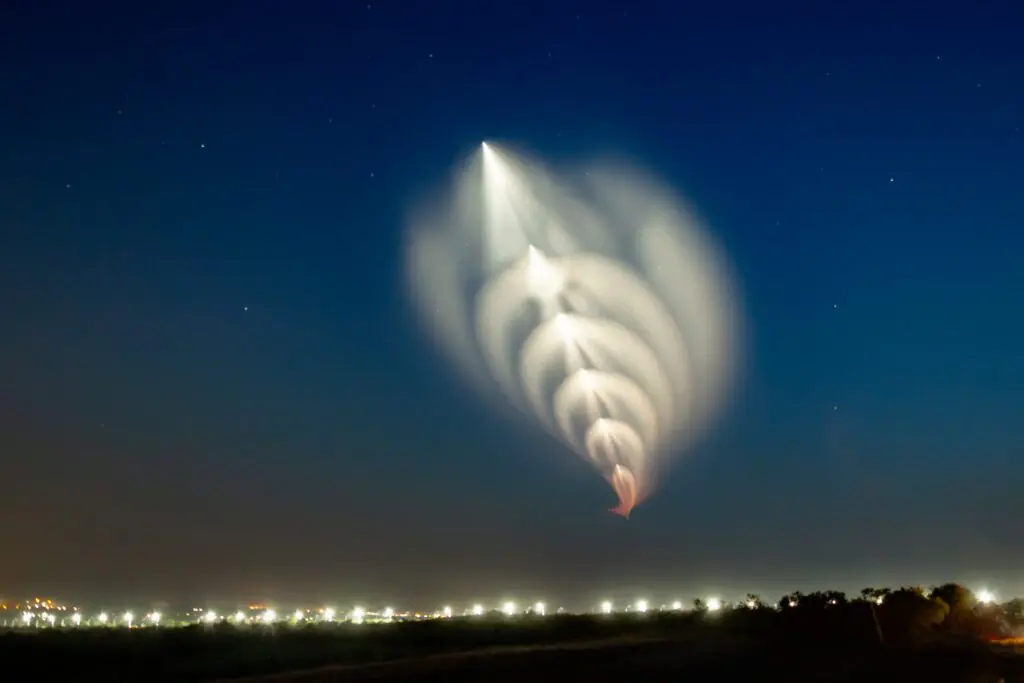
Petrozavodsk, 1977, the jellyfish that founded a state program
A Soviet city wakes up to a jellyfish of light in the sky, TASS publishes it, and the Kremlin ends up setting up a thirteen-year program. The light was a rocket. The program is the interesting part.
On September 20, 1977, around four in the morning, a luminous phenomenon described as a jellyfish projecting beams toward the ground is observed over Petrozavodsk and much of the Soviet northwest. TASS reports it. The launch catalog places the departure of the Kosmos 955 satellite from Plesetsk at that hour, with the geometry that produces that effect. The episode leads to the creation of the Setka state program, active between 1978 and 1990.
Executive summary of the case file. Everything essential before you dig deeper.
Fact sheet
OSINT - Traceability
Friends, today I bring a case I like for a decidedly unromantic reason: it is one of the few where you can follow the whole trail from the light in the sky to the file in the drawer. And the drawer, mind you, is Soviet. The kind that opens every thirty years, and with tweezers.
On September 20, 1977, around four in the morning, half of Karelia woke up and looked out the window. Over Petrozavodsk something appeared that everyone described more or less the same way: an enormous star that flared up and dropped beams of light toward the ground, like a jellyfish hanging in the sky. It lasted a few minutes. It was seen from Helsinki and Copenhagen to the west, and there are reports reaching the other end of the country. And then the truly unusual thing happened, which has nothing to do with the light.
The TASS agency reported it. In writing. A dispatch signed by correspondent Nikolái Mílov describing the phenomenon without irony, without a denial and without the customary reassuring tag line, published in the official press of a country that was not in the habit of telling its citizens strange things about the sky. In 1977, that is a bigger anomaly than the jellyfish.
What can be verified, first
Back to my own ground: papers, dates and agencies. And here the cleanest paper is in a NASA catalog, not in Moscow. The satellite Kosmos 955, international designation 1977-091A, is listed as launched on September 20, 1977 from the Plesetsk cosmodrome on a launcher from the family derived from the R-7. Plesetsk is in Arkhangelsk Oblast, northeast of Karelia. Petrozavodsk lies southwest of Plesetsk. In other words: the city was watching the launch from behind.
That geometry is what produces the jellyfish. A rocket crossing the upper layers in the darkness before dawn, with the nozzle still burning and the Sun lighting from below the horizon the cloud of gases it sheds, draws exactly that: a bright core and a halo expanding around it. Today it even has a brand name on social media, “space jellyfish,” and it is photographed several times a year. In 1977, in a Soviet city at four in the morning, it had no name at all.
The explanation was formulated by journalist and space analyst James Oberg shortly afterward, working from outside with public launch data. And here is the interesting part, because it did not stay a hobbyists’ quarrel: in 1984 it was backed from the inside by Yuli Plátov of IZMIRAN, who was one of the scientific leads of the Soviet state program we will get to shortly. A Soviet researcher publicly agreeing with an American about a phenomenon TASS had published without explanation. In the middle of the Cold War, that is no small thing.
And then there is the reach, which is the part usually told wrong. This was not a local sighting in a provincial city: there were observations from Helsinki and Copenhagen to the west and scattered reports across thousands of kilometers to the east. When a phenomenon is seen simultaneously across several time zones, the list of candidates shrinks enormously, because very few things can be seen from so far away at once. A low-altitude object over a city, certainly not. An engine burning tens of kilometers up, yes.
And there is a cruel asymmetry in all this. A Finnish citizen in 1977 could suspect it was a Soviet launch, because his press talked about Soviet launches. A citizen of Petrozavodsk could not: the space calendar of his own country was reserved material and he saw only the result. The same light, at the same hour, meant two different things depending on which side of the border you looked from. That is information policy, not ufology.
A note of context from the same catalog is worth adding. Two days earlier, on September 18, the USSR had launched Kosmos 954, a satellite with a nuclear reactor on board that in January 1978 broke up over northwestern Canada and forced a radioactive material recovery operation that lasted months. The Soviet sky that autumn was very busy. When you launch that much, something gets seen.
Launch of Kosmos 954
The satellite with a nuclear reactor that will fall on Canada in January 1978 leaves Baikonur.
Source ↗Kosmos 955 and the jellyfish
Plesetsk launches 1977-091A in the early morning. Petrozavodsk sees the jellyfish around four.
Source ↗TASS dispatch
Correspondent Nikolai Milov describes the phenomenon and the official press reproduces it.
Kremlin meeting
A meeting chaired by Lieutenant General B. A. Kiyasov discusses the case and concludes nothing.
Source ↗Kotelnikov authorizes the expert group
The Academy’s vice president signs off on sending a commission to the field.
Setka is born
Dual program: Setka-AN at the Academy of Sciences and Setka-MO at the Ministry of Defense.
Platov backs the explanation
The IZMIRAN researcher endorses the launch thesis.
Platov and Sokolov publish the assessment
The Academy of Sciences journal publishes the program told from the inside.
Source ↗What is said to have happened
The version that has reached us, and that resurfaces every few years in a documentary, says that an object stopped over Petrozavodsk and bombarded the city with beams of light, that those beams pierced the glass of a building leaving holes with melted edges, and that the episode was so serious it forced the Kremlin to set up a secret research program. It is also said that the authorities ordered silence, which is curious in a case that TASS broke.
The story of the pierced glass is the one that has traveled the most and the one that least withstands being asked where it comes from. It appears in secondhand accounts, with no reproducible expert examination, no chain of custody and nobody showing one of those panes. It is the kind of data point that here at Broken UFO is flagged as an unsupported claim and left there, waiting for someone to bring the paper, never published as fact.
The secret program, on the other hand, is strictly true. Only it was not secret forever and it was not set up out of fear of Martians.
What it could be, no Martians required
A jellyfish is an engine seen from afar
There is no need to believe anything: just look at the phenomenon today. Every time there is a night launch under similar conditions, the same photos appear on social media from hundreds of kilometers around, with the same core, the same expanding halo and the same comments from awestruck people. The difference between 1977 and now lies outside the sky: today anyone can check the launch schedule in ten seconds, and in 1977 the launch schedule was itself classified material.
The beams of light and perception
The rays that “came down to the city” are the daily bread of observing extended luminous phenomena. A very bright source seen through humid atmosphere, window glass, or simply eyes freshly opened at four in the morning, produces line radiation and halos that the brain interprets as beams directed downward. There is no need to postulate an emitter. You need to postulate a window.
Why TASS published it
This is the good question, and it has no closed documentary answer. The most sober hypothesis is also the most Soviet: so many people saw it, in so many cities and in so many neighboring countries, that silence was materially impossible. When half of Scandinavia is on the phone, you do not stay quiet: you publish something neutral and buy time. Mílov’s dispatch explains nothing, it describes. It is, at bottom, a defensive press release.
The real case file is called Setka
And now what interests me about this case, which is not the light. In October 1977 the matter was discussed at a meeting held in the Kremlin, and the Academy of Sciences also reviewed the material at the Space Research Institute. The conclusion was that nothing could be concluded. Three months later, on January 2, 1978, the Academy’s vice president, Vladímir Kotélnikov, authorized sending a group of experts. From that came the Soviet state program for the study of anomalous atmospheric phenomena, with two branches: Setka-AN, at the Academy of Sciences, and Setka-MO, at the Ministry of Defense.
Read that slowly, because it is the pattern we have been seeing in this archive since day one. A perfectly explainable phenomenon generates such a volume of public noise that the State is forced to create a structure to process it. It is created because there is a management problem, not because there is a threat. It is exactly what happened in the United Kingdom with the Flying Saucer Working Party and what happened in the United States with Sign and its drift toward Grudge.
States do not set up commissions on what they do not understand. They set them up on what they cannot stop having to answer.
Setka ran for thirteen years, from 1978 to 1990, and died with the USSR. We know it in detail because two of its protagonists put it in writing: Yuli Plátov, on the academic side, and Colonel Borís Sokolov, on the military side, in an article published in 2000 in the journal of the Russian Academy of Sciences, with an open English translation in Skeptical Briefs. It is a signed article in an Academy journal, not a leak or a stolen document. Soviet declassification, when it comes, comes through the most boring door possible.
And the assessment they give is the one programs of this kind always give when someone bothers to do the work: according to Plátov and Sokolov, more than 90% of what was collected over thirteen years was explained by rocket launches, aerospace tests, balloons and atmospheric phenomena. The same as Blue Book, the same as GEPAN, the same as the archive of the Spanish Air Force (Ejército del Aire). The surprise is not that the result repeats. The surprise would be if it did not.
Why this case does not die
Because it is the best available argument against two cages at once. The cage of “it’s all aliens, trust my cousin”: here the explanation was in a launch catalog, waiting for someone to consult it. And the cage of “it’s all a cover-up, trust me”: here the most hermetic State on the planet published the phenomenon on the front page and its own scientists ended up signing the mundane explanation in journals.
Because it also dismantles a deeply rooted idea: that official programs on UFOs are born from inexplicable encounters. Almost never. They are born from waves. And waves are born from a banal, highly visible stimulus falling on a population with no framework to interpret it. Swap the Soviet rocket for the Scandinavian ghost rockets of 1946 and you get the same film with a different cast.
Because the context of that autumn made things worse on its own. Four months after the jellyfish, Kosmos 954 fell on Canada with its reactor on board and forced the USSR to give international explanations about a program it had never acknowledged. For anyone paying attention, the takeaway was that what is up there is Soviet, it is dangerous and they are not telling us. With that climate in the background, the September jellyfish stopped looking like a rocket and began to look like a piece of something bigger.
Because honest loose ends remain. Not everyone inside the USSR accepted the launch thesis: Félix Ziegel, the best-known popularizer of the subject in the country, rejected it over inconsistencies in direction, and there were also objections from people with experience at cosmodromes. That disagreement existed and has to be told. What there is not is an alternative that explains the hour, the geometry and the geographic extent better than a rocket lifting off from Plesetsk at four in the morning.
And because the material remains hard to consult. The Plátov and Sokolov article, which can be read openly, is the best summary available, but the Setka document collection, as of September 2026, is not digitized or accessible the way Blue Book’s is. When someone in Russia decides to put it online, this case file will have to be rewritten. I hope so.
At four in the morning, in a provincial city, half a country looked up and saw something its own State was doing and had not told it about. That sentence, with different rockets and different languages, is practically the whole history of this archive.
OSINT – Source traceability
The total number of reports collected by Setka is not published; the percentage explained (more than 90%) is, and it appears in the open translation of the Sokolov and Plátov article. No exact date is given for the TASS dispatch because I have not been able to pin it down in a primary source. Corrected 2026-09-19: the October 1977 meeting took place in the Kremlin, not on October 1 at the IKI. The pierced glass is explicitly marked as low-reliability evidence.