
The Roswell Stone and the Long Family of Engraved Stones
A stone cannot be dated: what gets dated is the hole it came out of. And this one came out of no hole at all, carrying a drawing that had been in print for eight years.
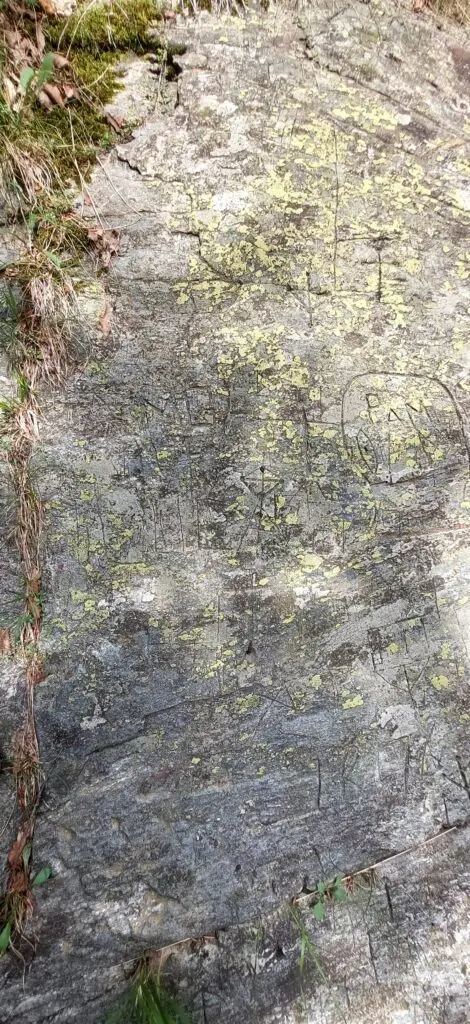
In 2004 a hunter found in the countryside near Roswell a small stone with an engraved design of two crescents and a disc, very similar to a crop formation that appeared in Wiltshire in 1996 and was widely published. The find was chance, single, with no witnesses or excavation, so the object lacks archaeological context and cannot be dated. No published independent analysis of tool marks or patina is on record. The case belongs to a category with documented forgeries, from the Ica stones to the Acámbaro figurines.
Executive summary of the case file. Everything essential before you dig deeper.
Fact sheet
OSINT - Traceability
An engraved stone is the perfect documentary medium for a lie, and it is so for reasons that have nothing to do with bad faith and everything to do with physics. A stone cannot be dated. A bone can be dated, and so can wood, cloth, charcoal: everything that was once alive carries a carbon clock inside it. A rock has been there for millions of years and will still be there tomorrow, and the notch someone cut in it with a chisel has no age of its own.
What does have an age is the place where it turned up. That is why archaeology is, before anything else, a bookkeeping of layers: the stratum, the level, the elevation, what lay above and what lay below, the ash next to the object that can be dated. Without that notebook, an engraved stone is a pretty object with a story behind it, and the story is supplied by whoever brings it in.
This case file is about that. About one particular stone that turned up near Roswell in 2004, and about the whole genealogy it belongs to, which is long, distinguished and full of confessions.
The verifiable first: the Roswell stone
What is on record is little, and it should not be stretched. In 2004, a hunter named Robert Ridge found in the countryside near Roswell, New Mexico, a small stone, about the size of a fist, with a design engraved on one face: two interlinked crescent shapes and a disc. He took it out of the ground, took it with him and showed it.
There is nothing more. There is no excavation, no photograph of the object in its original position, no second person who was present, no coordinates recorded by anyone but the finder himself, no stratum, no associated organic material. The object enters the story already cut off from its context, and that disconnection is irreversible: even if the exact spot were excavated tomorrow, the stone is no longer in it.
The design is what gave life to the matter, and it must be admitted that it draws the eye. It is strikingly similar to a formation that appeared in 1996 in a cereal field near Liddington Castle, in the English county of Wiltshire, widely photographed and published at the time. The coincidence was presented as proof of a connection: the same symbol, on an ancient stone in New Mexico and in an English field.
And it is exactly there that the argument turns over. Because the formation dates from 1996 and the find from 2004. Eight years apart, with the image circulating in books, magazines and websites the whole time. The direction of the coincidence is not determined by the data: a design published in 1996 and engraved on a stone afterward explains the resemblance equally well, and requires nothing extraordinary.
Magnetic properties have also been attributed to it: that it moves a compass needle, that it reacts to a magnet. Two things need to be said. The first is that a multitude of rocks contain magnetite and other ferromagnetic minerals, and that a stone that deflects a needle is not a rarity but a product of ordinary geology. The second is that no independent analysis of composition, tool marks or patina in the incisions has been published, and that is the only thing that could say anything about the age of the engraving.
Ica
Thousands of stones engraved with dinosaurs and impossible scenes spread through Peru. The farmer who sold them would end up stating that he engraved them himself.
Acámbaro
Waldemar Julsrud gathers thousands of ceramic figurines in Mexico. The archaeologist Charles Di Peso investigates them on the ground and concludes they are modern.
Liddington
A crop formation appears in a Wiltshire field; its design is widely photographed and published.
Roswell
A hunter finds in the countryside a stone engraved with a design very close to that of the formation, eight years after its publication. No excavation or context.
No published analysis
No independent study of tool marks or patina that could date the engraving is on record.
The family it belongs to
The Ica stones
In the 1960s and 1970s, thousands of river cobbles engraved with extraordinary scenes began to circulate in Peru: human beings hunting dinosaurs, performing organ transplants, looking through telescopes. They were promoted and collected by the physician Javier Cabrera, who ended up assembling an enormous quantity, and for a time they were the star argument of those who maintained an alternative chronology of humanity.
The story ended in the most prosaic way. The farmer who supplied them, Basilio Uschuya, stated that he engraved them himself, and explained how: motifs taken from magazines and popular books, incising with a rotary tool, and aging the surface with shoe polish and baking. Later he qualified and requalified his statements, in a back-and-forth that has its own logic (admitting to forging antiquities has legal consequences, and denying it has commercial ones), but the technical demonstration was done.
The Acámbaro figurines
In Acámbaro, in the Mexican state of Guanajuato, a German merchant named Waldemar Julsrud gathered from 1945 onward thousands of ceramic figurines, many of them shaped like dinosaurs. In 1952 and 1953 the American archaeologist Charles Di Peso, of the Amerind Foundation, went there to look at them up close, which is something almost nobody does.
His report is a model of method. He observed that the pieces did not show the wear marks or the encrusted soil in the crevices that would be expected from an object buried for centuries; that the fracture surfaces were clean and fresh; that there were no traces of roots or mineral deposits. And he located the local family that made them. No exotic analysis was needed: what was needed was to go, look and ask.
The Dropa stones
And the extreme case, the one worth keeping always at hand: the so-called Dropa discs, supposedly found in a cave in Tibet, with spiral grooves said to contain the account of a landing. Here there is not even an object. There are no pieces in any museum, no photographs with provenance, no documented expedition, no identifiable researcher. The matter goes back to popular articles from the mid-twentieth century and was passed from book to book without anyone ever managing to put a disc on a table.
What it may be, no Martians required
A modern engraving
This is the most economical hypothesis and the one that introduces the fewest new assumptions. Engraving a small stone with a motif copied from a published photograph requires neither exceptional talent nor expensive equipment. It requires an afternoon. That it is possible does not prove it happened, and this must be said clearly: nobody has shown that the Roswell stone is a fake, among other reasons because there is no record that anyone has tried with instruments.
A genuine object of no interest
It may also be a real ancient engraving of local origin, whose resemblance to the British formation is of the kind that often occurs among simple geometric motifs. Circles and crescents are two of the most repeated forms in human iconography of all times: they appear in petroglyphs on all five continents, because the sun and the moon can be seen from everywhere.
And what it cannot be
What it can in no case be is proof, and this does not depend on which of the previous hypotheses is true. A stone without excavation cannot be dated, and without a date no claim is possible about who made it or when. Provenance is not a bureaucratic requirement that delays the interesting conclusion: provenance is the dating. Without it, what is under discussion is not an ancient object but a story told by its bearer.
Why this case does not die
Because a stone has weight. It is the irrational advantage of objects: they can be held in the hand, and holding something in the hand produces a feeling of certainty that no chain of reasoning achieves. A document can be forged, a witness can be mistaken, but a stone is there. And that “is there” is exactly the point at which intuition betrays us, because what was in dispute was never the existence of the object but its origin.
And it does not die because complete refutation is impossible by design. Nobody can prove that a stone without context is not ancient; one can only point out that there is no reason to think it is. That asymmetry always keeps alive the stock phrase, “it has never been proven to be fake,” which sounds like caution and is, in fact, an inversion of the burden of proof.
It is worth viewing alongside the Ubatuba magnesium and Art’s parts. They are three physical objects, real, available, examinable, and all three share the same exact hole in the same place: nobody can say where they come from. An archive learns more from that coincidence than from any of the three separately.
And it is worth remembering that the name of the town does half the work. That stone turned up “near Roswell,” and that place name carries seventy years of case file on its back. Found near any other place, it would be a local curiosity. Geography, here, is part of the argument, and it should not be.
The analyses that could be done
I said that a stone cannot be dated, and that is true in the strict sense. But I do not want to leave the impression that nothing can be done with it, because there is, and it is precisely what nobody has done.
First, microscopy of the tool marks. An incision made with a stone or copper instrument leaves a cross-section profile, striations and chipping that are characteristic, different from those left by a modern rotary bit, which produces very regular walls and a floor with the arc of the disc. It is an established technique in archaeology and in forgery expertise, and it does not destroy the piece.
Second, the patina. When a rock surface has been exposed for a long time it develops an alteration crust: a thin film of oxides and secondary minerals that takes centuries or millennia to form depending on the climate. What matters is comparing the stone’s patina inside and outside the groove. If the interior of the engraving shows the same alteration as the outer face, the engraving is as old as the exposure. If the groove is clean and fresh, it was made yesterday. It is the observation that sank the Acámbaro figurines, and no exotic laboratory was needed, only a look inside the crevices.
Third, comparative petrography. Identifying the type of rock and seeing whether it matches the geological formations of the place where it is said to have turned up. It proves nothing by itself, but a stone that does not belong to its supposed surroundings is a question that has to be answered.
None of this has been published, as far as I know, on the Roswell stone. And that is the maddening part of the matter: the object’s supporters have not commissioned those analyses, which could prove them right, and the critics have not either, because for them it is enough to point to the absence of context. For two decades the piece has been an argument without ever having been an object of study. It is a waste, and it is reversible: it still exists, and it is still available.
In the end, what distinguishes a find from a souvenir is the notebook, not the piece. And in this trade the notebook is written before touching anything, crouched on the ground, noting elevations with a dirty hand. Everything that arrives already clean and already told has lost along the way the only thing that would have made it valuable.
OSINT – Source traceability
The stone is not claimed to be a forgery: no analysis demonstrating that is on record. Its evidentiary value is what is judged, and it is nil for lack of context. The dates of Basilio Uschuya’s statements about the Ica stones are described generically because there were several, contradicting one another.