
I am going to tell you the story of a civil servant. Not a romantic hero, not an Enlightenment thinker ahead of his time, not a rebel. A meticulous jurist who did his job and who, by doing it well, saved a number of lives that no one will ever be able to calculate.
His name was Alonso de Salazar y Frías. He was born around 1564, died in 1636, and was an inquisitor of the Logroño tribunal.
The man and the moment
He trained in canon law at Salamanca and Sigüenza. From 1600 he was fiscal general (chief prosecutor) of the Church of Castile. When he arrives in Logroño he is around fifty and has a career built in law, not in the theology of the devil.
And now the administrative detail on which everything else depends. Salazar joins the tribunal as its third inquisitor in June 1609. That is: after his two colleagues had interrogated the main defendants in the Zugarramurdi trial.
Arriving late saved his judgment. He had not signed those records. He had nothing to defend. He could read the file the way one reviews someone else’s work. And in any institution, that is the only position from which a systemic error can be detected.
Whoever signed cannot audit. Ever. In 1609 and in 2026.
His first act: voting against
Before the auto de fe of November 1610, when the tribunal votes on the sentences, the record shows that Salazar voted against at least one sentence of burning at the stake for lack of evidence: that of María de Arburu.
He lost that vote. María de Arburu burned. It is worth remembering this when the story is told as a triumph of reason: the man who later showed there were no witches sat on the tribunal that burned them, and failed to prevent it.
Eight months on the road
In 1611 the Suprema orders an inspection visit accompanied by an Edict of Grace: whoever confesses will be pardoned without punishment. Salazar sets out in May, alone, without his fellow tribunal members, and for about eight months travels northern Navarre, Gipuzkoa and Bizkaia, taking statements from anyone who wanted to speak.
He comes back with this: 1,802 confessions of witchcraft, of which 1,384 were from children. More than 5,000 names of people denounced who never appeared. 81 retractions of earlier confessions. And hearing records that filled more than eleven thousand pages.
And here lies his genius, which is methodological, not moral. With a single interrogation you can prove nothing. With eleven thousand pages you can do statistics: you can see whether the accounts resemble each other too closely, whether they depend on who is asking, whether they appear before or after the matter is being talked about in the village, whether the children repeat what they have heard.
Salazar turned the sheer volume of the file into proof that the file was worthless. In 1612, that is an enormous conceptual leap.
The memorials
On March 24, 1612 he delivers his first memorial to the Consejo de la Suprema. His conclusion, in the best-attested formulation, is that he has found no certainty, nor even indications from which one could infer, that a single act of witchcraft had really and bodily taken place.
And there is another sentence of his, the most quoted of all, which must be handled with care because it circulates in variants: it says, in essence, that there were no witches or bewitched in the place until they began to be treated and talked about. Some versions put “write” where others put “talk,” and change the gender. I give it as its main modern editor transmits it, not as a certified transcription from the file bundle.
On October 3, 1613 he presses the point with a second memorial. There he calls the accusations ridiculous, denounces the methods of coercion and threat used by his own colleagues on the tribunal, and warns that giving publicity to the matter is harmful.
That last warning is the most modern of all: discourse creates the crime. First the category is installed, then those who fill it appear. Four centuries later we still have not fully absorbed it.
What he achieved
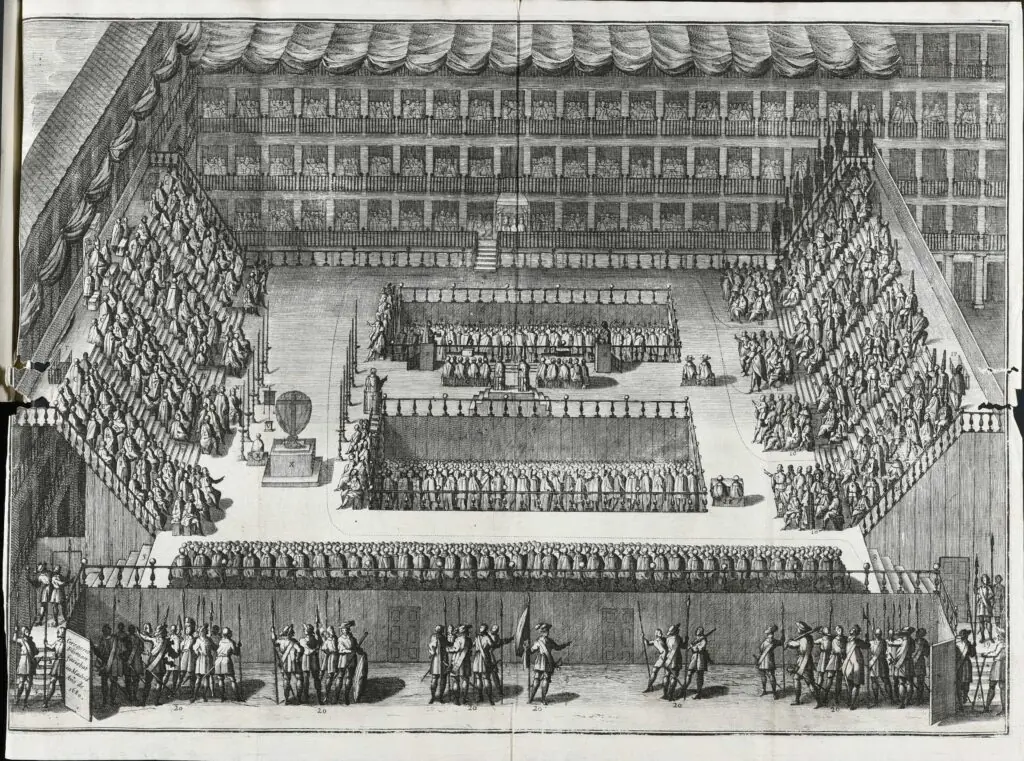
On August 29, 1614, the Suprema sent the Logroño tribunal an Instrucción en materia de brujos (instruction on witchcraft matters) that adopted nearly all his theses: strict evidentiary requirements, the order that sambenitos (penitential garments) not remain on display in churches, thus avoiding perpetual stigma on families, and reparation measures for the victims.
It was the end of inquisitorial executions for witchcraft in Spain, decades before much of Europe. Salazar ended up as a councilor of the Suprema itself from 1631.
The Danish historian Gustav Henningsen called him, in the title of his landmark 1980 work, The Witches’ Advocate. It is a beautiful title and slightly unfair. Salazar did not defend the witches. He defended the case file: he maintained that a tribunal cannot convict without proof and that a procedure that manufactures its own answers is not measuring the world.
It is the least epic and most useful lesson this trade has given. And that is why, when here at Broken UFO we talk about official reports that do not square with their own body of documents, the name to keep in mind is not that of any modern figure. It is that of a licentiate in canon law who in 1612 put himself through eight months on the roads of the north so that he could say, with eleven thousand pages under his arm, that there was nothing there.