Mari of Anboto: the lady of the cave who punishes only those who lie
She asks for no worship and no temple. She punishes lying, theft, boasting and breaking one's word. She is the supernatural sanction of a mountain social contract, and what we have stuck on top of her over four centuries is a manual on how a tradition gets falsified.
Mari, also called Anbotoko Dama, is the central figure of the Basque mythological corpus collected by ethnographic means between the late 19th century and the mid-20th, mainly by José Miguel de Barandiarán and Resurrección María de Azkue. She is attributed a dwelling in caves on several mountains, control of the weather, travel through the air and subterranean wealth, and she punishes a very specific set of social offenses: lying, stealing, boasting, breaking one's word and refusing help. On that base have been superimposed a Christianizing layer, an assimilation to witchcraft coming from the inquisitorial apparatus and a contemporary reading as a prehistoric mother goddess, the last without support in the sources.
Executive summary of the case file. Everything essential before you dig deeper.
Fact sheet
OSINT - Traceability
Intelligence Network
Today I put down the black marker and the org charts. Today we go to the Duranguesado, and we go with our caps in our hands.
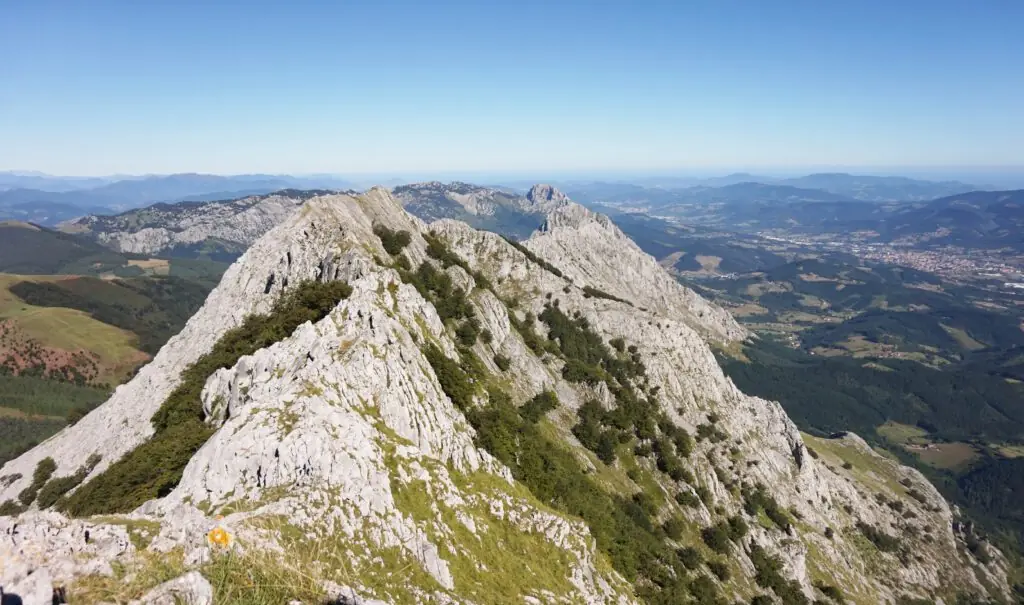
Anboto is a limestone wall some thirteen hundred meters and change that rises like a spine between Bizkaia and Álava. From the valley it looks enormous and it is hard to see: its head is almost always in a cloud. On its slope there is a cave. And in that cave, according to what the grandparents of those valleys told those who bothered to ask them, a lady lives.
She is not a ghost. She is not a demon. She is not, and this is important, a witch in the sense the Inquisition gave the word. She is Mari, and to understand what she means you have to leave at the door practically everything you think you know about mythology.
The verifiable first: who wrote this down, and when
I get down to my own work here too, even if today the papers don’t come from a ministry.
Everything we know about Mari comes from fieldwork. From people who climbed up to the farmsteads with a notebook, sat by the fire and asked. The central name is José Miguel de Barandiarán, priest and ethnographer, who began collecting tales systematically in the 1920s and kept at it, with an interruption of almost two decades of exile, well into the century. Alongside him we must cite Resurrección María de Azkue, who compiled a monument of oral tradition, and Julio Caro Baroja, who supplied the comparative framework.
And here comes the first warning, the one that matters most to me in the whole case file: there is no orderly Basque mythology. There is no sacred text, no pantheon with a hierarchy, no theology. What exists are hundreds of local tales, collected between the late 19th century and the mid-20th, often contradictory between one valley and the next, and always second or third hand with respect to the living tradition.
Barandiarán was the first to say so, and he said it uneasily: he put in order what he found, but the order was his. Any book that presents you with a clean, hierarchical Basque mythological system is selling you a 20th-century reconstruction as if it were an intact inheritance. And that, here at Broken UFO, is exactly the same sin as citing a report you haven’t read.
What we have is the transcription of what some grandparents remembered in 1925, not the voice of an ancient people. It is a great deal, and it is something else.
The other route
The Logroño trial of the residents of Zugarramurdi imposes on the imagination a vocabulary foreign to the local tradition: that of European demonic witchcraft. The word sorgin is contaminated for centuries.
The first collectors
Folklorists and romantic travelers begin to note down legends from the Basque Country, often embellishing them and fitting them into the literary molds of the time.
The serious work begins
José Miguel de Barandiarán founds the Anuario de Eusko-Folklore and begins the systematic collection of tales with ethnographic method: identified informant, locality, date and verbatim version.
The great corpus
Resurrección María de Azkue publishes his monumental compilation of Basque oral tradition. Together with Barandiarán's work, it forms the basis of everything we know today about Mari.
The parenthesis
War and exile interrupt the fieldwork for almost two decades, just when the oldest generation of informants was being lost. It is an irreparable documentary loss.
The synthesis
Barandiarán publishes his synthesis of Basque mythology, in which he orders the collected material and himself warns of the fragmentary nature of the sources.
Depopulation
The abandonment of the farmstead and the end of oral transmission close off the source. From here on, what circulates is no longer tradition: it is reading books about tradition.
Who Mari is, according to what was collected
On to the portrait, and I will try to make it without embellishment, which is the perennial temptation.
Mari appears almost always as a woman. Sometimes elegantly dressed, sometimes combing her hair with a golden comb at the mouth of the cave. Other versions describe her crossing the sky like a sickle of fire, or in a chariot, or as a flame going from one mountain to another. She lives underground, in caves and chasms, and not in just one: she changes residence among several mountains of the country, and that change is meteorological. Depending on the direction of her journey, drought will come or rain will come. The versions vary from one valley to another, which should not surprise us: each district arranged the myth within its own horizon.
A partner is attributed to her, Sugaar (also called Maju), serpentine in nature, and storms are born of their meeting. Underground she keeps wealth, but it is a wealth that punishes: what is taken from her cave out of greed turns into coal or something useless on reaching the valley.
And now the part I find extraordinary
Mari does not punish impiety. She does not punish heresy. She asks for no worship, no temple, no prayer. What she punishes is this:
- Lying.
- Stealing.
- Boasting, pretending to be what one is not.
- Not keeping one’s word.
- Refusing help to someone who needs it.
Read it again. That list is a code of coexistence, more than a religion, for a rural mountain society, where survival depends on the neighbor doing what he said he would do and on nobody moving a boundary stone at night. Mari is the supernatural sanction of a very concrete social contract. A people living scattered in farmsteads, with no authority nearby, needs someone to keep watch from the mountain. And they put her on watch.
The protocol of the cave
There is a detail that fascinates me and that convinces me of the antiquity of the core of the myth more than anything else: the rules of etiquette for visiting her, collected with notable agreement in different districts.
- Do not sit down inside the cave.
- Address her in the same form she uses with you, neither more familiar nor more ceremonious.
- And leave walking backward, without turning your back on her.
This is etiquette, not postcard folklore. It is the protocol of an audience with someone of higher rank, exactly the one followed before a court or before a lord. That the tradition preserves the rules of the visit more precisely than the description of the one visited says a great deal about how collective memory works: what one must do is preserved far better than what one must believe.
What has been stuck on top of her
And here comes the cleaning work, which is what we do with documents here at Broken UFO and what must be done just the same with tales.
Layer one: Christianization
In several collected versions, Mari stops being a figure of the earth and becomes a punished lady: a proud noblewoman, or a woman cursed by her mother, condemned to live on the mountain. It is a universal and perfectly identifiable pattern. When a new tradition cannot erase an old figure, it demotes her: it turns her into a punished human being. She ceases to be a power and becomes a moral example.
Layer two: witchcraft
This is the most damaging one, and I have told it in detail in the Zugarramurdi case file. The European inquisitorial apparatus arrived with a closed vocabulary (demonic pact, coven, flight, sabbat) and applied it on top of local beliefs that had nothing to do with it. The word sorgin ended up translated as “witch” and carrying the whole weight of the 1610 trial. From then on, any female figure in the Basque tradition fell under suspicion by contagion.
It should be said plainly: Mari is not a witch. She is not one in the sources that record her, she does not share a witch’s attributes and she does not belong to that conceptual universe. To call her one is to repeat the classification of a 17th-century court.
Layer three: ours
And the most recent, the one that falls to us. Since the 1970s a reading has circulated of Mari as the mother goddess of a prehistoric European matriarchy, a survivor of a religion older than the Indo-Europeans. It is a beautiful idea, it has enthusiastic partisans and it is not supported by the sources. What we have are tales collected in the 20th century in a rural Christian society. To project from there six thousand years back is a leap of faith, not a conclusion.
Let me be clear, just in case: I am not saying it is false. I am saying it cannot be known, and that whoever asserts it with certainty is doing to ethnography what the person who sees a spacecraft does with an out-of-focus video. Filling the gap with what they would like to be there.
Why this is in an OSINT archive
Someone will wonder what a lady from a cave in Bizkaia is doing among case files on radars and defense laws. She is doing a lot, and I’ll explain.
Because here we see, cleanly and in slow motion, the complete process that in the contemporary matter we always see only halfway: how an experience becomes a tale, how the tale is standardized, how an institution imposes its vocabulary on it, how a later era reinterprets it according to its ideological needs, and how in the end people swear that the last layer is the original. It is the same sequence that runs from the man who sees a light over a hill to the documentary that assures us something landed there.
And there is a second reason, a more personal one. In this trade, oral tradition is treated as raw material for speculation. You take a legend, strip out the context, put an ancient-visitors hypothesis on top and start selling books. That strikes me as disrespect toward people who can no longer protest. Barandiarán’s informants had names, had farmsteads, and trusted a gentleman with a notebook. The least we can do is cite them for what they said and not for what suits us.
Of everything that was collected about her, what I can’t shake is the list of offenses. Lying, stealing, boasting, breaking one’s word. A whole society put someone at the top of a mountain, with her head in a cloud, to watch for precisely that. I don’t tremble at the thunder. I tremble at the aim.
OSINT – Source traceability
It is expressly warned that there is no closed Basque mythological system and that the current order comes from the 20th-century collectors. Three later layers habitually presented as tradition are explicitly rejected: the Christianizing, the inquisitorial and the prehistoric-matriarchy ones. Local variants are presented as such and the tale is not unified.