
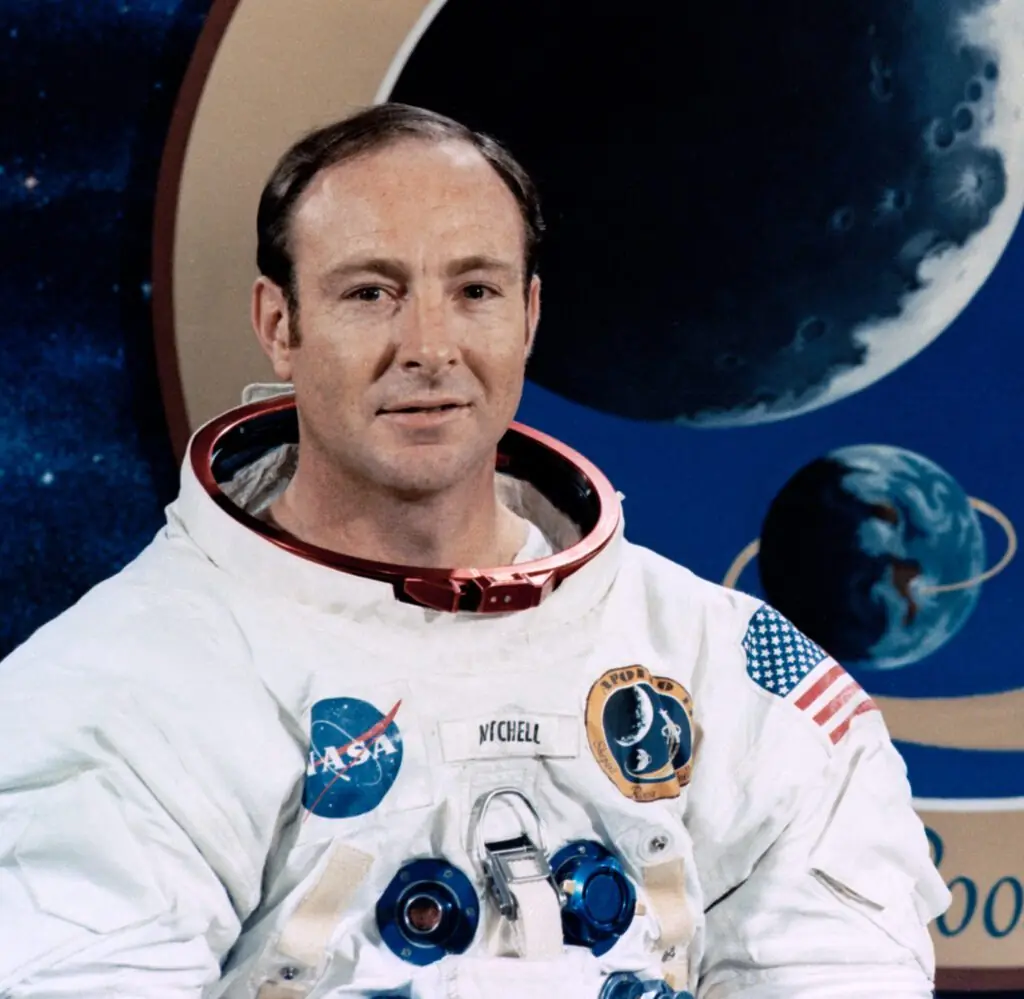
This profile, friends, is about a logical error with a name and a surname. It is called transferred authority, and it works like this: if someone has walked on the Moon, what they say about extraterrestrials weighs more than what your brother-in-law says. It sounds reasonable. It isn’t. Edgar Dean Mitchell walked on the Moon in February 1971, and that makes him a witness to the Moon, not to Roswell.
Time to separate the two things with the papers in front of us, because Mitchell deserves both columns. The astronaut’s, which is impeccable. And the lecturer of his later years, which is something else and which many people cite as if it were the same.
The astronaut: the impeccable column
What can be verified comes first. Mitchell was born in Hereford, Texas, in 1930 and grew up in New Mexico. He graduated from Carnegie Tech in 1952, joined the Navy, flew as a pilot and earned a doctorate in aeronautics and astronautics at MIT in 1964. In 1966 NASA selected him as an astronaut. So far, a textbook résumé: engineer, pilot, doctor.
He was the lunar module pilot of Apollo 14, with Alan Shepard as commander and Stuart Roosa in the command module. On February 5, 1971 they landed in the Fra Mauro region, and Mitchell became the sixth human being to walk on the Moon. His two moonwalks added up to more than nine hours. Nobody disputes any of this: it is in the mission transcripts and in NASA’s archives.
Having gone to the Moon makes you a witness to the Moon. Nothing else.
The trip home: Zener cards and an institute
During the flight, Mitchell ran an extrasensory perception experiment on his own: he tried to transmit the symbols on a set of Zener cards mentally to people on the ground. It was not a NASA experiment and it had no protocol published in advance, and the results he defended did not convince the scientific community. But it is the first paper that announces what would come later.
He said that on the return trip, looking at the Earth through the window, he had an experience of unity that changed his life. In 1973 he founded the Institute of Noetic Sciences, devoted to studying consciousness, and in 1996 he published The Way of the Explorer. All of that is legitimate as personal biography. The problem starts when that biography is used as a credential for something else.
The 2008 radio interview and what NASA answered
In July 2008, in an interview on the British station Kerrang! Radio, Mitchell said that Earth had received extraterrestrial visits, that the Roswell case was real and that governments had covered it up. The line went around the world in hours, under the kind of headline you can imagine: an Apollo astronaut confirms… NASA responded that it does not track UFOs or take part in any cover-up, and that it did not share Mitchell’s views on the matter.
Now, the paper that matters. Mitchell did not claim to have seen anything. What he told, he attributed to other people: locals from the Roswell area and military and intelligence contacts who, according to him, had confirmed things to him, with no verifiable names or documents ever published. In other words: secondhand testimony, without verifiable sources, told by someone whose prestige came from somewhere else.
It is the same underlying problem that David Grusch’s statement to Congress had in 2023: what others told him, with no papers to go with it.
What he can be faulted for
This site does not hand out medals, not even to those who walked on the Moon. The main reproach is precisely that: he let his astronaut’s uniform vouch for claims he could not support with documents. He knew better than anyone that his word carried disproportionate weight, and he used it to amplify rumors without providing a single paper. In Astro language: if you are asked to believe something because someone important says it, first ask what they have signed.
The second is more prosaic and also documented. In 2011 NASA sued him to recover a camera from the mission that he had kept since 1971 and tried to auction. The lawsuit ended in a settlement and the camera ended up in the National Air and Space Museum. It has nothing to do with UFOs, but it says something about his relationship with the line between what is private and what is public.
Why it matters
- An astronaut is an excellent witness to what he saw. Mitchell did not claim to have seen anything.
- A rumor told by someone important is still a rumor. With a better microphone.
- NASA answered. That answer circulates far less than the headline.
And it is exactly the opposite of the rule popularized by Carl Sagan: the more extraordinary the claim, the more solid the proof must be, not the résumé of the person making it. Mitchell matters because he is the textbook case of the argument from authority on this subject, and because his list of real accomplishments makes it harder to see. He died in West Palm Beach on February 4, 2016, the eve of the forty-fifth anniversary of his moon landing. He did walk on the Moon. The rest, friends, is still waiting for the papers.