
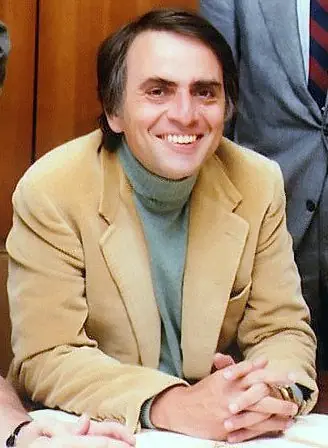
Friends, today we deal with a name everyone thinks they know. Carl Sagan: the corduroy jacket, the turtleneck, the series Cosmos on half the planet’s evening television. What almost nobody remembers is that Sagan sat at the tables where it was decided what to do about UFOs in the United States, and that those tables left papers. And you know by now that I care more about papers than about lights.
Today I’m after committees, minutes, symposia and a technical paper his admirers prefer not to look at too closely. Because Sagan was both the most influential skeptic of the 20th century and the scientist who did the most to get the search for extraterrestrial intelligence taken seriously. Both things are true, and they contradict each other much less than it seems.
The papers: three tables in four years
The verifiable part first. Sagan was born in Brooklyn in 1934, earned his doctorate at the University of Chicago in 1960 and spent almost his whole career at Cornell, working in planetary science: the atmospheres of Venus and Mars, the Mariner, Viking and Voyager missions. That is already a full life. But between 1966 and 1969 his name appears in three documents that interest this site more than any documentary.
One. In 1966 he served on the special committee chaired by Brian O’Brien that the U.S. Air Force created to review Project Blue Book. That committee recommended that universities study the cases, and from that came the commission to the University of Colorado that Edward Condon would end up directing. Two. On July 29, 1968 he was a speaker at the House of Representatives symposium, alongside J. Allen Hynek and James E. McDonald.
Three. In December 1969 he organized, with Thornton Page, the symposium of the American Association for the Advancement of Science in Boston, despite opposition from some colleagues who preferred not to give the subject that showcase, Condon among them. The papers came out as a book in 1972: UFO’s: A Scientific Debate. In Astro’s language: the guy who doubted the saucers argued that they should be discussed out loud. That doesn’t make him a cover-up man.
Extraordinary claims require extraordinary evidence. The phrase is not entirely his. The method is.
The phrase and its genealogy
He popularized the phrase everyone attributes to him in Cosmos (1980), but it has antecedents: the sociologist Marcello Truzzi had formulated something very similar a few years earlier, and the underlying idea is much older than both of them. What Sagan contributed was the loudspeaker. And a loudspeaker, on this subject, is half the battle.
In The Demon-Haunted World (1995) he devoted chapters to UFOs and abductions, with an argument that remains the best summary of reasonable skepticism: it is not a matter of saying something is impossible, but of asking to be shown. There is the parable of the invisible dragon in the garage. And there is also something that gets cited less: a respectful tone toward witnesses, whom he treats not as liars but as people describing something they really lived through, even if it was not what they believe.
What he can be faulted for
This site doesn’t hand out medals, not even to those who appear on TV in good lighting. First reproach, and it is a paper: in 1963 Sagan published in Planetary and Space Science a technical article on direct contact among galactic civilizations through relativistic interstellar travel, in which he speculated that Earth might have received visits in historical times and that traces might remain in ancient myths. It was declared speculation. The ancient astronaut industry read it as an endorsement, and still cites it.
Second reproach: the asymmetry. Sagan energetically defended funding the search for radio signals, a program that found nothing for decades, while dismissing UFO reports with considerably less patience. There are scientific reasons for that difference (a radio signal can be repeated and measured, a sighting cannot), but he did not always explain them. Often irony was enough for him, and irony is not an argument.
Third: the statue. His popularity turned each of his opinions into an argument from authority, exactly what he said he fought against. Many people repeat that “Sagan proved there are no UFOs.” He did not prove that, nor did he claim to. What he said is that there was not enough evidence, which is something else and considerably more honest.
Why it matters
Because he set the rules of the game for everyone who came after, on both sides. To believers he left the yardstick; to skeptics, the obligation not to mock. And to the official programs of the 21st century, three warnings they still haven’t fully read:
- Without raw data there is no case: there is an anecdote with a good budget.
- Without outside review there is no conclusion: there is a press release.
- Without being able to say “we don’t know” there is no science: there is marketing, from the Pentagon or from your cousin.
He also worked with Frank Drake on the Pioneer probe plaque and the Voyager golden record, and wrote the novel Contact (1985), whose protagonist, as has been told many times, owes a lot to Jill Tarter. That is: the greatest skeptic of the saucers spent half his life preparing the greeting in case someone answered. We have our own case file on that search, and on the Drake equation too.
He died in Seattle on December 20, 1996, at the age of sixty-two. He left a phrase that was not entirely his and a method that was. Keep the method; everyone already repeats the phrase.