
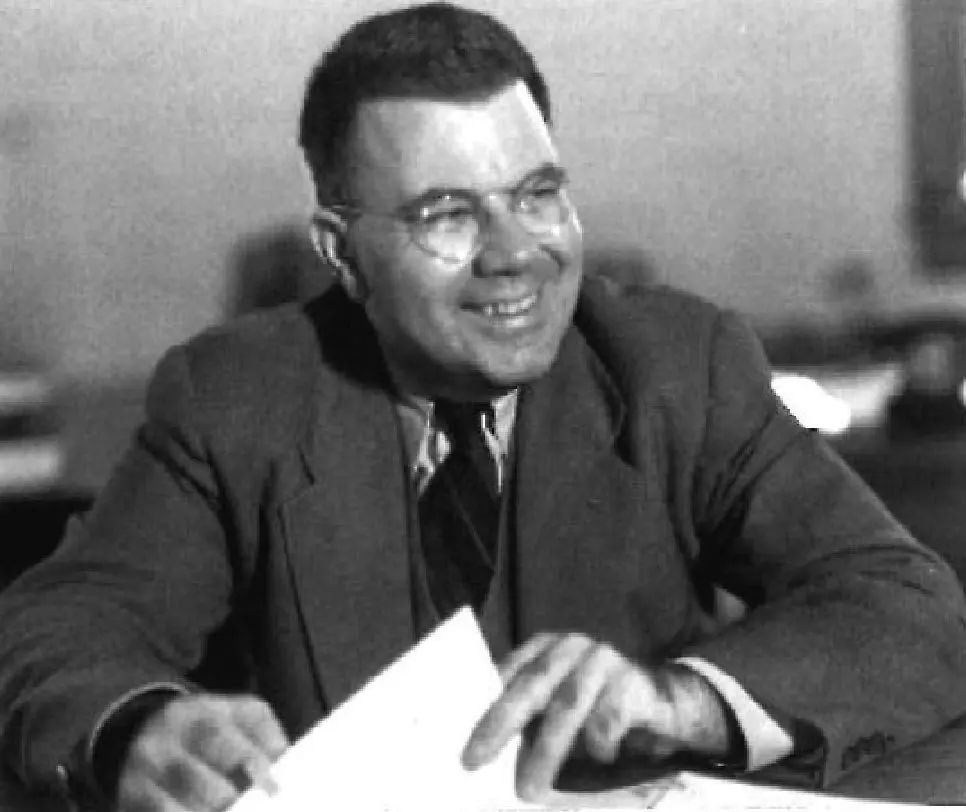
Some signatures weigh more than the document that carries them. Edward Uhler Condon’s signature on the University of Colorado report still weighs more, today, than the whole volume that follows it. Hardly anyone who argues about UFOs has read the entire report; they have read its summary, which he wrote, and on that basis they have decided whether or not to forgive him.
Condon did not come to that assignment as a gray functionary. He came as one of the most brilliant physicists of his generation, with a principle of quantum mechanics that bears his name and a political scar that would have sunk anyone else: the House Un-American Activities Committee had singled him out as a risk to the country’s atomic security. They were asking a man who had already been judged without evidence to judge a mystery.
What he did before the saucers
The verifiable first. Condon was born in 1902 in Alamogordo, New Mexico, not far from the test range where, forty-three years later, the first atomic bomb would go off. He earned his doctorate at Berkeley in 1926 and spent time in Germany in the years when quantum mechanics was fresh out of the oven, and from that came the Franck-Condon principle, which explains the intensity of vibrational transitions in molecules and is still taught in any spectroscopy course.
With Philip Morse he wrote one of the first quantum mechanics textbooks in English (1929), and with George Shortley, The Theory of Atomic Spectra (1935). He worked at Westinghouse as associate director of research, and in 1943 he accepted the post of Oppenheimer’s number two at Los Alamos. It lasted a few weeks: he resigned because the compartmentalization of information struck him as incompatible with doing science. In 1945 he was named director of the National Bureau of Standards.
In 1946 he served as president of the American Physical Society. Two years later, the House Un-American Activities Committee described him as one of the weakest links in atomic security. Nothing was proved. Truman defended him in public and the scientific community closed ranks, but suspicion followed him for years, with reviews of his security clearance that reopened like badly closed wounds.
The Colorado assignment
In October 1966 the Air Force contracted with the University of Colorado for an independent study of UFOs, and Condon agreed to direct it. It was the way out the Air Force itself had been looking for since that same year’s review by the O’Brien committee: a university, with prestige and without a uniform, would say whether it was worth continuing with Project Blue Book. The team, made up of physicists, psychologists and astronomers, worked for two years.
The final report, Scientific Study of Unidentified Flying Objects, was published in January 1969. Its overall conclusion, written by Condon, was that nothing studied in the previous twenty-one years had added to scientific knowledge and that further study of UFOs did not seem justified in the hope that science would advance as a result. A committee of the National Academy of Sciences reviewed the method and endorsed it. In December 1969, the Air Force announced the closure of Blue Book. The document has its own entry in this archive.
Condon signed the conclusion. His investigators signed the chapters. They did not always say the same thing.
What he can be faulted for
The bill of charges is long and documented, so it deserves a slow reading. The gravest item was not written by him: in August 1966, before the work began, the project coordinator, Robert Low, drafted an internal memorandum proposing that the study be presented to the public as objective and to the scientific community as the work of a group of skeptics. That paper was a statement of intent on university letterhead.
When two members of the team, David Saunders and Norman Levine, got the memorandum out of the project, Condon fired them in February 1968. In May, Look magazine published a report by John G. Fuller that told the episode in full detail. The damage was irreparable: ever since, every conclusion of the report has been read in the light of that paper, whether it deserves it or not.
The second charge is his own. Condon made scornful public comments about the subject when the study had barely begun, and he was little involved in the analysis of specific cases. The third is structural: the summary does not faithfully reflect some chapters. The classic example is the McMinnville photographs, which the analyst William K. Hartmann considered one of the few cases in which all the factors studied were consistent with what the witnesses described.
Later analyses reached opposite conclusions, but that does not erase what the report itself said in its pages.
What must be granted him
Now the other column of the ledger, because there is one. The Condon report is not a farce. It contains serious analyses of photographs, radar and individual cases, and most of its explanations have held up for half a century. The conclusion that the study of UFOs had not advanced science up to 1968 was defensible then and remains so in its literal sense. What was debatable was the leap to recommending that they not be studied any further.
Nor should we forget who was signing. Someone who had seen up close how a congressional committee could shred a reputation without evidence had reason to distrust conclusions that rest only on insistence. The irony is that, in his own project, the procedure handed his adversaries exactly the kind of ammunition that had once been fired at him.
Why it matters
Condon matters because his signature closed the official phase of UFO study in the United States for more than thirty years. Everything that came afterward was written against his shadow or in its favor. James E. McDonald devoted his last years to rebutting him, and the 1968 House of Representatives symposium was held while the Colorado team was still at work.
He died in Boulder in March 1974. He left behind a principle of physics that no one disputes and a report that never stops being disputed. Both carry his name. Only one can be studied in peace.