
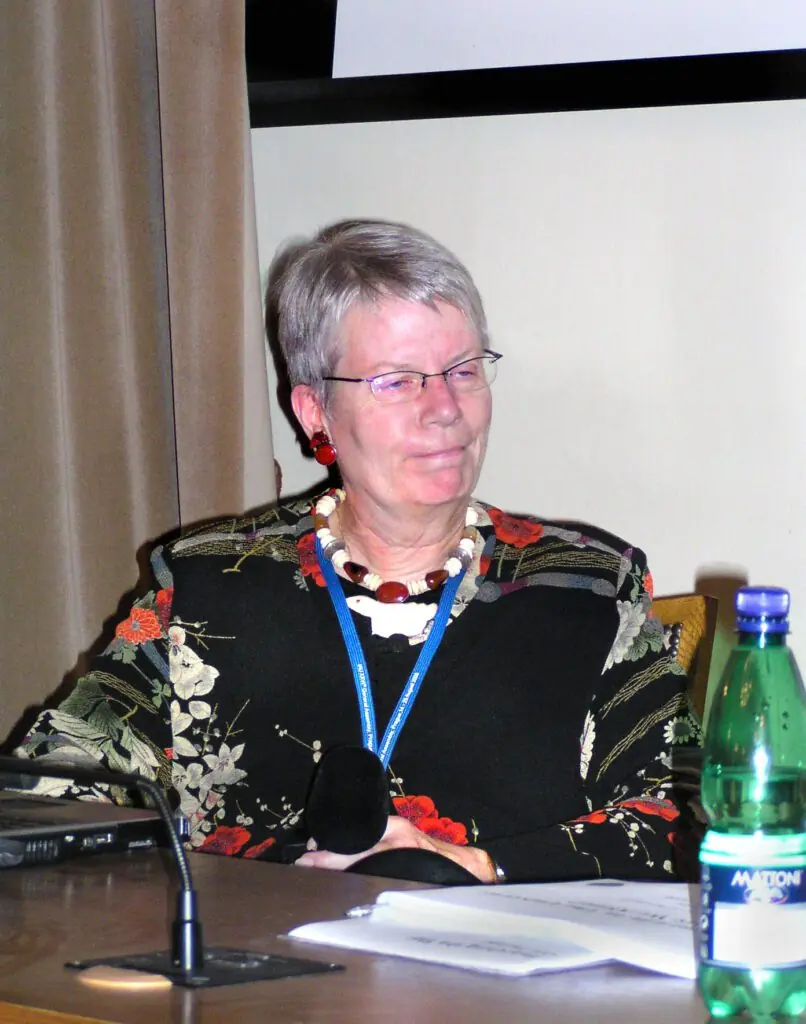
Friends, this one is right up my alley. Jill Cornell Tarter is probably the person who has devoted the most telescope hours to listening for whether anyone is calling us, and she has done it without ever promising that the phone would ring. In a field where half the congregation announces revelations for next Tuesday, that is almost an act of resistance.
Her story is told with the papers in front of us: degrees, programs, budgets canceled by Congress and antennas left half built. Because Tarter’s story concerns funding, patience, and how a scientific question is sustained when public money walks away, rather than lights in the sky.
The papers: from Cornell to brown dwarfs
The verifiable first. Tarter studied engineering physics at Cornell, where she was one of the few women in her class, and earned her PhD in astronomy at Berkeley in 1975. In her thesis she coined a term that is now in every textbook: brown dwarf, for objects that fall halfway between a star and a planet. For that alone she would have a place in the history of astronomy.
But her path led toward radio. She worked on signal search programs at Berkeley and with NASA, and she was at the SETI Institute from its early days, in the mid-1980s. When NASA launched its major search program in the early 1990s, Tarter was part of the team. And when Congress cut its funding in 1993, she had to watch a federal program vanish with one stroke of a budget pen.
Some redactions don’t come with a black marker. They come with a budget line set to zero.
Phoenix: listening on private money
The answer was Project Phoenix, and the name was no accident. Between 1995 and 2004, with private funding, Tarter directed the search that inherited NASA’s program: some eight hundred nearby stars observed with large radio telescopes, Arecibo among them. Result: no confirmed artificial signal. And that is the part I love, because she never sold it as a failure, but as what it was: a data point.
She has often used an image to explain it: what has been explored so far is equivalent to scooping a glass of water out of the ocean and concluding there are no fish. It is a way of saying that the absence of a result in a minuscule sample proves nothing. In Astro language, friends: “we haven’t found any” and “there are none” are different sentences, and the one that goes in a report is the first.
Contact, TED and a half-built array
Carl Sagan wrote the novel Contact (1985), and its protagonist, Ellie Arroway, closely resembles Tarter, something that has been told many times. Jodie Foster spoke with her to prepare for the role in the 1997 film. In 2004 TIME magazine included her among the hundred most influential people, and in 2009 she received the TED Prize, which she used to ask that anyone be able to take part in the search.
And then there is the Allen Telescope Array, at Hat Creek, California, funded largely by Paul Allen. The project spoke of hundreds of antennas; forty-two were built, and in 2011 the array had to be temporarily shut down for lack of funds to operate it. The science of patience depends, like everything, on who signs the checks.
What can be held against her
Here at Broken UFO we don’t hand out medals, not even to the ones I like. What can be held against Tarter is not a matter of method but of expectations. The Hollywood connection helped fund the search, but it also sold the public an idea of SETI with a happy ending two hours away. When the program needs money, that idea helps; when decades pass without a signal, it turns against it.
And the Allen Telescope Array fell far short of what was announced. No one person is to blame, but she was the face of the project, and when an infrastructure is promised and a fraction is delivered, credibility suffers for everyone. Without forgetting, however, that she has been one of the clearest voices in separating SETI from ufology: listening for signals is not chasing lights.
Why it matters
- Because she turned a search without results into a program with method that publishes its own limits.
- Because she survived a cut by Congress without pulling a signal out of her sleeve to justify the next budget.
- Because she separates what has not been found from what does not exist, which is exactly the line the sellers of revelations cross every week.
Her story is told alongside that of Frank Drake, who set the template, and that of the equation that bears his name. Without the Wow! signal nobody would have dreamed so much; without people like Tarter, nobody would have checked anything. The rest of that story is in SETI: more than six decades listening.
Thirty years listening and hearing nothing, and never ceasing to publish that nothing has been heard. There are fewer people capable of that than it seems.