
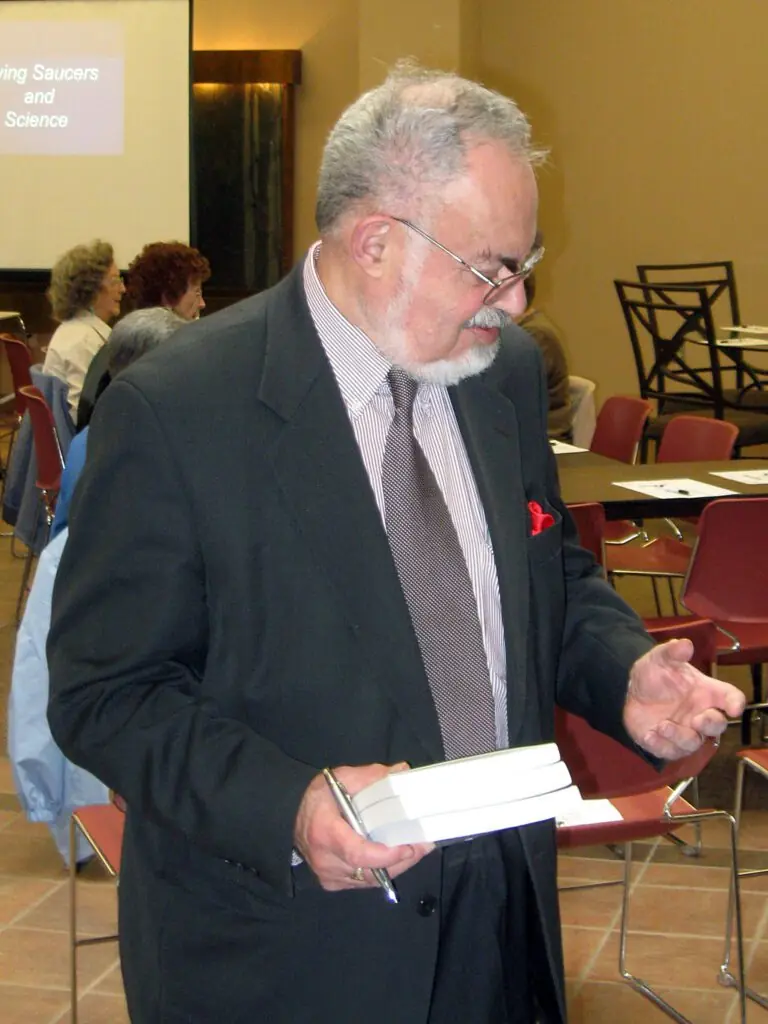
I have had an index card with his name on it for more than thirty years, and it still won’t fit on one. Stanton Terry Friedman was a nuclear physicist for fourteen years, a flying saucer lecturer for almost fifty, and the man who in 1978 went looking for a retired officer named Jesse Marcel and, with that visit, reopened Roswell. All of that is true and documented. What is harder to decide is what we do with it.
Because Friedman was no contactee and no seller of courses. He held a master’s degree in nuclear physics from the University of Chicago and had worked on nuclear aircraft and fission rocket programs for companies with names and invoices. And that is precisely why his case is uncomfortable: it is proof that method does not come with the degree. You practice it every morning, or you don’t.
Fourteen years of physics on the payroll
The verifiable first. He was born in Elizabeth, New Jersey, on July 29, 1934, spent two years at Rutgers, and graduated from Chicago in 1955, with the master’s in nuclear physics the following year. Between 1956 and 1970 he worked for General Electric, Aerojet General Nucleonics, General Motors, Westinghouse, TRW and McDonnell Douglas, on programs that now sound like science fiction and were then federal budget lines: nuclear propulsion for aircraft, fission and fusion rockets, power plants for space.
That is the Friedman he always put first, and rightly so: there were not many résumés like it in 1970s ufology. He had been lecturing on UFOs since 1967, and in 1970 he left physics to do it full time. What followed, by his own count, was more than six hundred universities, a hundred professional associations and some twenty countries. Two appearances before the U.S. Congress and one address at the United Nations. A physicist with a suitcase.
Flying saucers are, by definition, unidentified flying objects; but very few unidentified flying objects are flying saucers.
Paraphrase of a line attributed to Friedman in his lectures, recorded in his encyclopedic biography.
The day he went looking for Major Marcel
By 1978 Roswell had been dead for thirty years. It was a two-day news item from July 1947, a balloon denied at Fort Worth and nothing more. Friedman tracked down Jesse Marcel, the intelligence officer who had collected the debris at the ranch, and Marcel told him that the material displayed to the press was not what he had seen. From that conversation, and from those with other witnesses who kept turning up, came what is now called the Roswell case.
It is told in our case file, with its chronology and its balloon. Here all that matters is who came knocking at the door.
Here is a service-window detail I like very much. The book that made it all public, The Roswell Incident (1980), was signed by Charles Berlitz and William Moore. Friedman was credited as a researcher. The man who had opened the file was left off the cover, and it took him twelve years to sign his own version, Crash at Corona (1992), with Don Berliner. By then the story no longer had one saucer but two, and eight crew members. Stories, when they grow, don’t apply for a building permit.
Born in Elizabeth, New Jersey
Ashkenazi Jewish family. High school in Linden.
Master's in nuclear physics
University of Chicago. Joins General Electric the same year.
First lectures on UFOs
Combined with his work as a physicist until 1970.
Interview with Jesse Marcel
The retired officer rejects the balloon version. Roswell is reborn.
The Roswell Incident
Berlitz and Moore sign it; Friedman is listed as a researcher.
A roll of film in Jaime Shandera's mailbox
Undeveloped, in a brown paper package postmarked New Mexico. These are the MJ-12 documents.
The MJ-12 documents are made public
Promoted by Shandera, Moore and Friedman.
The FBI declares them completely bogus
After confirming that no such committee was ever authorized or formed.
Top Secret/Majic
Friedman maintains there is no substantive basis for ruling out their authenticity.
Dies in Toronto
At the airport, on the way home. He was 84.
What he must be reproached for
This site hands out no medals, and Friedman earns two serious reproaches. The first is called Majestic 12. In December 1984 an undeveloped roll of film turned up in Jaime Shandera’s mailbox, inside a brown paper package postmarked New Mexico. Once developed, it held a memorandum attributed to Truman dated September 1947 and a briefing document for Eisenhower dated November 1952. A secret committee of twelve wise men managing the Roswell wreckage.
Too neat. And too timely: it arrived by mail, with no return address, to the exact person who had spent years looking for it.
On November 30, 1988 the FBI, after asking and being told that no such committee had ever been authorized or formed, wrote two words about the document: completely bogus. Philip Klass had also pointed out that Truman’s signature was a photocopy pasted from a genuine signature, down to the same accidental scratches, taken from an October 1947 memorandum.
Friedman, in 1996, published Top Secret/Majic and maintained that there was no substantive basis for ruling out authenticity. A physicist defending a photocopied signature. That is the reproach, and it is not a small one.
The second reproach concerns method, and it stings more because it came from a physicist. Friedman also defended Betty Hill’s star map and Marjorie Fish’s interpretation, which matched it to Zeta Reticuli, and he did so with the certainty of someone who already knows the answer. The Hill case is in its case file.
And when the Condon Report closed Project Blue Book in 1968, Friedman spent the rest of his life citing the more than six hundred “unidentified” cases in that archive as proof that something was there, without pausing on the fact that “unidentified” means exactly that: unidentified. His own line, the one about the saucers, said it better than he did.
Why it matters
It matters because it is the cleanest case I know of a question this trade avoids: what is the credential for? Friedman had the best of his generation and used it, for five decades, to sustain conclusions he had reached before he had the evidence. He did not lie, as far as I know. He did not invent witnesses or documents. He did something more common and sadder: he believed those who arrived in his mailbox.
And yet, without him, Roswell would be a two-day note in a newspaper morgue. The same man opened the case file that occupies us most today and defended the most famous forgery in the field. My colleague Jon Aguirrezabalaga would say a stamp is a stamp; I say a pasted signature is not a signature either. We are both right, and Friedman, in his archive in Fredericton, has both things stored in the same box.
He died on the night of May 13, 2019 at the Toronto airport, returning home from a talk in Columbus, Ohio. At eighty-four he still traveled with a suitcase full of photocopies. That, at least, nobody can dispute.