
Dulce, New Mexico: Anatomy of a Base That Does Not Exist
Seven levels beneath a mesa, a security chief who appears in no record, and an origin that is documented: a disinformation operation with a known victim.
The legend of a seven-level underground facility beneath Archuleta Mesa, in Dulce, does not come from any verifiable witness. Its documented origin is the disinformation operation that the U.S. Air Force Office of Special Investigations carried out against businessman Paul Bennewitz between 1980 and 1983. The real starting phenomenon, the dead cattle of northern New Mexico, was investigated with public funding, and the 1980 report concluded that the injuries were consistent with scavenging and decomposition. The internal documents that support the detailed version are attributed to a person who appears in no record.
Executive summary of the case file. Everything essential before you dig deeper.
Fact sheet
OSINT - Traceability
Some places become famous for what happened in them, and some become famous for what did not. Dulce, New Mexico, belongs to the second category with an almost comic thoroughness: it is known in half the world for housing a seven-level underground facility that no one has seen, that appears in no record and that, if it existed, would be dug beneath the sovereign territory of an Indigenous nation that has never been consulted about it.
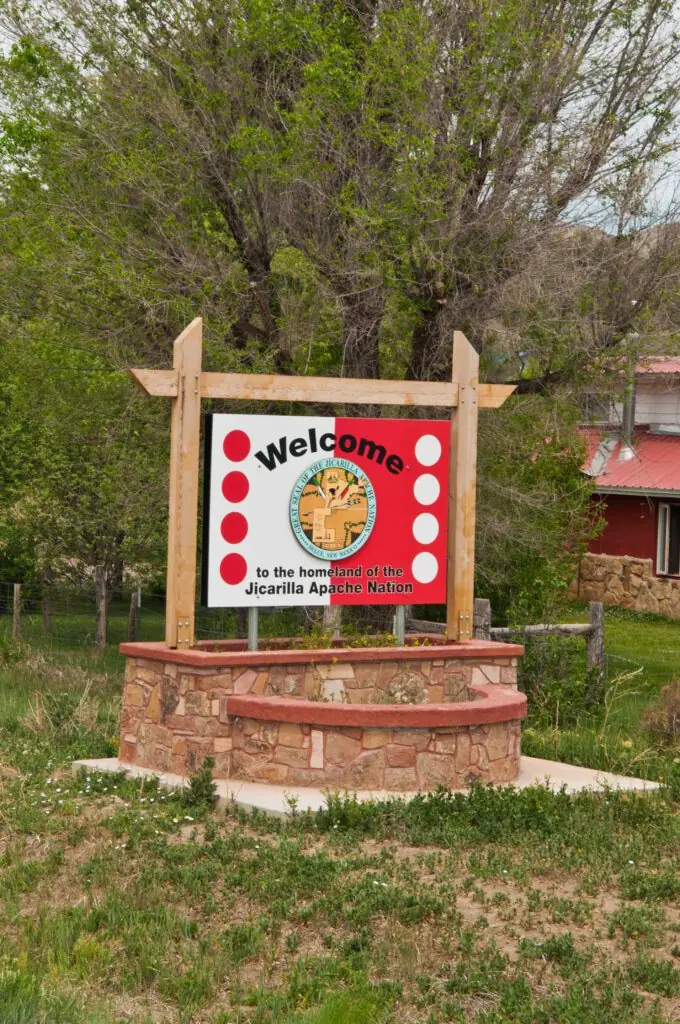
Dulce is a small town in Rio Arriba County, in the north of the state, almost touching Colorado. It is the capital of the Jicarilla Apache Nation. It has a couple of thousand inhabitants, one highway, a high school and a landscape of red mesas. To the north rises Archuleta Mesa, which is where the legend places the door.
What follows is the genealogy of that legend, which can be reconstructed almost entirely from public documentation and which turns out to be a far more interesting story than the one about the underground laboratory. Because at the origin of all this there is no witness: there is a disinformation operation by an intelligence service, and it is documented.
What can be verified, first
Let us start with what did happen, which is quite a lot and is recorded in real case files. In the mid-1970s, northern New Mexico went through a wave of cattle found dead with injuries that ranchers thought looked surgical. It was real in the sense that there were dead animals, complaints filed and officers taking statements. One of the affected ranches was right near Dulce, and a state police officer, Gabe Valdez, became deeply involved in the cases.
The matter worried people enough that a publicly funded investigation was set up. The district attorney’s office of New Mexico’s First Judicial District obtained a federal grant and assigned the work to Kenneth Rommel, a former FBI agent. Rommel spent months on it, examined cases in the field, commissioned necropsies and published his report in 1980.
His conclusion, which is public and can be read, was that the injuries were consistent with normal scavenging and decomposition. The soft tissues (lips, tongue, eyes, anus, udder) are the first that scavengers eat and the first to retract as they dry, and the resulting edges can look like clean cuts to the eye of a rancher who finds the animal two days later. It is neither comfortable nor popular, but it is the one that came out.
That is the substrate: a real phenomenon, distressing for anyone who lost cattle, with a conventional explanation that did not convince many people. Everything else was built on that substrate.
What is said to be down there
The canonical version describes a seven-level facility dug beneath Archuleta Mesa, shared by the United States Government and a non-human species, devoted to genetic engineering. It includes rooms with human beings in vats, sections given over to experimentation and an internal war in 1979 in which dozens of military personnel are said to have died. There are blueprints. There are descriptions of the levels. There is even the name of a former security chief who told it all.
And this is where the case file gets interesting, because that security chief appears nowhere. There is no service record, no Social Security number, no family, no photograph, not a single person who says they knew him. The documents attributed to him surfaced in the late 1980s, with no chain of custody and no verifiable signature. He is a witness made of paper.
The same goes for the rest of the narrative edifice. Not one employee, contractor, invoice or truck. A seven-level facility requires excavation, ventilation, power, water, spoil removal, staff coming and going, families living somewhere and a constant flow of supplies. None of that has left a trace in a town of two thousand people where everyone knows everyone.
The detail nobody mentions
And there is one point that seems decisive to me and that is conspicuously absent from the literature on the case: the land is the territory of the Jicarilla Apache Nation, which has its own government, its own powers and a relationship with Washington governed by treaty, rather than federal government land in the sense people imagine. The legend proposes, without saying so, that the State dug an underground city beneath Indigenous land without its owners finding out. It is a very grave claim made in passing, and one that no one has ever put forward before anyone.
Dead cattle
Wave of complaints about cattle found dead in northern New Mexico, some on ranches near Dulce.
The public investigation
The district attorney's office of the First Judicial District commissions Kenneth Rommel, a former FBI agent, to run a federally funded investigation. His report concludes that the injuries are consistent with scavenging and decomposition.
Bennewitz and AFOSI
Businessman Paul Bennewitz, convinced he is intercepting non-human signals near an air base in Albuquerque, receives false material from the Air Force Office of Special Investigations. The idea of the underground facility comes from this.
The “Dulce Papers”
Documents appear attributed to a security chief of the facility, about whom no verifiable data exists.
Amplification
The story enters circulation through lectures and widely distributed books, already detached from its origin.
Where it really came from: the documented part
The answer is in a case file that this site already has open and that is worth reading in full, because it is one of the few cases in which state disinformation is not a suspicion but an acknowledged fact.
In summary: in the late 1970s, an Albuquerque businessman named Paul Bennewitz, owner of a scientific instrumentation company, began recording lights and radio signals near a military installation close to his home. He became convinced he was intercepting non-human communications. And when he took his concern to the military, instead of reassuring him or ignoring him, someone decided to feed him.
They supplied him with false documents and self-serving confirmations. The goal, according to the later reconstruction, was twofold: to distract him from what was really going on at those installations and, in passing, to test how effectively a story could be injected into the community of researchers of the phenomenon. It worked perfectly. Bennewitz built an ever more elaborate account that culminated in an underground base, and that account was released into the world.
The human cost was considerable, and it should not be overlooked in the rush to tell the picturesque part: Bennewitz ended up with his mental health gravely impaired. He is not a character in an amusing legend. He is a real person who was manipulated until he broke, and the result of that manipulation is what is now told as if it were a discovery.
What it could be, without any Martians
The gas
The area sits on the edge of one of the largest natural gas basins in the United States. On the ground, that means very concrete things: wellheads, compressor stations, service roads cut in the middle of nowhere, trucks at odd hours, floodlights burning all night and a constant hum of machinery that carries for miles in a valley. Anyone who has driven at night through a hydrocarbon basin knows that it looks exactly like what people describe when they talk about secret activity beneath the mesa.
Low-frequency noise
A good part of the Dulce accounts include a persistent hum that is felt more than heard. It is a well-known phenomenon, documented in many places around the world, and its usual causes are industrial: compressors, pumping, ventilation. That a hum has no obvious source for the person hearing it does not mean it has none, especially in terrain where the energy infrastructure is in plain view of anyone with a map.
A documentary fraud with no author
And the third, the one that explains the blueprints. Fabricating the papers of an imaginary facility is a technique with a tradition in this field, and this site has case files on it: documents with an invented letterhead and sources manufactured from a publishing house. It costs little, leaves no trace and produces material that gets passed along for decades because it has the exact look of proof.
Why this case will not die
Because it has the structure of a good horror story and none of its obligations. A small town, a mesa, some lights, some dead animals and a door that no one can find. The absence of evidence suits the story as its setting. The less there is, the deeper the cover-up seems.
And it does not die because its real origin is so ugly that it is more uncomfortable than the legend itself. Saying that beneath Dulce there is a seven-level base is entertaining. Saying that an intelligence service set about systematically feeding the obsessions of a citizen until it ruined his mind, and that it worked so well that forty years later we are still repeating its content, is not entertaining at all. The latter, moreover, is documented.
There is an added injustice that is rarely mentioned. The legend places a human experimentation laboratory beneath the territory of a specific Indigenous community, with a name and a government, and does so without asking its opinion and without considering the harm that such a story does to a real place where real people live. The story talks about Dulce all the time and has never talked with Dulce.
The parallel with the genealogy of the men in black is exact in method: a fabricated element released into a receptive ecosystem which, after two or three transmissions, no one can trace back to its origin. The difference is that here the origin was traced, and it has the name of a military unit.
How to check that there is nothing under a mountain
It is often said that you cannot prove a negative, and in the abstract that is true. In concrete terms, when the negative takes the form of an industrial excavation, it can be approximated quite closely. Digging leaves traces, and those traces are wonderfully stubborn.
The first is material. An underground gallery generates a volume of spoil equal to the void it creates, and that spoil has to be hauled out and put somewhere. Spoil heaps are visible from the air, visible from space and, above all, permanent: vegetation takes decades to recolonize them, and the color of the displaced material gives away its origin. Aerial and satellite imagery of that region has existed for more than half a century, some of it from reconnaissance programs that are now declassified, and anyone can compare it.
The second is energy. A facility with forced ventilation, water pumping, refrigeration and permanent lighting consumes an amount of electricity that cannot be hidden. It needs a line, and a high-voltage line needs easements, towers, expropriations and a file in a public registry. In a rural district, moreover, it can be seen from the road.
The third is people. This is the argument that seems definitive to me. A seven-level facility requires staff in shifts, maintenance, security, kitchens, transport. Those people live somewhere, send their children to school somewhere, go to the doctor and draw a paycheck. In a low-density county with a town of two thousand inhabitants, that is a demographic change visible in the census, hardly a hidden workforce.
And the fourth is time. The claim is not from yesterday: it has been in circulation for more than forty years. In four decades Earth-observation technology has changed completely, to the point that today anyone can buy sub-meter resolution imagery of any point on the planet. No one has ever published a single image of Archuleta Mesa that shows anything. Not because looking is forbidden: because there is nothing to show.
What remains is the town, which is still there, with its highway and its high school and its two thousand inhabitants, carrying for forty years an underground city that was put on top of it without asking. Of all the things that have been invented in this trade, that is one of the least amusing.
OSINT – Source traceability
The alleged author of the Dulce Papers is not named as a real person because there is no record that he is one. The casualty figures for the supposed 1979 confrontation are not reproduced because they come from a document of unknown provenance. The Bennewitz case is dealt with in its own case file and is only summarized here.