
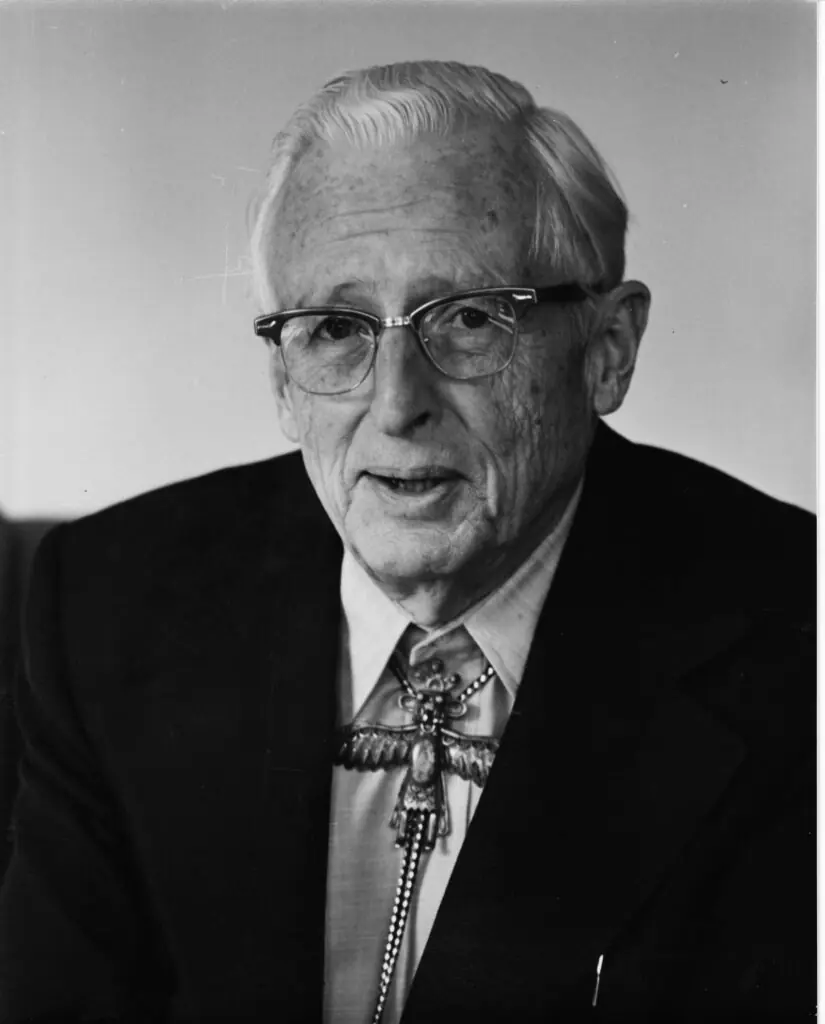
Some scientists walk into a debate the way you walk into a waiting room, and others walk in like the notary: with the stamp already inked. Donald Howard Menzel belonged to the second family. When he published his first book on flying saucers in 1953, the case file had been open for six years and he arrived with the ruling already signed: mirages, reflections, temperature inversions, light doing what light does.
The uncomfortable part is that, almost always, the ruling was correct. Menzel was no talk-show polemicist: he was one of the soundest astrophysicists of his generation, a specialist in the Sun and in the rarefied gases of its atmosphere, and director of the Harvard observatory. His problem was not the science. It was the manner of a man who processes petitions by the dozen without lifting his eyes from the counter.
What he did: the Sun first, the saucers later
The verifiable first, which is how you should walk down a dark corridor: feeling along the wall. Menzel was born in Florence, Colorado, in 1901, studied at the University of Denver and earned his doctorate at Princeton in 1924. He joined Harvard in the 1930s and spent nearly his whole career there. His field was solar spectroscopy, the chromosphere and the corona, the part of the Sun that can only be seen well during an eclipse or with very fine instruments.
He took part in setting up the high-altitude solar station at Climax, in the Rocky Mountains, and directed the Harvard observatory from 1952 to 1966. During World War II he served in the U.S. Navy on communications work with access to classified material, a discreet chapter of his biography that half a century later would have an unexpected second life.
Between 1952 and 1953, with the wave over Washington still in the newspapers, Menzel decided the matter was within his competence. And in a sense it was: an astronomer who has spent his life measuring how the atmosphere distorts light knows better than almost anyone how many ghosts a layer of warm air over a cold one can fabricate. His first book, Flying Saucers (Harvard University Press, 1953), is built on that idea. The Washington episode has its own case file here at Broken UFO.
The thesis: the sky lies, but according to physics
The argument had a textbook elegance. Mirages produced by temperature inversions, reflections of ground lights off layers of fog or ice crystals, sundogs, bright planets seen through turbulent air, balloons and aircraft lit from unusual angles. Each of those phenomena exists and is described in the technical literature. None of them needs a crew. The thesis is sensible. The problem was in the application.
Because Menzel did not apply his catalog to the cases: he applied the cases to his catalog. When an account did not fit, the temptation was to touch up the account, to suppose that the witness was mistaken about the time, the distance or the direction. With Lyle G. Boyd he signed The World of Flying Saucers in 1963, and posthumously, in 1977, came The UFO Enigma, written with Ernest H. Taves. Three books, twenty-four years and a single answer.
A mirage explains a great deal. It does not explain the person who refuses to read the whole report.
What he can be reproached for
This site does not hand out medals, and Menzel is owed his list of charges. The first concerns method: he resolved cases from the office, with incomplete data, and accepted as sound explanations that no one had checked on the ground. James E. McDonald, an atmospheric physicist and therefore a rival on his own turf, faulted him in the late 1960s on the grounds that the optical mechanisms he invoked could not, in several specific cases, produce the effects he attributed to them.
The second charge concerns tone. Menzel did not merely disagree: he treated witnesses as victims of their own naivety and those who asked for more study as amateurs. That disdain, repeated from a Harvard chair, was a gift to his adversaries. Every time one of his explanations turned out to be strained, the reader drew the wrong conclusion: if the astronomer has to stretch the physics, there must be something there. Not necessarily. But he made it easy.
The second life: Majestic 12
The second life arrived in the 1980s. The so-called Majestic 12 documents, which surfaced in 1984 and were circulated in 1987, listed Menzel among the twelve members of an alleged secret committee created in 1947 to manage the remains from Roswell. A public skeptic seated at the table of secrecy: the perfect script for anyone who wanted to read his whole body of work as a cover-up operation.
Stanton Friedman traced his biography and documented that Menzel had had access to classified material and dealings with the intelligence world, something the astronomer had never advertised. From there he leapt to a much bigger conclusion, and that leap does not hold: the FBI published the documents as fakes, and the formatting anomalies pointed out since then point to the same place. That an astronomer kept state secrets does not make a forged paper authentic.
Why it matters
Menzel matters because he set the mold of academic skepticism about UFOs for a quarter of a century, with its virtues and its arrogance. The physics he used was good, and most reports, indeed, are explained by air, light and badly estimated distances. What he failed to do was the second half of the job: taking the trouble to review each case file as if it might be the exception.
His legacy is twofold. He left a catalog of optical traps that any serious investigator still uses, and an example of what happens when the stamp comes down before the petition is read. J. Allen Hynek, who started on the same side, ended up on the opposite one; Menzel did not move a millimeter. Between the two of them you can understand almost the whole history of the academic debate, and Hynek’s case file tells the other half.
He died in Cambridge in December 1976, with his third book still unpublished. The sky went on distorting light exactly as he had described. Some witnesses did too.