
Robert Hastings and “UFOs and Nukes”: Half a Century of Interviews and Half a Case File
Five decades collecting testimony from military personnel assigned to nuclear missile silos. The 1975 overflights are in the paperwork. The connection between UFOs and downed missiles is in none of it.
Robert L. Hastings has been interviewing former U.S. Air Force personnel assigned to nuclear weapons installations about incidents involving unidentified objects since 1973. He published his synthesis in 2008 and, in September 2010, together with Robert Salas, organized a public appearance in Washington with several former servicemen. His most solid documentary basis is the unidentified overflights of bases in the northern United States in the fall of 1975, established by official documentation. His weak point is the causal link between those objects and weapons system failures, which no contemporary document establishes.
Executive summary of the case file. Everything essential before you dig deeper.
Fact sheet
OSINT - Traceability
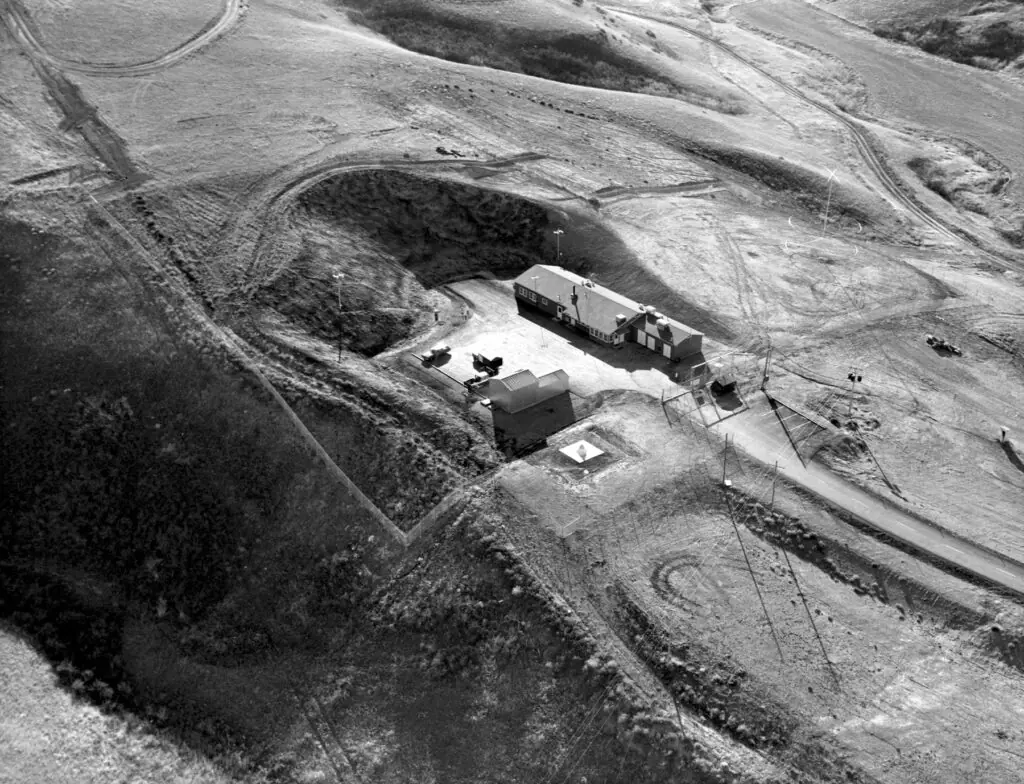
In Montana, in January, the wind doesn’t blow: it scrapes. The high prairie in the middle of the state is a brown, treeless sheet where the snow never quite settles because the air carries it off first, and where the horizon is so far away that it takes a while to understand that what you’re looking at isn’t a hill but the curvature of the world. Every so often, beside a gravel track, there is a fenced plot the size of a basketball court. Inside there is nothing: a concrete slab, a couple of antennas, a sign forbidding entry. Underneath, an intercontinental ballistic missile.
And after every ten of those plots there is an eleventh, a little larger, with a small shack on the surface where a security guard and a cook live. Beneath that shack, several stories down and behind a blast door weighing several tons, a capsule hangs suspended on shock absorbers with two officers inside. Twenty-four-hour shifts. Bad coffee. Consoles from the sixties. And ten lights that have to be green.
Right. Enough literature. On to the case file, because the man we’re talking about today has spent half a century doing one very specific thing, and he deserves to be assessed for what he does, not for what is said about him.
The verifiable part, first
Since 1973, Robert Hastings has devoted himself to one thing: locating and interviewing former U.S. Air Force personnel assigned to nuclear weapons installations, and recording what they say about incidents involving unidentified objects. By his own count, he has gathered more than a hundred and fifty testimonies. In 2008 he published the book that sums up this line of work, and in 2016 a documentary built on the same material.
On September 27, 2010, together with former launch officer Robert Salas, he organized a public appearance in Washington in which several former servicemen took part. Among them was Lieutenant Colonel Charles Halt, the same man who signed the Suffolk memorandum. It was the event that gave this line of research its greatest visibility.
Now, the interviews are not what matters about Hastings. What matters is the part of his work that rests on official paper, and that part exists and is solid. Between late October and November 1975 there was a series of unidentified aerial intrusions over bases in the northern United States, the so-called Northern Tier, including installations with nuclear weapons in Maine, Michigan, Montana and North Dakota. This does not rest on a witness speaking forty years later: it is in the aerospace defense command records and in the Strategic Air Command message traffic, released through freedom of information requests.
The documents describe objects and lights over weapons storage areas, helicopter chases, security alerts and considerable irritation up the chain of command at not knowing what they were. They do not say “UFO” in the sense the public gives the word. They say something rather more interesting in case-file terms: that for several weeks the U.S. military apparatus had intruders over its nuclear installations and was unable to identify them. That, on letterhead, is in writing.
Hastings begins
He starts collecting testimony from former Air Force personnel assigned to nuclear installations. He will keep up this line of work for five decades.
Malmstrom, Echo Flight
Ten Minuteman missiles of a single flight go inoperative in rapid succession. The event is on record in the unit's documentation. Its cause and its relation to sightings are disputed.
The Northern Tier overflights
Unidentified aerial intrusions over bases with nuclear weapons in Maine, Michigan, Montana and North Dakota. Recorded in official documentation later released through freedom of information requests. This is the most solid documentary basis of the entire line of work.
Suffolk
The Rendlesham events, with Charles Halt's memorandum, are added to the repertoire of cases associated with sensitive installations.
Publication of the book
Hastings gathers his material in a volume that becomes the reference for this line of work.
The Washington appearance
Seven former servicemen, with Hastings and Robert Salas as organizers, publicly present their accounts in the federal capital.
The internal contradictions
The two officers who were on duty in Echo Flight in 1967 publicly deny that the shutdown was linked to any object.
What is said to have happened
Hastings’s thesis, put forward more cautiously than he is usually given credit for, amounts to this: for decades, incidents involving unidentified objects have occurred at U.S. nuclear installations; some of those incidents coincided with failures or interference in weapons systems; and the whole suggests a sustained interest, on the part of whatever those objects are, in atomic weaponry.
The centerpiece of that reasoning is the March 1967 episode at Malmstrom. On March 16, the ten missiles of an entire flight went inoperative within minutes. That is on record. A whole flight out of service is a serious event and it was documented in the unit’s history. The question is what caused it, and that is where the case file forks into two paths that do not lead to the same place.
A flight of downed missiles is a fact. A UFO overhead is a claim. And in fifty years nobody has managed to join the two with a piece of paper.
The first path is the testimonial one. Robert Salas maintains that he lived through an equivalent episode in Oscar Flight, with security guards reporting an object over the installation while the missiles went down. Other former officers have offered accounts in the same direction over the years, almost all of them collected by Hastings himself.
The second path is the documentary one, and it is more uncomfortable. The unit’s documentation records the failure, but it records no object. A technical study was carried out to determine the cause, and the hypothesis put forward pointed to an electromagnetic pulse originating in the system itself during maintenance work, capable of propagating through the wiring and taking down the entire flight. Nothing exotic: an electromagnetic compatibility problem, which in an installation of that era was a frequent and very unromantic ghost.
One more thing needs saying about method, because it is the key to the whole matter. A military testimony collected forty years later can be tested: unit histories, daily reports, maintenance records and assignment orders exist, and in the United States a good part of that material can be requested through freedom of information. An investigator who interviews a former launch officer and then does not request his wing’s history to check the date, the unit and the incident has done exactly half the work. Hastings did that half with admirable persistence. The other half was left, in most cases, undone.
What it could be, no Martians required
A very crowded military sky
The missile fields of the high prairie are, by definition, in sparsely populated areas with a great deal of airspace. Over them fly security helicopters, maintenance aircraft, tankers, low-altitude training exercises and, in the seventies, a whole catalog of test programs. Add the local weather: temperature inversions that distort distant lights, northern lights at high latitudes, and an atmosphere so clean that a low star looks like a lighthouse.
A twenty-year-old security guard, at three in the morning, thirty degrees below zero and holding a flashlight, is not a poor witness because he is incompetent: he is one because he is in the worst possible place to judge distances and sizes. And it is worth remembering that personnel at those installations were trained precisely to report anything odd. That multiplies the reports, which is exactly what was intended, and in passing multiplies the false positives.
Missiles go down on their own quite often
This point is the one that sinks the most spectacular part of the argument. A weapons system of the sixties, with thousands of kilometers of buried cable, tens of thousands of electromechanical components and continuous maintenance, fails. It fails a lot. Inoperative states were part of the daily routine, and a whole maintenance apparatus existed to put the lights back to green.
What stands out about the 1967 case is that all ten missiles of a single flight failed almost at once, which points to a common cause propagated through the shared system. An electrical pulse originating in the equipment during a maintenance intervention explains exactly that pattern. It also explains, incidentally, why the matter was investigated thoroughly at the time: a failure mode capable of taking down an entire flight is a first-order national security hole, Martians or no Martians.
And the witnesses contradict each other
Here is the main crack in the Hastings line, and no armchair skeptic opened it: the protagonists themselves did. The two officers on duty in the Echo Flight capsule that day in 1967 have stated publicly that they saw no object, that they received no sighting report associated with the failure, and that the link was constructed afterward. One of them has gone so far as to explain that the only mention of an object that day was a joke by a maintenance crew over the radio.
That does not make Salas an impostor (he may be remembering another episode, at another installation, with the date shifted, a perfectly normal memory phenomenon at a distance of forty years). But it does mean that the most cited case in the whole repertoire has, among its direct witnesses, a flat denial. A case file in which the witnesses contradict each other cannot be closed.
Why this case won’t die
Because the underlying question is sensible and remains unanswered. If there is one place on the planet where any unidentified aerial intrusion has to be taken seriously, it is the perimeter of a nuclear warhead depot. You don’t need to believe in anything to maintain that: installation security is enough. And the 1975 documents show that there were sustained intrusions the military apparatus could not identify. That case file remains open and nobody has ever closed it.
It also doesn’t die because Hastings did, in his own way, what almost nobody does: long, boring fieldwork without glamour. Tracking down a retired noncommissioned officer in North Dakota, earning his trust and recording two hours of conversation is a thankless trade that makes no headlines. The trouble is that this work stopped halfway. A testimony without its unit history beside it is half a case file, and the other half was one request away.
And it doesn’t die because the pattern it describes reappears in the Malmstrom case file itself and, in different dress, in the Suffolk events of 1980, which took place right next to an area where weapons were stored and whose highest-ranking witness shared a platform with Hastings in 2010. Whatever the explanation, there is an obvious geographic constant: reports pile up where there is a perimeter, a guard and sensitive material. The honest question is whether that happens because there is something there to look at or because there are people there trained to look. Nobody has settled it.
And a consideration of scale is in order before getting indignant in either direction. At the moment of maximum Cold War tension there were around a thousand operational silos on the North American prairie, with two officers on duty in each capsule and daily relief shifts. That adds up to hundreds of thousands of night watches accumulated over three decades, with young people, extreme cold, boredom and a regulatory obligation to report anything that moved. In a universe of that size, a few dozen strange accounts is roughly what any human population subjected to those conditions would produce.
What remains is the image of the prairie and the eleven fenced plots, with the snow blowing past. Ten green lights on a console twenty meters underground. At some point in March 1967 they all went out at once, and we have spent almost sixty years arguing over whether there was something overhead that night. What we do know, because it is written down, is that eight years later there were things overhead for weeks and nobody could say what they were.
OSINT – Source traceability
Exact interview figures are not given because they come from the researcher's own count and lack external audit; they are presented as such. Statements by Carlson and Figel are not quoted verbatim because no verified transcript is available; the sense of their denials is described. No report numbers or signatures are attributed to the 1975 documentation, which is described by agency and date.